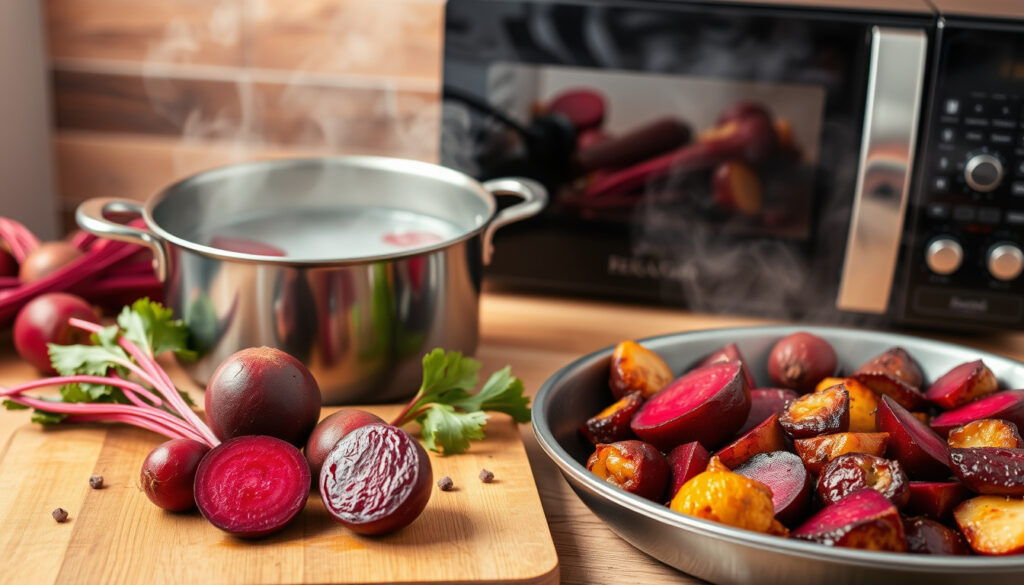
How to Cook Beetroot: Best Methods – Boil, Roast, Microwave
There’s a reason beetroot shows up in everything from hearty salads to Eastern European borscht: it’s versatile, packed with nutrients, and surprisingly easy to cook once you know the right method. Whether you’re looking to retain its natural sweetness, preserve water-soluble vitamins, or simply avoid a stained kitchen, this guide breaks down the evidence behind each technique to help you compare boiling, roasting, microwaving, and steaming on time, taste, and nutrient retention, as well as what the latest research says about beetroot’s health effects and possible risks.
Boiling time (whole): 30–45 minutes ·
Roasting temperature: 200°C (400°F) ·
Nitrate content (per 100g): 110–250 mg ·
Folate per cup: 37% of daily value
Quick snapshot
- Cook whole, unpeeled, skin on (WebMD – health information resource)
- 30–45 minutes in simmering water (WebMD)
- Skin slips off easily after cooking (WebMD)
- Mild, sweet flavor (WebMD – health information resource)
- Wrap in foil or roast uncovered (WebMD)
- 45–60 minutes at 200°C (400°F) (WebMD)
- Concentrated, caramelized taste (WebMD)
- Best for salads and sides (WebMD)
- Pierce skin, place in dish with a little water (WebMD)
- 8–12 minutes on high (WebMD)
- Quick method, minimal nutrient loss (WebMD)
- Check tenderness with fork (WebMD)
- Steam whole, unpeeled (Biology Insights – cooking science education)
- 20–30 minutes until tender (Biology Insights)
- Often best for nutrient retention (Biology Insights)
- Mild, earthy flavor (Biology Insights – cooking science education)
The table below summarizes the key cooking and nutrition facts for beetroot.
| Fact | Value |
|---|---|
| Boiling time (whole, medium beets) | 30–45 minutes (PMC – cardiovascular research) |
| Roasting time at 400°F (200°C) | 50–60 minutes, check every 20 min (Healthline – nutrition and wellness) |
| Microwave time (high power) | 8–12 minutes (WebMD) |
| Steaming time (whole) | 20–30 minutes (Biology Insights) |
| Nitrate content (per 100g) | 110–250 mg (commonly cited range; PMC) |
| Effect on blood pressure | Lower systolic and diastolic BP in human studies (PMC – 2020 review) |
| Oxalate content | High (can contribute to kidney stones; Drugs.com – professional reference) |
| Folate per cup (cooked) | ~37% of daily value (general nutrition data) |
| Calories per 100g (cooked) | ~44 kcal (general nutrition data) |
What is the best way to cook beetroot?
The answer depends on your priorities: time, flavor, or nutrient retention. Below we cover the four most common methods, each with evidence-based guidance.
How to cook beetroot on the stove (boiling)
- Scrub beets gently, leaving skins intact to retain color and nutrients (WebMD).
- Place in a pot of warm water, bring to a simmer, and cook 30–45 minutes until fork-tender (WebMD).
- Larger beets may take up to 1 hour (Easy Clean Cook – home cooking blog).
- After cooking, plunge into cold water and slip off the skins.
How to cook beetroot in the oven (roasting)
- Preheat oven to 200°C (400°F). Wrap individual beets in foil or place in a covered dish (WebMD).
- Roast 45–60 minutes; check tenderness every 20 minutes (WebMD).
- Roasting concentrates natural sugars, producing a caramelized, sweet flavor (Healthline).
- Peel after roasting while still warm, or leave skin on if preferred.
How to cook beetroot in the microwave
- Pierce the skin several times to prevent bursting (WebMD).
- Place in a microwave-safe bowl with a few tablespoons of water.
- Cover and microwave on high for 8–12 minutes, checking at the midpoint (WebMD).
- A fork should slide through the center easily when done.
How to cook beetroot in an air fryer
- Peel and cut into uniform chunks or wedges (size matters for even cooking).
- Toss with a light spray of oil and seasonings.
- Air fry at 180°C (350°F) for 20–30 minutes, shaking halfway.
- The exterior becomes crispy while the inside stays tender — a texture that boiling or steaming can’t achieve.
Roasting takes the longest but delivers the richest flavor. Boiling is the fastest wet method but may leach water-soluble vitamins like folate. Microwaving offers a convenient middle ground with good nutrient retention, while steaming is often cited as the method that best preserves nutrients (Biology Insights).
Do you put salt in the water when boiling beetroot?
Should you salt the water?
Adding salt to the boiling water enhances flavor, but it may draw out some moisture and minerals. Many cooks omit salt to preserve the beetroot’s natural sweetness (WebMD). Salting after cooking is a common alternative that allows you to control seasoning precisely.
How salt affects flavor and texture
Salt in the cooking water can slightly firm the beet’s texture (similar to how salt affects potatoes). If you’re boiling beets for a salad where you want a clean, sweet taste, skip the salt. For a savory side dish, a teaspoon of salt per litre of water is enough.
The catch: salting after cooking preserves natural sweetness and gives you precise control — a small shift that makes a noticeable difference in salads.
Do I peel beets before boiling?
Peeling before vs. after cooking
Peeling after boiling is far easier: the skin slides off under cold running water or with a gentle rub. Boiling unpeeled also helps retain color and nutrients. The skin is technically edible but often removed for texture (WebMD).
How to peel cooked beets easily
Once beets are tender, drain them, rinse with cold water, and use your fingers or a paper towel to rub off the skins. A paring knife can help with stubborn spots. The process takes under a minute per beet.
Is it healthier to boil or roast beetroot?
Nutritional differences
Roasting concentrates flavor and generally retains more nutrients than boiling, because water-soluble vitamins like folate and vitamin C can leach into the boiling water (Biology Insights). However, roasting at high heat for longer periods may degrade some heat-sensitive compounds.
Taste and texture comparison
Boiled beets are soft, mild, and slightly earthy. Roasted beets develop a deeper, caramelized sweetness and a firmer, denser texture. Steamed beets fall somewhere in between — tender but not waterlogged.
Best method for different dishes
- Salads: Roasted or steamed beets hold their shape and flavor better.
- Soups (e.g., borscht): Boiled beets are traditional and allow the broth to absorb color and taste.
- Purees: Any method works, but microwaving is fastest for small batches.
If you’re optimizing for nutrient density, steaming or roasting are superior to boiling. But the difference is marginal in the context of a balanced diet. Choose the method that fits your recipe and schedule.
What happens to your body when you eat beetroot?
Beetroot and blood pressure
Beetroot is rich in dietary nitrates, which the body converts to nitric oxide — a molecule that relaxes blood vessels. A 2020 review in PMC reports that beetroot supplementation is associated with lower systolic and diastolic blood pressure in human studies (PMC – 2020 review). A 2015 review confirms that beetroot ingestion can increase nitric oxide availability and may help manage hypertension and endothelial dysfunction (PMC – 2015 review).
Beetroot for liver and heart health
Red beetroot exhibits antioxidant, anti-inflammatory, and anticarcinogenic properties according to a PubMed-indexed review (PubMed – peer-reviewed medical literature). It has beneficial effects on cardiovascular, metabolic, inflammatory, and gastrointestinal conditions. The fiber and folate content also support liver function and reduce inflammation.
Can beetroot remove plaque from arteries?
While beetroot can improve arterial function and blood flow, the claim that it removes existing arterial plaque is not conclusively proven in human studies (PMC – 2021 review). More research is needed to determine whether it can reverse established atherosclerosis.
Beetroot can interact with ACE inhibitors and other blood pressure medications because of its nitrate content. If you’re on antihypertensives, consult your doctor before consuming large amounts of beetroot or beetroot juice (Drugs.com).
Who must not eat beetroot?
People with kidney stones or oxalate sensitivity
Beetroot is high in oxalates — around 50–100 mg per 100 grams (general reference) — which can contribute to calcium oxalate kidney stone formation. Individuals with a history of kidney stones should limit intake (Drugs.com).
Interactions with blood pressure medications
Because beetroot naturally lowers blood pressure, taking it alongside ACE inhibitors or beta-blockers may cause hypotension. Medical News Today advises caution for anyone on antihypertensive medication (Medical News Today – health and medical news).
Beeturia and other side effects
Beeturia — red or pink urine after eating beetroot — is a harmless condition affecting about 10–14% of the population. Some people also experience digestive discomfort, especially when consuming raw beetroot in large amounts.
Comparison: Boiling vs Roasting vs Microwaving vs Steaming
Four approaches, one goal: perfectly cooked beets. Here’s how they stack up on the factors that matter most.
| Method | Time | Flavor profile | Nutrient retention | Best for |
|---|---|---|---|---|
| Boiling | 30–45 min (WebMD) | Mild, earthy | Lower (folate leaches) (Biology Insights) | Soups, purees |
| Roasting | 45–60 min (Healthline) | Caramelized, sweet | High | Salads, sides |
| Microwaving | 8–12 min (PMC) | Mild, slightly earthy | Moderate–high | Quick meals, small batches |
| Steaming | 20–30 min (Biology Insights) | Earthy, clean | Highest | Nutrient-conscious cooking |
The pattern: speed trades off against flavor depth, but nutrient retention is highest with steaming and roasting. For most home cooks, roasting offers the best balance of taste and health.
Upsides and downsides of eating beetroot
Upsides
- Rich in dietary nitrates that lower blood pressure (PMC – 2015)
- High in antioxidants and anti-inflammatory compounds (PubMed)
- Supports liver function and may improve exercise performance (PMC – 2021)
- Good source of folate, fiber, and potassium
Downsides
- High oxalate content may promote kidney stones (Drugs.com)
- Can interact with blood pressure medications (Medical News Today)
- Beeturia (red urine) can cause unnecessary alarm
- Digestive discomfort possible with raw consumption
How to cook beetroot: step-by-step guide
Follow these steps for any method you choose. The general preparation is the same across boiling, roasting, microwaving, and steaming.
- Wash thoroughly – Scrub beets under cold water to remove dirt. Do not peel yet.
- Trim – Cut off the leafy tops, leaving about 2 cm of stem to prevent bleeding color during cooking.
- Choose your method – Refer to the timing table above. Adjust cooking time based on size: smaller beets cook faster.
- Test for doneness – A fork or skewer should slide into the center with little resistance.
- Cool and peel – Run under cold water or let rest until cool enough to handle. Rub off skins (they slip off easily after wet cooking).
- Slice or serve whole – Use as desired in salads, soups, or sides.
“Roasting beets at 400 F for 50 to 60 minutes, checking every 20 minutes, until a fork easily pierces the center.”
— WebMD (health information resource)
“Beetroots and beetroot juice have been associated with improved blood flow, lower blood pressure, and increased exercise performance.”
— Healthline (nutrition and wellness publisher)
What we know and what remains unclear
Confirmed facts
- Beetroot consumption can lower blood pressure due to dietary nitrates (PMC).
- Boiling reduces folate content compared to roasting or steaming (Biology Insights).
- Beeturia (red urine) is a harmless side effect.
What’s unclear
- Whether beetroot can remove existing arterial plaque — human studies are lacking.
- Optimal dosage for blood pressure benefits — most studies use concentrated juice rather than whole beets.
For the home cook in the United States, the choice is clear: if you want maximum flavor with good nutrient retention, roast your beets. If speed matters more, microwave them. And if you’re watching your oxalate intake or on blood pressure medication, enjoy beetroot in moderation — and talk to your doctor before making it a daily habit.
Frequently asked questions
Can you eat beetroot raw?
Yes, raw beetroot is edible and retains all nutrients. It has a crunchy texture and earthy flavor. Grate it into salads or juice it. However, raw beetroot is harder to digest and may cause discomfort in sensitive individuals.
How do you store cooked beetroot?
Refrigerate cooked beets in an airtight container for up to 5 days. They can also be frozen for up to 10 months. Blanch before freezing if you want to preserve texture.
What is beeturia?
Beeturia is the passing of red or pink urine after eating beetroot. It affects about 10–14% of people and is caused by betalain pigments. It is harmless and temporary.
Is beetroot good for weight loss?
Beetroot is low in calories (~44 kcal per 100g) and high in fiber, which can promote satiety. Its nitrate content may also improve exercise performance, indirectly supporting weight management.
Can you freeze cooked beetroot?
Yes. Cool completely, package in freezer-safe bags or containers, and freeze. Thaw in the refrigerator overnight. Freezing may soften the texture, so it’s best for soups or purees.
How do you cut beetroot for roasting?
Peel the cooked beetroot, then cut into uniform wedges or cubes — about 1–2 cm pieces. Toss with oil and seasonings. For faster roasting, cut into smaller pieces.
Is beetroot safe during pregnancy?
Yes, in normal food amounts. Beetroot provides folate, which is important for fetal development. However, large doses of beetroot juice are not well studied in pregnancy. Stick to moderate consumption.
More related posts
 NZ vs Australia Rugby: TV Channel, Kick-Off & Live Stream
 Count of Monte Cristo: Summary, Quote & Movie Guide
 Wellington to Queenstown Flights: Jetstar Reliability & Fares
 What Are the Love Languages? 5 Languages Explained
 Unused Wordle Words: Full List of Remaining 5-Letter Answers
 Puppies for Sale Christchurch: Buying Guide & Breeder Tips
 Kim Ji-won: biography, dating rumors, religion, and career
 NZ Currency Rate in India Today: 1 NZD = 54.52 INR