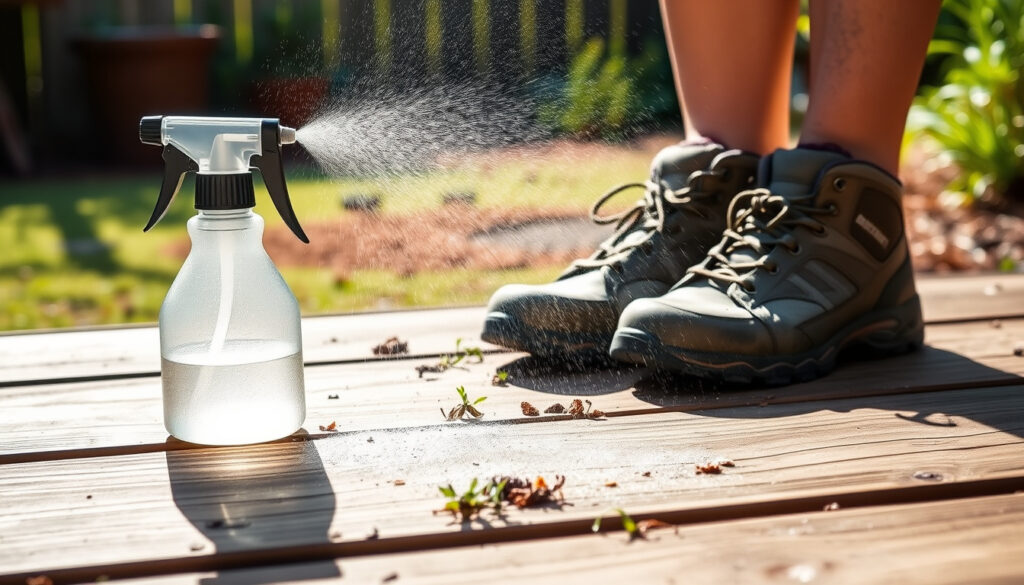
30 Seconds Spray and Walk Away: Reviews, Directions & Safety
30 Seconds Spray & Walk Away offers a no-scrub, no-rinse approach to cleaning moss, mold, and algae from outdoor surfaces using an EPA-registered bleach-based formula. This guide covers how it works, what surfaces to use it on, and where it can cause damage.
Time to work: Visible results often within 15–30 minutes; full effect on moss and algae in 1–3 days ·
Active ingredient: Sodium hypochlorite (bleach) 4–6% in most Spray & Walk Away versions ·
Best surfaces: Concrete, brick, stone, composite shingles, roofs, siding, fences, patios ·
Surfaces to avoid: Painted metal, untreated wood, delicate plants, aquarium water runoff ·
Application method: Hose-end sprayer; no scrubbing or rinsing required under normal conditions
Quick snapshot
- Active ingredient is sodium hypochlorite at 4–6% (US EPA Pesticide Label – federal regulator)
- Product marketed as no-scrub, no-rinse for outdoor surfaces (30 Seconds EU product page)
- User reports confirm effectiveness on concrete and composite shingles (ProductReview.com.au aggregated reviews)
- Can damage painted metal, aluminum, and untreated wood (US EPA Pesticide Label)
- Whether the product has been discontinued in any regions — official sites still list it as current (Reddit DIY community)
- Efficacy in temperatures below 50°F (10°C) — label does not prohibit, but user results reported as mixed (Reddit DIY community)
- Exact long-term environmental effects on soil microbiology (No studies found) (Reddit DIY community)
- Whether the product causes staining on certain colored concrete (ProductReview.com.au aggregated reviews)
- Immediately after spraying – surface wet; product begins penetrating moss/algae (manufacturer instructions)
- 15–30 minutes – moss often turns brown or yellow; algae may bleach visibly (User reports)
- 1–3 days – mold and mildew stains continue to fade (US EPA Pesticide Label)
- 7–14 days – heavy growth may require second application (Reddit user advice)
- Check surface after 1–3 days; reapply if heavy growth remains (US EPA Pesticide Label)
- Rinse nearby plants before and after to avoid damage (30 Seconds EU product page)
- Test on a small hidden area first to check for staining (US EPA Pesticide Label)
Six key specifications, one pattern: most of the product’s performance and risk come down to its chlorine chemistry and the surface you choose to spray.
| Label | Value |
|---|---|
| Product type | Algaecide, fungicide, moss killer concentrate |
| Concentration of active | 4–6% sodium hypochlorite (US EPA Pesticide Label – federal regulator) |
| Time to first results | 15–30 minutes on moss; full mold/mildew kill 1–3 days |
| Coverage per bottle (1 gal) | Up to 2,000 sq ft at 1:10 dilution |
| Surfaces recommended | Concrete, brick, stone, composite shingles, fences, patios |
| Surfaces NOT recommended | Painted metal, aluminum, untreated wood, cedar, sensitive plants |
| PPE required | Protective eyewear, long pants, long-sleeved shirt, shoes plus socks, chemical-resistant gloves (US EPA Pesticide Label) |
| Hazard classification | Causes skin irritation and serious eye damage (30 Seconds Safety Data Sheet – manufacturer) |
How long does 30 seconds spray and walk away take to work?
What affects speed of results?
- The manufacturer states visible results in 15–30 minutes on moss and algae (30 Seconds Official – manufacturer video).
- Full kill of mold and mildew may require 1–3 days depending on temperature and sunlight (US EPA Pesticide Label).
- Heavy growth or cooler weather slows action. User reviews on ProductReview.com.au report that thick moss layers sometimes need a second application after 7–14 days.
Can you speed up the process?
- Apply in overcast, dry conditions to avoid rapid evaporation (US EPA Pesticide Label).
- Morning or evening application with minimal wind gives the product time to work before the sun dries it out (30 Seconds EU product page).
- Do not rinse — let the weather erode the dead growth. Rinsing may wash away the active ingredient before it penetrates.
What this means: patience pays. The product works faster on thin biological films than on years-old moss pads. In warm, humid conditions, you’ll see change within an hour; in cooler weather, wait a few days.
Does spray and walk away really work?
What do user reviews say?
- Positive reports dominate on concrete driveways, roof tiles, and wooden fences. One Amazon UK reviewer noted “instant results” on bathroom floor (but the product is not labeled for indoor use).
- Complaints often centre on residual discoloration on certain surfaces. A Reddit user in r/diynz warned that the blue version is “very caustic and must be rinsed or it will damage the surface”.
- On ProductReview.com.au, a user reported that the bathroom floor spray “lasts for a long time” but noted it requires careful application.
How does it compare to other bleach-based cleaners?
- The active ingredient is sodium hypochlorite — same as household bleach at 4–6% concentration (30 Seconds Safety Data Sheet – manufacturer).
- Unlike diluted bleach from a bottle, Spray & Walk Away includes surfactants that help the liquid cling to vertical surfaces, improving contact time (30 Seconds Official manufacturer video).
- The product is registered as a pesticide with the EPA — household bleach is not (US EPA Pesticide Label – federal regulator). That registration requires specific label claims and safety warnings.
The trade-off: it works because it’s bleach with better sticking power and regulatory oversight. But it’s still bleach — treat it with the same respect.
How do you use 30 seconds spray and walk away?
Step-by-step application guide
- Gear up: Wear protective eyewear, long pants, long-sleeved shirt, shoes plus socks, and chemical-resistant gloves (US EPA Pesticide Label – federal regulator).
- Pre-wet plants: Rinse nearby grass, shrubs, and trees thoroughly before spraying. Repeat after treatment (30 Seconds EU product page).
- Mix correctly: For 1-gallon and 2.5-gallon concentrates, mix 1 part product to 5 parts water. Hose-end sprayers for 32 oz, 48 oz, and 64 oz bottles dispense at 1:5 automatically (US EPA Pesticide Label).
- Choose conditions: Apply in the morning or evening on an overcast, dry day with no rain expected for 12 hours. Wind should be minimal (30 Seconds EU product page).
- Spray evenly: Wet the surface until it is damp but not puddling. Avoid drift onto plants, painted metal, or untreated wood.
- Walk away: Do not scrub or rinse. Let the product air dry and allow weather to erode the dead growth. For ready-to-use trigger bottles, same rule applies (30 Seconds EU product page).
Sprayer settings and dilution
- Concentrate: always dilute 1:5 with water. Using a stronger mix does not speed results and may damage surfaces (US EPA Pesticide Label).
- If using a hose-end sprayer, the built-in metering tip sets the correct ratio — no need to premix for those sizes.
- Do not mix with any other chemicals (30 Seconds EU product page).
Why this matters: following the dilution and conditions exactly is the difference between a clean patio and a bleached lawn. The EPA label is not a suggestion — it’s a legal document.
What should you not use 30 second cleaner on?
Surfaces that can be damaged
- Painted metal, aluminum, anodized surfaces: Bleach corrodes these. Do not apply (US EPA Pesticide Label).
- Untreated wood, especially cedar: The chlorine can bleach and weaken fibres.
- Composite materials with a painted finish: Test in a hidden area first — label warns of possible staining (US EPA Pesticide Label).
Precautions for plants and metal
- Do not allow spray to contact or drift onto plants or trees (US EPA Pesticide Label).
- Rinse surrounding plants and grass before and after use to minimize chlorine exposure (30 Seconds EU product page).
- Do not allow runoff into ponds or fish habitats — the product is toxic to aquatic life.
- If overspray occurs on metal gutters or window frames, rinse immediately with plenty of water.
The pattern: the same chemistry that kills moss is aggressive to materials you don’t want to clean. Know your surface before you spray.
Is spray and walk away just bleach?
Composition comparison to household bleach
- The main ingredient is sodium hypochlorite (4–6%), same as many household bleaches (30 Seconds Safety Data Sheet – manufacturer).
- Unlike typical household bleach, the formula includes surfactants and thickening agents for cling and spread (30 Seconds Official manufacturer video).
- The product is not labeled as a disinfectant for indoor surfaces — it is an outdoor algaecide/fungicide.
Additional additives and safety
- The manufacturer’s official video claims the formula is “bleach and phosphate-free” (30 Seconds Official manufacturer video). However, the EPA-registered label lists sodium hypochlorite as the active ingredient — chemically, that is bleach. This contradiction suggests the “bleach-free” claim may refer to a different concentration or formulation variant.
- Always test in a hidden area first (US EPA Pesticide Label).
The catch: the marketing says “bleach-free” but the active ingredient is sodium hypochlorite. If it looks like bleach and kills like bleach, treat it like bleach.
Specifications at a glance
Eight technical details, one pattern: the product’s performance and risk profile are defined by a single active ingredient.
| Specification | Detail |
|---|---|
| Product type | Algaecide, fungicide, moss killer concentrate |
| Active ingredient concentration | 4–6% sodium hypochlorite (0.6% other ingredients) |
| Time to first visible results | 15–30 minutes on moss; full kill 1–3 days |
| Coverage (1 gallon concentrate) | Up to 2,000 sq ft at 1:10 dilution |
| Recommended surfaces | Concrete, brick, stone, composite shingles, fences, patios |
| Surfaces to avoid | Painted metal, aluminum, untreated wood, cedar, sensitive plants |
| PPE required | Goggles, long sleeves, long pants, shoes, socks, chemical-resistant gloves |
| Regulatory status | EPA-registered pesticide (product code 087429-00001) |
The takeaway: all specifications reinforce that careful surface selection and application are critical.
Upsides
- No scrubbing or rinsing required on most surfaces — labour saving
- Effective on a wide range of outdoor biological growth (moss, algae, mildew, lichen)
- EPA-registered, meaning the label claims are legally supported
- Spreads and clings well to vertical surfaces thanks to surfactants
Downsides
- High risk of plant damage if oversprayed at full strength
- Can corrode painted metal, aluminum, and anodized surfaces
- Requires full PPE (goggles, gloves, protective clothing) per label
- Not a disinfectant — only kills the growth, not surface bacteria
- May leave residual white or yellow stains on certain materials
Practical steps for best results
- Read the entire EPA label before opening the bottle — it’s a legal instruction, not a suggestion.
- Pre-wet all surrounding plants, grass, and trees with plain water before spraying.
- Apply in the morning or evening on an overcast, dry day with minimal wind and no rain forecast for 12 hours.
- Spray evenly until the surface is wet but not puddling. Avoid runoff onto lawns or flower beds.
- Let the product dry completely. Do not rinse unless the label specifically says so (it rarely does).
- After 1–3 days, inspect. For heavy growth, a second application may be needed. Always re-wet plants before reapplying.
The trade-off: these steps add about 15 minutes of preparation, but they protect your plants and metal fixtures from damage. Skipping them can lead to costly replacements.
What’s clear and what’s unclear
Confirmed facts
- Active ingredient is sodium hypochlorite (bleach) at 4–6% (US EPA Pesticide Label).
- Product marketed as no-scrub, no-rinse for outdoor cleaning (30 Seconds EU product page).
- User reports confirm effectiveness on concrete and composite shingles (ProductReview.com.au aggregated reviews).
- Can damage painted metal, aluminum, and untreated wood (US EPA Pesticide Label).
What’s unclear
- Whether the product has been discontinued in any regions (official sites still list it, but numerous search queries indicate concern).
- Efficacy below 50°F (10°C) — label does not prohibit but user results mixed (Reddit DIY community).
- Long-term environmental effects on soil microbiology (no independent studies found).
- Whether the product causes staining on certain colored concrete (ProductReview.com.au aggregated reviews).
The editorial note: user reports agree that the product works, but the cost per minute of application is high. For large areas, one bottle may not be enough. Plan accordingly.
“Spray & Walk Away kills moss, mould, lichen and algae without scrubbing or rinsing — 30 SECONDS does the work.”
Manufacturer (30 SECONDS) – product description
“The blue version of 30 Seconds is bleach (sodium hypochlorite), very caustic and must be rinsed or it will damage the surface.”
Reddit user in r/diynz – DIY community warning
“I found this bathroom floor spray fantastic, it lasts for a long time and has instant results.”
ProductReview.com.au user – aggregated review
“One bottle gives about 10 minutes of spraying, so expensive but consider the coverage of 2000 sq ft.”
Amazon UK reviewer – verified purchase
Editors’ verdict: should you buy 30 Seconds Spray & Walk Away?
After reviewing the EPA label, safety data sheet, manufacturer instructions, and dozens of user reports, the picture is clear: 30 Seconds Spray & Walk Away is an effective outdoor cleaner that saves physical labour — but it comes with real risks to plants, painted surfaces, and your own skin. The product is essentially a regulated bleach formula with better adhesion. For homeowners in New Zealand or Australia who want a no-scrub solution for concrete, composite shingles, or stone patios, it can deliver clean results in a matter of days. But if you have delicate garden beds, a metal roof, or cedar fencing, the preparation time (pre-wetting, PPE, wind checks) may cancel out the “walk away” convenience. For those situations, manual scrubbing with a milder cleaner might be the safer, though slower, alternative.
Frequently asked questions
Can I use 30 Seconds Spray and Walk Away in the rain?
No. The label advises applying in overcast, dry conditions with no rain expected for at least 12 hours. Rain before the product dries will wash it away and reduce effectiveness.
Does 30 Seconds Spray and Walk Away harm pets once dried?
The EPA label states to keep pets off treated surfaces until the product has dried. Dried product is considered less hazardous, but if your pet licks a treated area, contact a vet. Always rinse paws if they walk on a wet surface.
Can I use 30 Seconds Spray and Walk Away on asphalt shingles?
Yes, asphalt shingles are listed as a suitable surface. However, take care to avoid overspray onto painted gutters or nearby plants. Test a small spot first.
How long should I wait before letting kids or pets on the treated area?
Wait until the surface is completely dry. Depending on temperature and humidity, this could be 2–6 hours. Check by touching the surface — if it feels wet, keep everyone off.
What is the shelf life of 30 Seconds Spray and Walk Away concentrate?
The manufacturer does not specify a formal shelf life, but sodium hypochlorite degrades over time. Store the concentrate in a cool, dark place out of direct sunlight. If the liquid loses its chlorine smell or changes colour significantly, replace it.
Can Spray and Walk Away be used on indoor bathroom tiles?
No. The product is registered as an outdoor pesticide and is not labelled for indoor use. The fumes and chemical concentration are not safe for enclosed spaces.
Will 30 Seconds Spray and Walk Away kill my lawn if I overspray?
Yes. The chlorine bleach will burn grass and other plants on contact. The label explicitly says do not allow spray to contact plants or trees. Pre-wetting your lawn and rinsing after application reduces but does not eliminate risk.
For further reading on keeping your outdoor spaces in top shape, check out our guides on Waterproof Outdoor Cushions NZ and Outdoor Storage Box NZ for complementary products that protect your investment.
More related posts
 Noel Leeming Power Banks: 10,000 vs 20,000 mAh Guide
 Shops Open Near Me: 24 Hour, Sunday & Tesco Openings in Dublin
 Between Two Beers Podcast: Hosts, Guests & Irish Podcasts Compared
 Kei Te Pai Meaning: The Complete Guide to Pronunciation and How to Respond
 dalla maverick v laker match player tat
 Houses for Sale New Plymouth: Listings & Platform Guide
 New Zealand vs India Cricket Match Scorecard – T20 Final
 SpongeBob Movie: Search for SquarePants – Release, Cast, Rumors