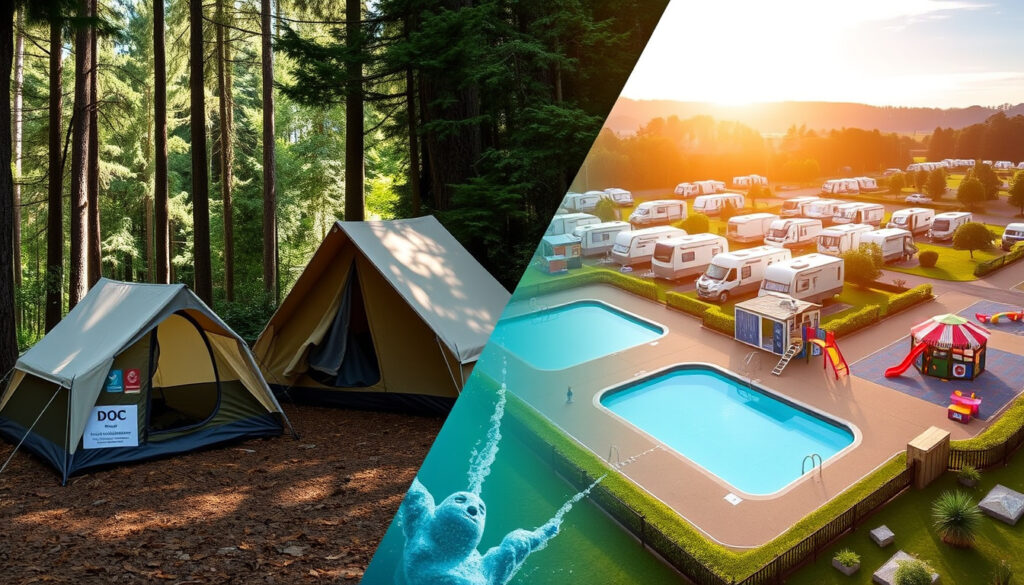
DOC campground vs holiday park: cost, facilities, and pros & cons
Every camper planning a New Zealand road trip runs into the same fork in the road: a no-frills DOC campsite buried in native bush, or a holiday park with hot showers and a playground. The choice comes down to more than comfort — it shapes your daily budget, how early you stop driving, and who you share the evening with.
DOC campsites in New Zealand: over 300 ·
Basic DOC campsite per adult per night: NZ$6–$15 ·
Holiday park powered site per night (two people): NZ$30–$60 ·
DOC Campsite Pass (adult, 12 months): NZ$80
Quick snapshot
- DOC groups its campsites into Basic, Standard, and Serviced categories, each with different facilities and fees (Department of Conservation (New Zealand’s public-land agency)).
- DOC camping fees are charged per adult — two adults staying together are charged for two adults (DOC (campsite booking and paying guidance)).
- Some basic DOC campsites are free, but only for campers who are fully self-sufficient (NZMCD (NZ motorhome and camping guide)).
- Which holiday park counts as “the best” varies with region, season, and traveler type — there’s no single winner in the data. (NZMCD (NZ motorhome and camping guide))
- Real-time availability at first-come, first-served DOC sites is hard to predict in peak season (NZMCD (NZ motorhome and camping guide)).
- DOC’s published price bands overlap between categories, so the exact fee at a specific campsite can differ from the table (DOC (campsite facilities and fees)).
- DOC published an accommodation price-change page for 2025/26 (DOC (2025/26 price changes)).
- A 2026/27 price-change page followed, confirming fees are now reviewed annually (DOC (2026/27 price changes)).
- Check the campsite category before arriving — power, showers, and booking rules vary by tier (DOC (campsite facilities and fees)).
- Run the NZ$80 DOC Campsite Pass against your planned DOC nights before buying (DOC (campsite booking and paying guidance)).
- Book holiday parks ahead for December–February (New Zealand Report (travel planning blog)).
A cheaper nightly rate is the headline, but the real pattern is in what the price includes — and how DOC’s own fee bands spread across three campsite tiers.
| Fact | Value |
|---|---|
| DOC campsites in New Zealand | over 300 (DOC (campsite facilities and fees)) |
| DOC campsite categories | Basic, Standard, Serviced (DOC (campsite facilities and fees)) |
| Basic DOC campsite, adult per night | NZ$6–$15; some basic sites are free for self-sufficient campers (DOC (campsite facilities and fees); NZMCD (NZ motorhome and camping guide)) |
| Serviced DOC campsite incl. powered, adult per night | about NZ$20–$28 (DOC (campsite facilities and fees)) |
| Holiday park powered site, two people per night | NZ$30–$60 (New Zealand Report (travel planning blog)) |
| DOC Campsite Pass, adult, 12 months | NZ$80 (DOC (campsite booking and paying guidance)) |
| DOC booking model | many sites first-come, first-served (DOC (campsite booking and paying guidance)) |
| Holiday park booking model | reservations recommended, especially Dec–Feb (New Zealand Report (travel planning blog)) |
| Facility baseline | DOC basic: long-drop toilets, cold water, no power (NZMCD (NZ motorhome and camping guide)); holiday parks: flush toilets, hot showers, kitchens, laundry (Britz (campervan rental operator)) |
| Price review cycle | DOC published 2025/26 and 2026/27 price-change pages (DOC (2025/26); DOC (2026/27)) |
What is the difference between a DOC campground and a holiday park?
At its simplest, the difference is who runs the land and what they install on it. DOC campgrounds sit on public conservation land and are split into Basic, Standard, and Serviced tiers (Department of Conservation (New Zealand’s public-land agency)); holiday parks are commercial operations that bundle power, showers, kitchens, and booking services into one nightly site rate (New Zealand Report (travel planning blog)).
DOC campground definition and typical facilities
- Managed by the Department of Conservation on public conservation land.
- Three categories: Basic, Standard, and Serviced, with facilities and fees stepping up by tier (DOC (campsite facilities and fees)).
- Basic sites: pit or long-drop toilets, cold water, usually no power (NZMCD (NZ motorhome and camping guide)).
- Standard sites: more equipped than Basic but less developed than Serviced (DOC (campsite facilities and fees)).
- Serviced sites: flush toilets, hot showers, rubbish collection, and some powered sites (NZMCD (NZ motorhome and camping guide)).
- Most DOC sites are unstaffed and use self-registration on arrival (DOC (campsite booking and paying guidance)).
DOC’s own published rates show the range: powered-site categories run around NZ$20–$28 per adult per night, some campsite categories sit near NZ$25, and lower-facility categories span about NZ$10–$20 (DOC (campsite facilities and fees)). Planning guides put the cheapest basic sites at NZ$6–$15 per adult, with some free for fully self-sufficient campers (NZMCD (NZ motorhome and camping guide)).
The practical rule from long-term camper guides: never assume from the name alone. A DOC “campsite” can be a serviced campground with hot water or a patch of grass with a long-drop, so check the category before you commit (NZMCD (NZ motorhome and camping guide)).
The widest gap between the two options isn’t price — it’s predictability. A NZ$6 basic site can mean a long-drop toilet in the bush, while a NZ$60 powered site buys a hot shower, a cooking bench, and a flat place to sleep. Same night, two different travelers.
How much does a DOC campsite cost vs a holiday park?
Price is where the two options stop being similar. DOC charges per adult and rewards minimalism; holiday parks charge per site and bundle the extras. The gap can be wide — or nearly nothing, depending on who’s travelling.
DOC campsite pricing per person per night
- Basic campsites: planning guides quote NZ$6–$15 per adult per night (DOC (campsite facilities and fees)).
- DOC’s lower-facility fee bands: about NZ$10–$20 per adult per night (DOC (campsite facilities and fees)).
- Serviced campsites, including powered sites: roughly NZ$20–$28 per adult per night (DOC (campsite facilities and fees)).
- Some basic sites are free, but only for fully self-sufficient campers (NZMCD (NZ motorhome and camping guide)).
- Fees are charged per adult — two adults staying together pay two adult fees (DOC (campsite booking and paying guidance)).
That per-adult model is the biggest pricing difference from holiday parks. A solo hiker can sleep for NZ$6–$15, while a couple on a serviced site lands in the NZ$40–$56 range for the same night (DOC (campsite facilities and fees)).
Holiday park pricing per site per night
- Powered site for two people: typically NZ$30–$60 per night, according to New Zealand Report (travel planning blog).
- Unpowered site for two: usually NZ$30–$40 per night (New Zealand Report (travel planning blog)).
- Prices climb with season, location, and park standard; lakeside and tourist-town parks sit at the top of the range (New Zealand Report (travel planning blog)).
- Extras such as additional adults, WiFi, laundry, and cabins push the total higher (Britz (campervan rental operator)).
Holiday parks charge for the site, not the people. That quirk flips the value equation for families: two adults with children can pay less for a powered holiday park site than two adults pay at a serviced DOC campground.
DOC Campsite Pass value
- The DOC Campsite Pass costs NZ$80 for an adult and covers 12 months of camping fees at many standard DOC campsites (DOC (campsite booking and paying guidance)).
- At NZ$15 a night, the pass roughly covers its own cost in five nights.
- The pass applies only to DOC campsites — it doesn’t cover holiday parks.
What this means: the more people in your vehicle, the smaller the gap between DOC and a holiday park. Two adults at serviced DOC sites can pay NZ$40–$56, which sits inside the NZ$30–$60 holiday-park band — so the comfort premium shrinks as your group grows.
What are common campsite issues to avoid?
Most campsite stress in New Zealand follows the same script: the wrong expectation, the wrong booking window, or the wrong vehicle for the site.
Booking not made in advance during peak season
- Many DOC sites are first-come, first-served and fill early in summer; unstaffed sites can’t hold a spot for late arrivals (DOC (campsite booking and paying guidance)).
- Holiday parks take reservations and are commonly booked out from December to February (New Zealand Report (travel planning blog)).
- In summer, popular sites fill days ahead — plan the day’s driving around where you’ll sleep.
Not checking for self-contained vehicle requirements
- Freedom camping outside designated areas generally requires a certified self-contained (CSC) vehicle (Britz (campervan rental operator)).
- CSC certification means a fixed toilet, fresh water, and holding tanks for waste — features many rental campervans don’t have (Britz (campervan rental operator)).
- Without CSC, the cheapest overnights disappear, leaving DOC campsites and holiday parks as the realistic options (Britz (campervan rental operator)).
The cheapest DOC sites assume self-sufficiency: water, toilet, power, and rubbish all travel with you. A campervan without certified self-containment converts NZ$6–$15 DOC nights into NZ$30–$60 holiday-park nights, because freedom camping is legally off the table (Britz (campervan rental operator)).
Arriving after dark at unstaffed DOC sites
- Most DOC campsites are unstaffed and use self-registration on arrival (DOC (campsite booking and paying guidance)).
- Arriving after dark makes it harder to find a level spot, pay correctly, or avoid disturbing other campers.
- Holiday parks have staffed reception and defined check-in procedures (New Zealand Report (travel planning blog)).
The predictability gap, not the price gap, is what catches most travelers: a DOC site is an adventure with a toilet, while a holiday park is a service. Arriving at each with the right expectations removes most of the “issues” before they happen.
Is it a good idea to use a campervan in New Zealand?
For most visitors, yes — a campervan is the classic New Zealand move, because the country’s best camping is spread across long, scenic distances. But the vehicle you choose decides which campsites you can legally use.
Freedom camping rules and self-containment
- Freedom camping outside designated areas generally requires a certified self-contained (CSC) vehicle (Britz (campervan rental operator)).
- Holiday parks and many DOC serviced sites don’t require CSC, which is why budget travelers mix them with freedom camping (Britz (campervan rental operator)).
- Campervan rental rates across New Zealand operators typically range from NZ$60 to NZ$250 per day, depending on season, age, and size (Britz (campervan rental operator)).
The CSC rule reshapes the budget: a van without certification is locked out of free overnight spots, so its cheapest legal options are DOC sites and holiday parks. A certified van unlocks free nights, which can offset the higher daily rental.
A certified self-contained van unlocks free nights, but it also raises your baseline: at NZ$60–$250 per day in rental, the NZ$6 DOC site saves less than it seems once the van is parked. The cheapest trip on paper isn’t always the cheapest trip in practice.
Best campervan types (certified self-contained, 2-berth, 6-berth)
- 2-berth certified vans are the most flexible: cheaper to rent, easier to park, and able to use freedom camping (Britz (campervan rental operator)).
- 4- and 6-berth vans fit families but cost more and need larger booked sites.
- Certified self-contained (CSC) vehicles unlock the widest range of overnight options (Britz (campervan rental operator)).
- Holiday parks remain the most comfortable base for campervan travelers, especially in bad weather (New Zealand Report (travel planning blog)).
For first-timers, the usual advice is to match the van to the itinerary, not the itinerary to the van: a small certified van keeps every door open, while a large non-certified van makes holiday parks a requirement.
The balance: campervan travel fits New Zealand’s wild layout, but it works best as a hybrid — freedom camping on fine nights, DOC sites for convenience, holiday parks when the weather turns. That mix also keeps the nightly average down.
What to beware of in New Zealand?
None of these should scare anyone off — they’re the kind of local knowledge that costs one bad afternoon to learn the hard way.
Sandflies in coastal and lake areas
- Sandflies are common along the West Coast and in Fiordland, especially near beaches, lakes, and bush edges (NZMCD (NZ motorhome and camping guide)).
- They bite during the day, which makes the standard dawn-and-dusk repellent routine useless.
- Insect repellent with DEET, long sleeves, and screened areas are the standard defenses (NZMCD (NZ motorhome and camping guide)).
Sandflies are more nuisance than danger, but they quietly shift accommodation choices: they’re one reason some campervanners end up inside holiday park buildings at twilight rather than sitting out, even in places that look perfect for a DOC site.
Unpredictable mountain weather
- Mountain passes can get snow and ice even in summer, and alpine weather changes fast (NZMCD (NZ motorhome and camping guide)).
- Check the forecast and official road alerts before crossing high passes.
- Carry warm layers and a rain jacket even on a “summer” DOC trip.
Driving conditions around Arthur’s Pass
- The Arthur’s Pass road is narrow and winding, with weather that can change quickly; drive cautiously (NZMCD (NZ motorhome and camping guide)).
- It is not exceptionally dangerous, but it deserves daylight and attention.
- Allow more driving time than the map suggests — distances in New Zealand take longer than they look.
The real hazards in New Zealand camping are small, manageable, and regional: sandflies near water, weather on the passes, and a vehicle that doesn’t match the rules. Preparation removes almost all of the risk — and most of the surprises too.
Which is better, Queenstown or Christchurch?
For travelers building a New Zealand itinerary, Queenstown and Christchurch serve different trip styles. The choice depends on whether you prioritize adventure sports or cultural city life.
Queenstown: adventure tourism, lakes, mountains, higher prices
- Queenstown is the adventure capital: bungee jumping, skydiving, jet boating, and skiing define the town.
- Set on Lake Wakatipu with dramatic mountain views, it draws travelers who want action in a compact area.
- Accommodation and dining are more expensive than Christchurch, and holiday parks fill fast in peak season.
Christchurch: cultural attractions, gardens, gateway to Canterbury and Kaikoura
- Christchurch offers a food scene, heritage buildings, botanical gardens, and a slower pace.
- It serves as a gateway to the Canterbury plains, Kaikoura’s whale watching, and Arthur’s Pass.
- Holiday parks here tend to be more affordable and easier to book on short notice.
The pattern: Queenstown suits travelers who want a packed itinerary of thrills; Christchurch suits those who prefer city culture and day trips. Both have excellent DOC sites and holiday parks nearby, so your camping budget stays similar either way.
DOC campground vs holiday park: side-by-side
Across every row, one pattern holds: DOC sells the landscape at cost, holiday parks sell comfort at a premium. The side-by-side comparison below makes the trade-offs visible at a glance.
| Factor | DOC campground | Holiday park |
|---|---|---|
| Operator | Department of Conservation on public land (DOC (campsite facilities and fees)) | Private commercial operator (New Zealand Report (travel planning blog)) |
| Typical nightly cost | NZ$6–$15 per adult (basic); NZ$20–$28 per adult (serviced/powered) (DOC (campsite facilities and fees)) | NZ$30–$60 for two people (powered site) (New Zealand Report (travel planning blog)) |
| Facilities | Long-drop toilets, cold water (basic); flush toilets, hot showers, rubbish collection (serviced) (NZMCD (NZ motorhome and camping guide)) | Flush toilets, hot showers, kitchens, laundry, WiFi, playgrounds (Britz (campervan rental operator)) |
| Booking | Many first-come, first-served; some sites bookable online (DOC (campsite booking and paying guidance)) | Reservations recommended, especially December–February (New Zealand Report (travel planning blog)) |
| Atmosphere | Quiet, unstaffed, nature-focused | Busier, social, family-oriented, staffed |
| Best for | Solo travelers, hikers, self-sufficient couples, budget road trips | Families, first-time campers, rainy-day comfort, longer stays |
The trade-off, in one line: the cheaper the DOC site, the more self-sufficiency it assumes; the more a holiday park costs, the less you have to bring, plan, or fix yourself.
Pros and cons: DOC campgrounds vs holiday parks
Neither option is objectively better; the honest version is that each one is weak at exactly what the other does well.
Upsides of DOC campgrounds
- Lowest rates in New Zealand camping: NZ$6–$15 per adult per night at basic sites (DOC (campsite facilities and fees)).
- Some basic sites are free for self-sufficient campers (NZMCD (NZ motorhome and camping guide)).
- Campsites sit inside conservation land — often the most scenic spots in the country (DOC (campsite facilities and fees)).
- Quiet, unstaffed, and close to tramping tracks, rivers, and lakes.
Downsides of DOC campgrounds
- Basic sites mean long-drop toilets, cold water, and no power (NZMCD (NZ motorhome and camping guide)).
- Many sites are first-come, first-served and fill early in summer (DOC (campsite booking and paying guidance)).
- Per-adult fees stack up for couples and families (DOC (campsite booking and paying guidance)).
- No staffed reception, shop, or backup if the weather turns.
Upsides of holiday parks
- Hot showers, flush toilets, cooking benches, and rubbish collection as standard (Britz (campervan rental operator)).
- Powered sites run heaters, fridges, and appliances reliably (Britz (campervan rental operator)).
- Laundry, WiFi, playgrounds, and staffed reception reduce travel friction (New Zealand Report (travel planning blog)).
- Reservations give certainty in peak season (New Zealand Report (travel planning blog)).
Downsides of holiday parks
- Powered sites for two people run NZ$30–$60 per night (New Zealand Report (travel planning blog)).
- Peak-season and tourist-town pricing pushes toward the top of that range (New Zealand Report (travel planning blog)).
- Busier and noisier than conservation-land campsites.
- Less of the “in the middle of nowhere” feeling that draws campers to DOC sites.
The pattern worth remembering: holiday parks sell a guaranteed good night; DOC sites sell a guaranteed good view. Most repeat campers in New Zealand end up using both — the trick is knowing which one you need on a given night.
What’s confirmed and what’s still unclear
Part of this comparison rests on official DOC documentation; part still depends on a site-by-site check. Here’s the honest split.
Confirmed facts
- DOC runs three campsite tiers — Basic, Standard, Serviced — with facilities and fees that step up by tier (DOC (campsite facilities and fees)).
- DOC camping fees are charged per adult, so two adults staying together are charged for two adults (DOC (campsite booking and paying guidance)).
- Holiday parks bundle flush toilets, hot showers, kitchens, laundry, and powered sites into the nightly site rate (Britz (campervan rental operator)).
- DOC has published accommodation price-change pages for 2025/26 and 2026/27, so fees are under active review (DOC (2025/26); DOC (2026/27)).
What’s unclear
- Whether a specific DOC site has power, hot showers, or flush toilets depends on its category — the site name alone doesn’t tell you (NZMCD (NZ motorhome and camping guide)).
- Real-time space availability at first-come, first-served DOC sites is impossible to predict in peak season (DOC (campsite booking and paying guidance)).
- Which holiday park is “the best” varies with region, season, and traveler type — there’s no single winner in the data.
- DOC’s published price bands overlap between categories, so the exact fee at a given campsite can land differently than the table suggests (DOC (campsite facilities and fees)).
- Future DOC price changes after the 2026/27 review could narrow the gap with holiday parks (DOC (2026/27 price changes)).
The dividing line: the confirmed facts are structural — how DOC and holiday parks operate, price, and staff themselves. The unclear parts are situational — what a specific site offers on a specific night. Plan for the structure, verify the situation.
What the guides say
Three sources frame the practical difference better than any price table.
The camping fee applies per adult, not per site — if two adults stay where a fee applies, the fee for two adults is charged.
— Department of Conservation (campsite booking and paying guidance)
Serviced DOC campsites are the closest thing DOC operates to a holiday park — flush toilets, hot showers, and rubbish collection — while standard sites trade those comforts for a cheaper night with long-drop toilets and often cold showers.
— NZMCD (New Zealand motorhome and camping guide)
Holiday park facilities — flush toilets, tap water, cooking benches, hot showers, and rubbish collection — are what make campervan life work for travelers without a fully self-contained setup.
— Britz (New Zealand campervan rental operator)
The implication: these aren’t competing definitions of camping — they’re two halves of the same trip. DOC sets the rules and the price, camper guides adjust expectations, and rental operators fill the gap with powered sites and hot showers.
The takeaway: which should you choose?
Pick DOC campsites when the trip is about the landscape and you’re traveling solo or light — the NZ$6–$15 nightly rate (DOC (campsite facilities and fees)) leaves room in the budget for experiences, and basic facilities matter less when you’re outside all day. Pick a holiday park when comfort, weather, or children are the deciding factors; the NZ$30–$60 powered site (New Zealand Report (travel planning blog)) buys hot showers, a working kitchen, and a booking that holds. For travelers in New Zealand, the honest answer is to mix both: DOC sites on fine nights, holiday parks after cold rain, and freedom camping only in a certified van. The traveler who plans that mix — DOC for dry stretches, holiday parks for alpine passes — avoids the daily argument with the forecast.
travellers-autobarn.co.nz, doc.govt.nz, doc.govt.nz, aucklandjournal.nz, sagarandami.com, campingapp.nz
Frequently asked questions
Do I need to book DOC campsites in advance?
Many DOC campsites are first-come, first-served; serviced and popular sites can be booked online, and booking is recommended in peak season. Holiday parks operate differently — reserve ahead from December to February, especially on the South Island (DOC (campsite booking and paying guidance); New Zealand Report (travel planning blog)).
Are DOC campsites free?
Some basic campsites are free, but only for campers who are fully self-sufficient. Most DOC sites charge per adult per night — roughly NZ$6–$15 for basic, NZ$10–$20 for lower-facility categories, and NZ$20–$28 for serviced and powered sites (NZMCD (NZ motorhome and camping guide); DOC (campsite facilities and fees)).
What facilities do holiday parks offer?
Typically flush toilets, tap water, cooking benches, hot showers, rubbish collection, laundry, and powered sites, with WiFi and playgrounds in many parks (Britz (campervan rental operator); New Zealand Report (travel planning blog)).
Can I stay in a holiday park with a tent?
Yes — most holiday parks keep unpowered tent sites, usually the cheapest option in the park. Tent sites are a good middle path between DOC’s basic facilities and a fully powered site (New Zealand Report (travel planning blog)).
Do holiday parks have wifi?
Most do, but speeds and data limits vary, and some parks charge extra for faster connections. If wifi matters, check the park’s listing before booking (New Zealand Report (travel planning blog)).
Which is cheaper: DOC campsite or holiday park?
At basic and standard DOC sites, DOC is clearly cheaper — NZ$6–$20 per adult versus NZ$30–$60 for a holiday park site. At serviced DOC sites the gap narrows: two adults can pay NZ$40–$56, close to a holiday park’s powered-site rate, but with fewer amenities (DOC (campsite facilities and fees); New Zealand Report (travel planning blog)).
Are pets allowed in DOC campsites?
Rules vary by site. Some DOC campsites allow dogs under control, but conservation-sensitive areas — island sanctuaries, kiwi habitats, some tracks — ban them entirely. Check the individual campsite page before you travel.
More related posts
 Pink Salt Recipe for Weight Loss: Viral Drink & Risks
 Galaxy S21 Ultra to Buy 2026: Prices & Worth It Ireland
 Tau Lin Chinese Takeaways Menu: Mangawhai Prices & Top Picks
 Is Light in the Box Legit? Shipping, Returns, and Reviews
 Lakes Edge Holiday Park Guide: Accommodation, Amenities & Reviews
 Spark Mobile Plans Prepaid – Prices Data Rollover and Deals 2025
 A Court of Mist and Fury Summary: Plot, Bans & Key Facts