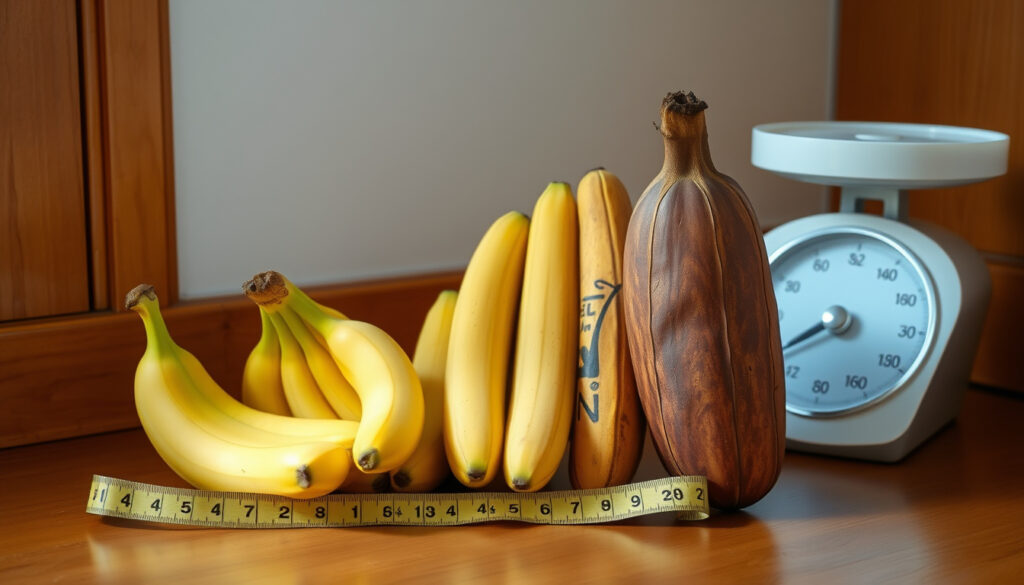
How Many Calories in a Banana? Calorie Counts by Size and Ripeness
You’ve probably grabbed a banana on the way out the door without thinking twice about what’s inside — yet one medium banana (about 7 to 8 inches long) lands at roughly 105 calories, most of them from carbohydrates. The numbers shift by size and ripeness, the diet and sugar debates are more nuanced than they look, and there’s a potassium-and-medication warning most healthy-eating posts skip.
Medium banana (118g): 105 kcal ·
Banana per 100g: 89 kcal ·
Carbs: 27g ·
Natural sugar: 14g ·
Fiber: 3g
Quick snapshot
- Medium (118g): 105 kcal (Healthcare OnTime)
- 100g raw: 89 kcal (USDA data) (Healthcare OnTime)
- Ripeness: starch becomes sugar, but calorie totals barely move.
- Fiber: 3g per medium fruit supports fullness (Harvard’s Nutrition Source)
- Calories: 105 kcal per fruit fits a low-calorie snack budget. (Harvard’s Nutrition Source)
- Pairing: protein or fat steadies appetite (Harvard’s Nutrition Source)
- Natural sugar: 14g per medium banana
- Glycemic index: about 51, moderate. (14g per medium banana)
- Fiber bonus: the same fruit carries 3g of fiber. (14g per medium banana)
- Potassium warning: AARP warns that bananas can push potassium too high with ACE inhibitors or ARBs
- Moderation: you don’t need to ban bananas — keep portions moderate and inform your doctor (AARP warns)
- Variation: potassium estimates range from 375mg to 450mg across sources — source differences, not conflicting data (AARP warns)
Banana calories and nutrition at a glance
Eight numbers, one baseline: the medium banana is the serving that most calorie trackers compare against, and the figures below trace back to federal and medical nutrition data.
| Measure | Value (medium banana) |
|---|---|
| Typical serving | 1 medium banana (7–8 in, ~118g) |
| Calories | 105 kcal |
| Calories per 100g | 89 kcal |
| Carbohydrates | 27g |
| Natural sugar | 14g |
| Fiber | 3g |
| Protein | 1.3g |
| Potassium | 422mg |
The catch: potassium estimates vary by source — about 375mg (American Heart Association) versus 422mg at Cleveland Clinic — because fruit size and rounding differ, not because the data is broken.
How many kcal does 1 banana have?
The short answer is about 105 kcal for the banana most people call “normal” — one medium fruit, 7 to 8 inches long. Everything else depends on how the banana is sized, weighed, and ripened.
Banana calories by size and weight
- Small banana (under 6 inches, ~101g): about 90 kcal
- Medium banana (7–8 inches, ~118g): about 105 kcal
- Large banana (8–9 inches, ~136g): about 121 kcal
- Extra-large banana (9+ inches): about 135 kcal
A consumer breakdown built on USDA-style serving data from Healthcare OnTime tracks that progression — calories climb with edible weight, the same pattern USA Today confirms by size.
The implication: size, not ripeness, is the first variable a calorie counter has to fix.
Calories per 100 grams of raw banana
- 100g of raw banana: 89 kcal
- 1 medium banana (118g): 105 kcal — so a weighed portion differs from a whole-fruit portion
Per-100g numbers are useful for comparing fruits on a label, but people eat bananas by the fruit, so the medium banana is the conversion that matters.
Does ripeness change the calorie count?
- Green to yellow: starch converts to sugar, which is why ripe bananas taste noticeably sweeter
- Calorie shift: minimal — ripeness changes sugar perception more than total calories in any way that matters for practical eating
- What changes: glycemic response and texture, not the energy math
The pattern: a ripe medium banana and a green one are roughly calorie twins; the real difference is how fast their sugar enters your bloodstream.
For someone counting calories, chasing green bananas to save energy is a distraction. For someone managing blood sugar, ripeness is the variable worth watching.
Are bananas good for dieting?
For weight loss, a banana is a useful but easily miscounted snack: it’s low in fat, portable, and simple to eat — and simple to over-eat once the bunch is in front of you.
Can I eat 2 eggs and bananas in the morning for weight loss?
- The classic combo: 2 large eggs (about 144–156 kcal total) plus 1 medium banana (105 kcal) lands near 250–260 kcal before cooking fat, per USDA food-composition data
- Protein: two eggs add roughly 12g of protein, which the banana doesn’t provide
- Carbs and potassium: the banana contributes about 27g of carbohydrates and 422mg of potassium to the same plate
As a single breakfast, egg-and-banana is calorie-reasonable and fast. As a multi-day “banana-egg diet,” it becomes a short-term restriction that loses protein diversity, fats, and vegetables.
The banana-egg breakfast creates a tidy calorie deficit, but it’s a meal pattern, not a nutrition plan — weight loss still needs vegetables, fats, and variety.
Is it healthy to eat 2 bananas a day for 30 days?
- Two medium bananas: about 210 kcal, 6g of fiber, and roughly 28g of natural sugar
- Potassium: about 840mg across two fruits — meaningful, and worth flagging if you take a potassium-raising medication
- The 30-day question: bananas replace ultra-processed snacks well, but they don’t cover protein or fat needs
Two bananas a day is not inherently unhealthy for most people; it becomes a problem only when it displaces the foods that keep a diet balanced.
How many calories are in 2 bananas?
- 2 medium bananas: about 210 kcal
- 2 large bananas: about 242 kcal (based on the 121 kcal per serving consumer estimate)
- 2 small bananas: about 180 kcal
The doubling is predictable — which is exactly why “just a banana” turns into “how many bananas left the bunch” by the end of the day.
The American Heart Association puts a similar caution on portions: bananas fit a heart-healthy pattern because of potassium and fiber, but they’re not an unlimited food.
Is a banana a day too much sugar?
The word “sugar” gets bananas in trouble, but the fruit’s 14–15g of natural sugar behaves differently from the added sugar in a soft drink. The nuance is in the fiber and the serving size.
Natural sugars in a medium banana
- About 14g of natural sugar per medium banana, according to USDA food-composition data
- Rounded up: Cleveland Clinic and Harvard’s Nutrition Source both list 15g — rounding, not a different fruit
- Same fruit brings 3g of fiber, which changes how quickly the sugar is absorbed
Fruit sugar arrives inside a package of fiber, water, and potassium — not as a standalone stream of sweetness.
Glycemic index of bananas
- Ripe banana GI: around 51 on the glycemic index — moderate, per Harvard’s Nutrition Source
- Green bananas: score lower, because resistant starch digests slowly instead of flooding the bloodstream with glucose
- What GI misses: total calories and portion size, which matter more for weight
The glycemic index is a ranking, not a verdict: a moderate-GI fruit can still fit a balanced plate.
Banana sugar versus added sugar
- Intrinsic vs added: banana sugar is built into the fruit; added sugar is what manufacturers put into products
- Fiber changes absorption: the 3g of fiber in a medium banana slows the sugar spike compared with a sugar-sweetened drink of similar sweetness
- The takeaway: “contains sugar” is not the same as “it’s candy”
If you’re healthy and eat a banana a day, the sugar math is rarely the problem — the second and third bananas are.
Why this matters: banning bananas for sugar is a solution to a problem most people don’t have; the real lever is total calorie intake.
Which is better, egg or banana?
The question sounds like a breakfast cage match, but nutritionally it’s a pairing, not a contest. Egg and banana cover different gaps in the morning meal.
Nutrition comparison: egg vs banana
- Egg (1 large): about 72–78 kcal and 6g of protein
- Banana (1 medium): about 105 kcal, 1.3g of protein, 27g of carbs, and 422mg of potassium — figures consistent with USDA food-composition data
- Neither is “better” alone: egg supplies protein; banana supplies carbohydrate and potassium
Asking which one “wins” depends on what the meal still needs; as a breakfast pairing, they cover each other’s gaps.
Protein, fat, and carb differences
- Protein density: an egg delivers about 6g in roughly 75 kcal; a banana delivers about 1.3g in 105 kcal
- Carbohydrates: bananas bring 27g; eggs bring essentially none
- Fat: eggs supply fat; bananas are nearly fat-free at about 0.4g
That macro split explains why the egg-and-banana breakfast keeps showing up in diet plans: fast fuel from the fruit, staying power from the egg.
Which gives better satiety for weight loss?
- Eggs usually win on satiety per bite: 6g of protein in a 75-kcal package is a strong fullness-per-calorie trade
- Bananas win on convenience: fiber and water add volume, and you can eat one without utensils, cooking, or cleanup
- The practical move: pair them — banana for the carbs you’ll burn, egg for the fullness you’ll feel
The trade-off: banana is the fuel, egg is the staying power; a combined breakfast of about 250–260 kcal outperforms either alone.
Banana vs egg: the numbers side by side
Three data points decide the banana-vs-egg debate: calories, protein, and what each food is actually doing in the meal.
| Metric | Banana (1 medium) | Egg (1 large) |
|---|---|---|
| Calories | 105 kcal | 72–78 kcal |
| Protein | 1.3g | ~6g |
| Carbohydrates | 27g | Minimal |
| Best role in a weight-loss breakfast | Fast carbs + potassium | Protein and satiety |
The pattern that matters for weight loss: one food gives you fuel, the other gives you fullness — which is why they keep ending up on the same plate.
Pros and cons of eating bananas
Every food comes with a trade-off; bananas are no exception once servings grow past one fruit.
Why not eat a banana on an empty stomach?
- Empty stomach: can worsen reflux in sensitive people due to the fruit’s acidity and sugar content.
- Night: the 105-kcal math doesn’t change after dark — timing doesn’t affect calorie storage.
- Banana trick: warm banana with water is a folk remedy, not a proven therapy for bowel emptying.
Upsides
- 105 kcal in a medium fruit keeps portion math simple
- 3g of fiber supports fullness and regularity
- 422mg of potassium fits a heart-healthy diet in most people
- Portable, cheap, and ready to eat — practical for meal prep
Downsides
- 14–15g of sugar per fruit adds up when portions multiply
- Potassium can complicate ACE-inhibitor and ARB therapy
- Only about 1.3g of protein — a banana alone is a carb snack, not a complete meal
The catch: bananas are rarely the problem at one fruit a day; they become a problem in bunches, or in combination with potassium-raising medication.
How to use bananas in a weight-loss plan without sabotaging it
Five practical steps keep the banana in the diet without letting the calorie line drift.
- Set your baseline portion: one medium banana (7–8 in, 118g) equals 105 kcal — log it as one serving, not “a snack”
- Weigh it once: a 100g portion is 89 kcal; eyeballing after that is fine because you’ve seen the difference
- Pair it with protein: eggs, yogurt, or nuts slow the sugar rise and add the satiety the fruit lacks
- Adjust for ripeness if you’re watching blood sugar: greener bananas deliver more resistant starch; spotted ones taste sweeter and digest faster
- Check your medication: if you’re on an ACE inhibitor or ARB, keep banana portions moderate and flag your intake to your doctor
The pattern: portion control plus protein pairing solves most banana-related diet drift.
What’s confirmed, what’s unclear
Separating the data from the diet folklore is the difference between a snack and a strategy.
Confirmed facts
- USDA food-composition data lists 89 kcal per 100g of raw banana
- A medium banana (7–8 in, 118g) is about 105 kcal
- A medium banana provides about 3g of fiber and 422mg of potassium
- Ripeness changes sugar perception more than total calories
What’s unclear
- The “banana trick” for emptying bowels is anecdotal, not clinically proven
- An empty stomach may worsen acid reflux in some people
- The 105-kcal math doesn’t change after dark — timing is not a weight-gain factor
- The potassium threshold that interferes with blood-pressure medication varies by person
- Banana-only cleanse claims lack scientific support
- Snippet-level USDA data sometimes shows a potassium figure that conflicts with major medical sources — a data-quality trap
The pattern: the core nutrition numbers are stable across federal and medical sources; the miracle claims are the ones that keep changing.
Expert reads on bananas, calories, and potassium
Three credible voices frame the same fruit from three different angles.
A medium banana provides about 375mg of potassium, and bananas can fit into a heart-healthy eating pattern — as long as portions stay reasonable.
As a banana ripens, starch turns to sugar and the fruit tastes sweeter, but the calorie change is not meaningful for practical eating decisions.
Potassium-rich foods such as bananas can push potassium levels too high in people taking ACE inhibitors or ARBs, potentially causing heart rhythm problems.
— AARP
What these agree on: bananas are a portion puzzle, not a poison — and the medication context is the part most nutrition content skips.
The takeaway
Bananas are not the calorie villain of diet folklore, nor a free pass: one medium fruit delivers about 105 kcal of carbohydrate, fiber, and potassium that most healthy eaters can fit into a day. The moments that deserve attention are quantity — the second and third banana add up — and medication, where potassium-rich produce can complicate ACE-inhibitor and ARB therapy. For anyone on a weight-loss plan, the decision is clear: treat the medium banana as the baseline portion and pair it with protein, or log the extra-large banana as the 121-kcal snack it actually is.
lhsfna.org, goodrx.com, gbchealth.org, singlecare.com, agingcare.com, healthcareontime.com
Frequently asked questions
What medications should you not eat bananas with?
The main ones are ACE inhibitors (lisinopril, enalapril) and ARBs (losartan, valsartan), which help the body hold onto potassium. AARP warns that potassium-rich foods like bananas can push levels too high and disturb heart rhythm; GoodRx and SingleCare give the same caution for high banana intake. You don’t need to ban bananas — keep portions moderate and tell your doctor how often you eat them.
What fruit should I eat every day?
No single fruit is required. A banana is a sensible default because it’s cheap, portable, and delivers 105 kcal, 3g of fiber, and 422mg of potassium in a medium fruit. Eating a variety of fruits is still the better long-term move.
How many bananas can I eat a day?
For most healthy people, 1–2 medium bananas a day fits easily into a balanced diet — about 210 kcal and 28g of natural sugar total. If you have kidney disease or take an ACE inhibitor or ARB, keep portions conservative and clear them with your doctor.
Can bananas cause constipation?
Usually no. Ripe bananas are constipation-neutral to helpful because of their 3g of fiber. The “banana trick” — warm water with banana — is an anecdotal remedy without clinical backing; water and whole fruit are the evidence-based baseline.
Are bananas good before a workout?
Yes for most. A medium banana about 30–60 minutes before exercise gives you 27g of quick carbohydrates and 422mg of potassium, which supports muscle function without weighing you down.
Is it bad to eat a banana at night?
No strong evidence says a banana at night causes weight gain — 105 kcal is 105 kcal regardless of the clock. If you snack before bed, pairing the banana with protein or fat steadies the sugar rise.
More related posts
 Song Joong-ki Biography: Age, Wife, Net Worth, and Facts
 How to Draw Stitch: Easy Step-by-Step
 House of Chocolate NZ: Auckland Locations, Menu & Products
 How to Win Friends and Influence People: Summary & Guide
 Newcastle United FC vs Chelsea FC Lineups – Chelsea Confirmed, Newcastle Predicted
 Spark Internet Not Working? Check Outages & Fix It Fast
 Man City vs Wydad AC Lineups: Starting XI June 18, 2025
 Wedding Guest Dress NZ – Etiquette, Colours and Seasonal Tips