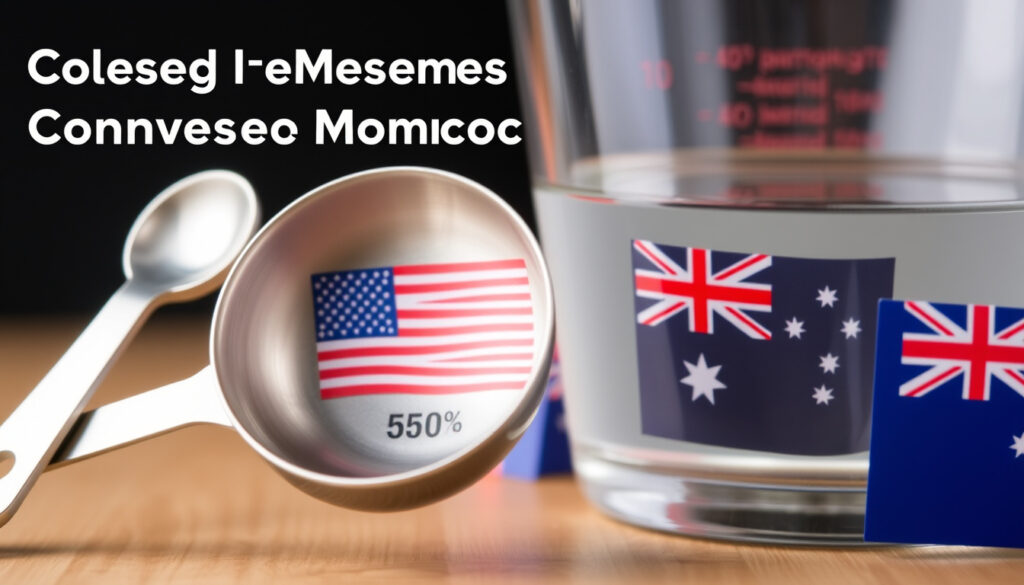
How Many mL in a Tablespoon? US, UK & Australia Conversions
The tablespoon is not a one-size-fits-all measure: the standard answer to “how many mls in a tablespoon” depends on whether you’re cooking in the US, UK, Australia, or following a nutrition label. While most kitchens round to 15 mL, the exact value can vary by nearly 5 mL—enough to throw off a recipe or a medicine dose.
Standard US/UK tablespoon: 15 mL
Australian metric tablespoon: 20 mL
US teaspoon: 5 mL
1 US fluid ounce: 29.6 mL
Standard tablespoon (US, UK, Canada)
- 15 mL – NIST Metric Kitchen (tier 1)
- Most common worldwide
- Used in most recipes
Australian metric tablespoon
- 20 mL – Wikipedia (tier 3)
- Legal standard in Australia for nutrition labeling
- Check recipe origin before measuring
Teaspoon comparison
- 1 teaspoon = 5 mL – USDA ARS (tier 1)
- 3 teaspoons = 1 tablespoon
- Always use level measures for accuracy
Tablespoon for medicine
- Use medical syringe, not kitchen spoon
- 1 tablespoon = 15 mL
- 15 mL per dose unless label states otherwise
Key facts at a glance:
| Region | Definition | Source |
|---|---|---|
| US customary (exact) | 14.7868 mL | NIST (tier 1) |
| US nutrition label | 15 mL | Inch Calculator (tier 2) |
| UK (official & common) | 15 mL | UnitCalcTools (tier 3) |
| Canada (common use) | 15 mL | Wikipedia (tier 3) |
| Australia (metric tablespoon) | 20 mL | The Calculator Site (tier 2) |
| UK imperial (historical) | ~17.758 mL | CleverCalculator (tier 3) |
| US teaspoon | 5 mL | NIST (tier 1) |
How many mL in a tablespoon?
The most direct answer is 15 mL for the tablespoon used in the US, UK, Canada, and most international recipes. But the number changes depending on where you are and what you’re measuring. The NIST Metric Kitchen (tier 1) lists 15 mL as the rounded value for cooking, while the exact US customary tablespoon is 14.7868 mL.
What is the difference between US tablespoon and metric tablespoon?
The US customary tablespoon is defined as 1⁄16 US cup, which equals about 14.7868 mL according to NIST (tier 1). In contrast, the metric tablespoon used in many countries (and in US nutrition labeling) is exactly 15 mL. The difference is just 0.2132 mL—negligible for most cooking but relevant for technical baking or when scaling recipes.
When does a tablespoon equal 20 mL?
If you’re using an Australian recipe, the answer changes: the Australian metric tablespoon is 20 mL. This is a legal definition used in nutrition labeling, as confirmed by Wikipedia (tier 3) and The Calculator Site (tier 2). The 5 mL gap can drastically alter the outcome of a cake, sauce, or dressing.
The catch: Relying on a 15 mL tablespoon for an Australian recipe will under-measure by 25 % per spoonful, leading to a thinner, less concentrated dish.
Is a tablespoon 15 or 20 mL?
Both – it depends on the country. 15 mL is the standard in the US, UK, Canada, and most of Europe. 20 mL is the legal definition in Australia. The Calculator Site (tier 2) describes Australia as the notable outlier among common recipe conventions.
Which countries use 20 mL tablespoon?
Only Australia legally defines a tablespoon as 20 mL for nutrition labeling. New Zealand recipes sometimes follow the Australian standard but often default to 15 mL; always check the recipe source. Wikipedia (tier 3) notes that Australia stands apart from the 15 mL consensus.
Why does Australia use a larger tablespoon?
The origin is historical: when Australia adopted the metric system in the 1970s, it chose 20 mL for a tablespoon, possibly to align with the imperial dessertspoon or to simplify fractions. No official contemporary explanation is widely cited, but the effect is consistent across Australian food regulations.
“An Australian metric tablespoon is 20 mL.” – Wikipedia, Tablespoon (tier 3)
How many mL is a tablespoon in the UK?
The UK tablespoon is officially 15 mL. The UnitCalcTools (tier 3) entry for metric tablespoons includes the UK as a 15 mL region. UK recipes and the National Health Service (NHS) both assume 15 mL per tablespoon for liquids. The historical imperial tablespoon was larger (about 17.758 mL), but modern recipes use the metric 15 mL definition.
Is UK tablespoon the same as US tablespoon?
Practically yes, both are 15 mL in everyday cooking. But the US customary tablespoon is slightly smaller (14.7868 mL) while the UK adopted the metric 15 mL exactly. For home cooking the difference is negligible, but for precision baking the US spoon is fractionally less.
What does the NHS or UK recipes assume?
The NHS advises using a proper measuring spoon for liquid medicines, not a kitchen spoon, but when a recipe calls for a tablespoon, the assumed volume is 15 mL. This matches the guidance from NIST (tier 1) for international equivalency.
Is 15 mL 1 teaspoon or 1 tablespoon?
15 mL is 1 tablespoon, not 1 teaspoon. A teaspoon is 5 mL. USDA ARS (tier 1) confirms that 1 tablespoon = 3 teaspoons. So 15 mL = 3 × 5 mL = 1 tablespoon.
How many mL in a teaspoon?
A standard teaspoon is 5 mL. The USDA ARS conversion tables (tier 1) list this as the base unit in food composition work. Note that Australian teaspoons are also 5 mL, not 20 mL like their tablespoon.
What is the conversion between teaspoon and tablespoon?
1 tablespoon = 3 teaspoons. So 5 mL (1 tsp) × 3 = 15 mL (1 tbsp). This holds for US, UK, metric, and Australian teaspoons alike.
Editorial judgment: Using a kitchen spoon to measure medicine can be dangerous because spoon sizes vary by 2–5 mL. Always use a medical syringe or dosing cup—saving 30 seconds is not worth a dosage error.
Practical tip: If you only have a 15 mL tablespoon but the recipe is Australian, reduce the number of tablespoons by 25 % (e.g., 4 tbsp → 3 tbsp) or use a kitchen scale for weight-based accuracy.
Comparison Table: Tablespoon Definitions Worldwide
The table below contrasts the major definitions, showing how a “tablespoon” can mean different volumes in different contexts.
| System / Country | Volume (mL) | Notes |
|---|---|---|
| US customary (exact) | 14.7868 | Used in technical conversions; rounded to 15 mL in cooking |
| US nutrition labeling | 15 | Required by FDA for food labels |
| UK (metric) | 15 | Modern standard; historical imperial was ~17.76 mL |
| Canada (practical) | 15 | Historical 14.21 mL noted but 15 mL utensils common |
| Australia | 20 | Legal for nutrition; notable outlier |
| New Zealand | 15 (or 20) | Mixed usage; always verify recipe |
| Imperial UK (historical) | ~17.758 | Occasionally found in older British cookbooks |
The pattern: The global consensus is 15 mL, but Australia breaks rank with a 20 mL tablespoon, affecting any recipe that does not specify its origin.
Practical measurement tips
When you don’t have a measuring spoon, use these rough equivalents (for water-like liquids only):
- 1 tablespoon ≈ 15 mL = volume of a standard ice cube tray cell (approx. 3 ice cube compartments).
- 1 teaspoon ≈ 5 mL = one-third of a tablespoon.
- For sticky ingredients like honey or peanut butter: The volume is the same, but coating your spoon with a little oil helps the ingredient slide off completely.
- For solid butter: 1 tablespoon = 14.2 grams. Use a knife to level off the spoon.
- Always level dry ingredients with a straight edge; do not pack unless the recipe says “packed”.
The implication: Volume is only half the story – density and stickiness affect how much actually stays in the spoon. For accuracy, especially in baking, a kitchen scale is your best friend.
For a detailed breakdown of how many milliliters are in a tablespoon across different regions, see this guide on US, UK, and metric tablespoon conversions.
FAQ
How many mL in a tablespoon of water?
15 mL (or 20 mL in Australia). Water’s density is 1 g/mL, so 1 tbsp = 15 g.
How many mL in a tablespoon of oil?
Same volume as water: 15 mL. Oil is less dense, so weight is about 13.5 g.
How many mL in a tablespoon of butter?
15 mL of melted butter = 1 tbsp; solid butter = 14.2 g. Volume is the same once melted.
How many mL in a tablespoon of medicine?
15 mL liquid = 1 tbsp, but always use the dosing device provided – never a kitchen spoon.
5 mL equals how many tablespoons?
5 mL = 1 teaspoon = ⅓ tablespoon.
How many grams in a tablespoon?
Depends on ingredient: granulated sugar ~12.5 g, all-purpose flour ~7.8 g, butter ~14.2 g.
For more precise conversions, see our guide on 100 Grams to Cups: Exact Conversions for Flour, Sugar, Butter or try a regional recipe like Cheese Rolls Recipe NZ | Southland Style.
More related posts
 Cast of The Ex-Wife: Full Cast List and Season 2 Recast
 The Times Death Notices: UK Obituaries & Irish Times Guide
 Best S&P 500 Index Funds 2025: Low-Cost & How to Buy
 Mortgage Repayments Calculator NZ: Top Bank Tools Guide
 Dawn of War 4: Release Date, Factions & Gameplay Confirmed
 30 Seconds Spray and Walk Away: Reviews, Directions & Safety
 Daily Post Deaths Today: Find Obituaries & Death Notices
 Dr Brown Bottles NZ: Sizes, Prices, and Buying Tips