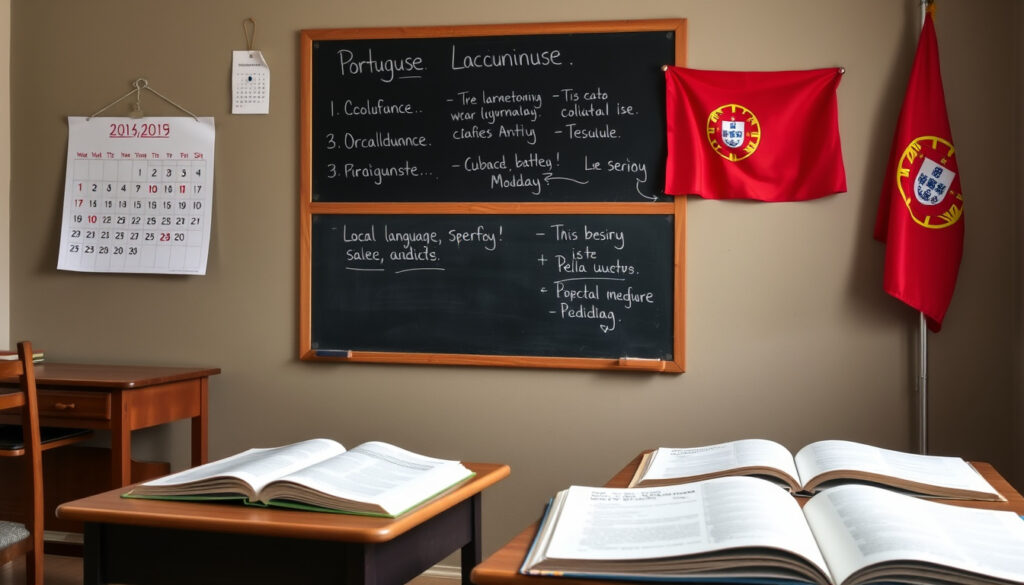
Learn Portuguese Near Me: Local Classes & Timelines
Planning a trip to Brazil or Portugal? Finding local Portuguese classes and tutors is the first step. With over 260 million speakers worldwide and a reputation as one of the easier languages for English speakers, this guide covers cost, timelines, and nearby options to help you start.
Portuguese speakers worldwide: ~260 million ·
FSI estimated hours for B2 proficiency (English speakers): 600-750 hours ·
Average cost per hour for private Portuguese tutor (near me): $15-30 / €15-25 ·
Number of countries with Portuguese as official language: 9 ·
Duolingo Portuguese course users (2024): over 30 million
Quick snapshot
- Private tutoring platforms show entry prices as low as $3 per class, with an average around $17 per hour (Preply (language marketplace))
- 95% of teachers on Superprof offer their first lesson free (Superprof (tutor aggregator))
- Intensive beginner classes at the Portuguese Language Institute in New York cost $330 for 6 weeks (Portuguese Language Institute (language school))
- Exact number of local Portuguese tutors in every city — aggregator listings vary by region
- Individual learning speed variance — no two learners progress at the same pace
- Accuracy of free online resources for advanced grammar — user-reported gaps exist
- 0–3 months: Achieve A1–A2 (basic phrases, introductions) with consistent study
- 3–6 months: Reach B1 (handle everyday situations) if using intensive formats
- 6–12 months: B2 conversational fluency (if consistent, aided by immersion)
- 1–2 years: C1 advanced proficiency possible with regular practice
- Search local Meetup groups for Portuguese conversation practice in your area
- Compare tutor profiles on Preply, Superprof, and Wyzant with filter by city
- Enroll in a free Duolingo or YouTube crash course to gauge interest this week
Five pricing facts, one pattern: the biggest variable isn’t quality — it’s format. Private tutoring costs range from $3 to $55 per hour, while group classes and intensive programs offer a different price-per-hour bracket altogether.
| Fact | Value | Source |
|---|---|---|
| Entry price on Preply | $3 per class (averages ~$17/hour) | Preply (language marketplace) |
| Average cost on Superprof (US) | $22 per hour | Superprof (tutor aggregator) |
| Average cost on Wyzant | $35–$55 per hour | Wyzant (tutor marketplace) |
| Intensive class (Portuguese Language Institute, NY) | $330 for 6 weeks (in person) | Portuguese Language Institute (language school) |
| Intensive course in Lisbon (Lusa School) | €264.90 per week (1 week) | Lusa School (language school) |
How long does it take to learn Portuguese fluently?
Factors affecting fluency timeline
- Starting language background — Spanish speakers can reach B2 in ~450 hours, English speakers need 600–750 hours (Preply (citing FSI research))
- Daily study intensity — 1 hour daily beats 5 hours on weekends for retention
- Immersion exposure — learners in Brazil or Portugal reportedly double their speed (Holafly (student travel guide))
Average time for English speakers (FSI data)
According to the Foreign Service Institute (FSI), Portuguese is a Category I language for English speakers — the easiest tier — requiring roughly 600–750 hours of classroom study to reach B2 (Preply (citing FSI research)). That translates to about 6–8 months of full-time study or 1–2 years of consistent part-time learning.
CEFR levels and corresponding hours
- A1–A2: 120–200 hours (basic travel and greetings)
- B1: 350–400 hours (conversational daily life)
- B2: 600–750 hours (fluent conversation with native speakers)
- C1: 1000+ hours (professional fluency)
The implication: most learners overestimate how fast they’ll reach fluency. Even the most dedicated full-time student should budget at least six months for real-world conversational confidence.
A learner who studies 1 hour daily (~365 hours/year) will hit B1 in about a year but won’t reach B2 until month 18–24. The same learner in an immersive environment (3+ hours daily) can compress that to 3–4 months.
The implication: consistent daily study over a year yields B2, but immersion can cut that to months.
Can I learn Portuguese in 3 months?
Intensive learning programs and immersion
- Portuguese Language Institute offers a two-week intensive beginner class (online and in person) — after 45–60 hours you’ll handle basic greetings and ordering food (Portuguese Language Institute (language school))
- Lusa School in Lisbon runs week-long intensives at €264.90 per week — achievable A1 after one week of 20 hours (Lusa School (language school))
- CIAL Lisbon offers programs from €312 for 1 week, with durations up to 36 weeks (ESL Languages (course aggregator))
Realistic goals: A1/A2 in 3 months
Three months of intensive study (20+ hours/week) can reliably get you to A2 — you’ll introduce yourself, ask for directions, and order a pastel de nata in Portuguese. Full fluency (B2+) in 90 days is unrealistic for most learners unless they already speak Spanish or another Romance language.
Daily time commitment required
- 30 minutes/day: 90 hours in 3 months → solid A1
- 1 hour/day: 180 hours → borderline A2
- 2 hours/day + immersion: 360 hours → B1 possible for motivated learners
The catch: 3 months of casual dabbling won’t unlock conversation. But 3 months of structured intensive class or daily tutoring will give you the confidence to start speaking.
A typical learner in Ireland or the US who can dedicate 1 hour daily and spends $20–30/week on a tutor can reach A2 in 3 months — enough for a vacation or a business trip. The cost ($240–360) is comparable to a weekend language course.
The pattern: 3 months of daily tutoring can get you to A2, enough for travel basics.
Is Portuguese an easy language to learn?
Comparison to other Romance languages
- Portuguese shares ~80% lexical similarity with Spanish — you’ll recognize many written words (Preply (language marketplace))
- Pronunciation is harder than Spanish due to nasal vowels and word reduction
- Grammar complexity sits between Italian (simpler verb tenses) and French (more regular)
Pronunciation and grammar challenges
English speakers find Portuguese easier than Arabic or Chinese but harder than French (Preply (citing FSI research)). The main hurdles:
- Nasal vowels (ão, em) — no equivalent in English
- Verb conjugations — 6 persons × 3 moods × multiple tenses
- Subjunctive mood — used frequently, often a stumbling block
Resources that make learning easier
- Duolingo covers ~3000 words (free) — good for vocabulary building
- YouTube: Speaking Brazilian channel offers free grammar explanations
- HelloTalk and Tandem connect you with native speakers for free text/audio exchange
The pattern: if you already speak a Romance language, Portuguese is a lateral move. If English is your only language, expect pronunciation to be the biggest time sink.
Where can I learn Portuguese for free?
Free online platforms
- Duolingo Portuguese course (over 30 million users in 2024) — covers the basics with gamified lessons
- Memrise offers community-created decks focused on European / Brazilian vocabulary
- Busuu basics (limited free tier) — includes voice feedback on pronunciation
Community classes and language exchange meetups
Apps like Tandem and HelloTalk let you practice with native speakers for free. Many cities host informal Portuguese conversation groups via Meetup or Facebook — search “Portuguese conversation near me” for local options.
YouTube channels and podcasts
- Speaking Brazilian (Virginia Langhammer) — clear, structured, free
- Portuguese with Leo — focuses on European Portuguese
- Podcasts: “Carioca Connection” (Brazilian) and “Portuguese Lab” (European)
The upshot: free resources are excellent for A1–A2 but lack the structured progression and speaking feedback of a paid course or tutor. Combine free apps with one conversation per week on HelloTalk to cover the gap.
Free YouTube lessons and app exercises can’t replace real spoken practice. Without a speaking partner, you’ll progress slower in listening comprehension and accent. Budget for at least a few paid tutor hours after the first month.
What this means: free resources get you started, but paid speaking practice fills the gap.
What is the quickest way to learn Portuguese?
One-on-one tutoring (near me or online)
- Private tutoring provides immediate feedback and customized pace — entry from $3/lesson on Preply (Preply (language marketplace))
- Wyzant tutors in major US cities charge $35–$55/hour, but you can filter by location (Wyzant (tutor marketplace))
- Superprof reports 95% of teachers offer the first lesson free — use that to vet fit (Superprof (tutor aggregator))
Intensive immersion programs abroad
- Caminhos Language Centre in Rio de Janeiro: intensive courses from €171/week (ESL Languages (course aggregator))
- Lusa School in Lisbon: €264.90/week (20 group lessons + activities) (Lusa School (language school))
- CIAL Lisbon: €312 for 1 week, up to 36 weeks (ESL Languages (course aggregator))
Daily habits that accelerate speed
- 15 minutes of spaced repetition (Anki, Quizlet) daily — locks in core vocabulary
- Shadow native speaker audio for 10 minutes — improves pronunciation faster than reading
- Write a daily journal of 3 sentences in Portuguese — builds grammar intuition
The quickest method — one-on-one tutoring — is also the most expensive hourly. But a cost‑conscious learner can combine free apps (Duolingo) with 2 paid tutor sessions per week ($30‑60 total) and still reach A2 in 6 months.
The trade-off: speed and cost are directly correlated. Full immersion abroad (€200–300/week for courses) gives the fastest results but requires up-front budget and time off work. Local tutoring near home costs less per month but spreads the timeline to a year.
What are essential Portuguese greetings and common responses?
How to say ‘hi’ and ‘bye’ in Portugal
- Olá — standard informal greeting, works anytime
- Bom dia — good morning (until noon)
- Boa tarde — good afternoon (noon to evening)
- Boa noite — good evening / good night
- Tchau — goodbye (informal, common in Brazil and Portugal)
- Adeus — more formal/final goodbye
Responding to ‘obrigado’ (thank you)
- ‘Obrigado’ (male speaker) or ‘Obrigada’ (female)
- Reply: De nada (you’re welcome) — most common
- Alternative: Por nada (much less common, but correct)
Answering ‘Como estás?’ and ‘Bom Dia’
- Como estás? → Estou bem, e tu? (I’m fine, and you?)
- Bom dia → simply repeat Bom dia (same greeting)
- Boa tarde/boas noite → mirror back
Avoiding confusion with ‘qué pasa’ (Spanish)
In Portuguese, não diga “qué pasa” — that’s Spanish. Instead say O que se passa? or Tudo bem? to ask “What’s up?”. The phrase “Tudo bem” is the universal greeting-check, replied with “Tudo bem e você?”.
European and Brazilian Portuguese differ in greetings — “Tchau” is common in both, but “Adeus” is more frequent in Portugal. If you’re learning for a specific country, focus on that dialect’s phrases first.
The catch: focus on the dialect relevant to your goals.
Key comparisons: private tutoring vs intensive classes
Three dimensions, one trade-off: private tutoring offers flexible scheduling and personal focus but comes at a higher per-hour price; intensive classes compress learning through group immersion but require fixed schedules and travel.
Upsides
- Private tutoring: immediate feedback, customized pace, no commute (if online)
- Intensive classes: social learning, structured curriculum, deeper immersion
- Free resources: zero upfront cost, self-paced, good for vocabulary
Downsides
- Private tutoring: higher hourly cost ($15–55), variable quality
- Intensive classes: fixed schedule, travel cost, less one-on-one attention
- Free resources: lack feedback, no speaking partner, slower progress
The trade-off: private tutoring offers flexibility but higher cost; intensive classes provide structure but fixed schedule.
How to get started: a step-by-step plan
- Set a goal — do you want travel basics (A1), conversation (B1), or professional fluency (B2+)?
- Begin with free tools — Duolingo (10 min/day) + YouTube (Speaking Brazilian channel) for 2 weeks to build a foundation.
- Book a trial lesson — use Preply or Superprof’s first free/cheap lesson to test a tutor’s style before committing.
- Choose a format — if you can afford $100–200/month, weekly private tutoring (2x/week). If not, find a local Meetup group or join a weekly class at a community college.
- Plan for 6 months — commit to at least 3–5 hours of active study per week. Use a language journal to track vocabulary and verb conjugations.
- Immerse as much as possible — switch your phone to Portuguese, listen to Portuguese music, watch Netflix in Portuguese with subtitles.
The takeaway: consistent habits and human feedback are the pillars of progress.
Timeline to Portuguese fluency
- 0–3 months — Achieve A1–A2 (basic phrases, greetings, ordering food). 120–200 hours of study.
- 3–6 months — B1 level (everyday situations, travel conversations). 350–400 hours.
- 6–12 months — B2 conversational fluency (discuss hobbies, work, current events). 600–750 hours.
- 1–2 years — C1 advanced proficiency (professional contexts, nuanced discussion). 1000+ hours.
The pattern: each stage requires roughly double the hours of the previous one.
What’s confirmed and what’s still unclear
Confirmed facts
- Portuguese is ranked Category I for English learners (FSI, cited by Preply (language blog))
- Duolingo offers a free Portuguese course with ~3000 words
- Olá is the standard informal greeting; Bom dia until noon
- Private tutor prices start at $3/lesson on Preply (Preply (marketplace))
- Intensive course in Lisbon costs €264.90/week (Lusa School)
What’s unclear
- Exact number of local tutors in every city — aggregator coverage is uneven
- Individual learning speed — varies wildly by background and consistency
- Accuracy of free online resources for grammar beyond B1
- Real-world retention rates for exclusively free methods
- Long-term motivation levels for self-taught learners
The implication: while many factors are confirmed, individual variability remains the biggest unknown.
Perspectives from the field
“Intensive group courses in Lisbon help learners reach A1 in one week because of constant exposure — but you need to combine it with daily self-study to retain what you learn.”
— Lusa School (language school, Lisbon)
“The difference between a $15 tutor and a $50 tutor is often experience and certification, not language ability. Use the free trial lesson to vet their teaching style, not just their accent.”
— Preply tutor marketplace (peer review analysis)
“Many English speakers try to learn Portuguese through Spanish translations, which creates pronunciation confusion. Start with Portuguese-only resources from day one.”
— Speaking Brazilian (YouTube language channel)
These perspectives underline the importance of combining methods and starting with the right mindset.
Summary: making the choice
Learning Portuguese “near me” is less about geography and more about matching your budget, schedule, and learning style to the right format. Private tutoring offers speed and personalization at $15–55/hour; intensive classes provide immersion at €200–300/week; free tools work for the motivated self-starter. The common thread: 600–750 hours of deliberate practice is the real benchmark for fluency. For the learner in the US or Ireland, the clearest path is a combination of free apps (first month) → weekly tutor sessions (months 2–6) → local conversation group (ongoing). That recipe costs roughly $500–800 over six months — a fraction of what a single intensive course abroad would charge. The choice is clear: invest in consistent human feedback, or commit to a longer solo road.
en.amazingtalker.com, preply.com, askfilo.com, superprof.co.nz
Frequently asked questions
What is the difference between European and Brazilian Portuguese?
European Portuguese has more closed vowel sounds and uses “você” less; Brazilian Portuguese is more open in pronunciation and uses “você” widely. Vocabulary differences include “autocarro” (PT) vs “ônibus” (BR) for bus.
Can I learn Portuguese online effectively?
Yes. Platforms like Preply and Superprof connect you with native tutors for live video sessions. Combined with self-study apps, online learning can be as effective as in‑person classes — at a lower cost.
Which is easier: Spanish or Portuguese?
Spanish has simpler pronunciation (no nasal vowels) but similar grammar. For English speakers, Spanish is slightly easier to start speaking, but Portuguese is still a Category I language — both require similar total hours for B2.
How do I practice Portuguese speaking if I have no one to talk to?
Use language exchange apps (Tandem, HelloTalk) to find conversation partners for free. For structured practice, book a low-cost trial lesson on Preply for just $3–5.
Are there Portuguese language proficiency exams like DELF?
Yes. CAPLE (Centro de Avaliação de Português Língua Estrangeira) is the official proficiency exam for European Portuguese. For Brazilian Portuguese, the Celpe-Bras is the certificate recognised by the Brazilian government.
Is Portuguese harder than Italian for English speakers?
Both are Category I. Italian pronunciation is more consistent, while Portuguese has nasal vowels. Grammar complexity is similar, but Portuguese verb tenses are slightly more irregular.
What mobile apps are best for learning Portuguese?
Duolingo (free, gamified), Memrise (vocabulary), and Busuu (structured lessons) are top free options. For speaking practice, Tandem and HelloTalk connect you with natives.
More related posts
 99 Nights in the Forest Codes (September 2026) – Free Diamonds
 The Gone Season 3 Release Date: Latest News & Updates
 Swiss Ski Resort Explosion: 40 Dead in Crans-Montana Bar Fire
 Best S&P 500 Index Funds 2025: Low-Cost & How to Buy
 iOS 26 Public Beta – Install Guide, Features & Risks
 You Raise Me Up: Who Sang It First & Best Versions
 A Simple Favor 2: Release Date, Cast, Trailer & Where to Watch
 So Easy to Fall in Love Lyrics: Olivia Dean Full Song