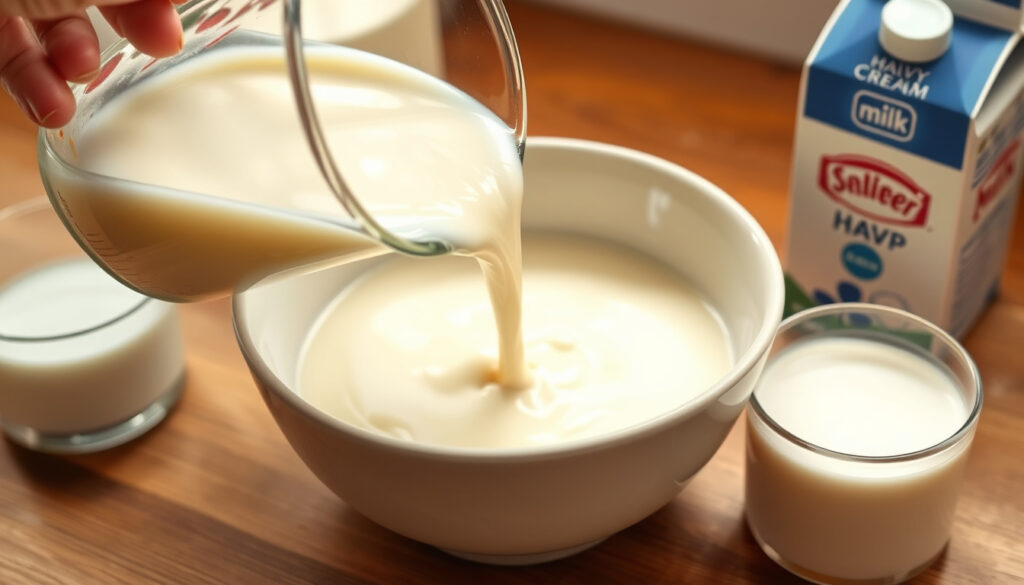
What Is Half-and-Half? Definition, Substitutes, & How to Make
You’ve probably poured half-and-half into your coffee without a second thought, but this dairy blend is more than just a creamer. It strikes a useful middle ground between milk and heavy cream, with a fat content regulated by the U.S. Food and Drug Administration at 10.5 to 18 percent. By the end of this guide, you’ll know exactly what half-and-half is, how it behaves in cooking, and how to swap it when the carton runs out.
Milk fat content: 10.5–18% · Composition: Equal parts whole milk and light cream · Common uses: Coffee, sauces, baking, soups · U.S. regulation: FDA standard of identity
Quick snapshot
- Mixture of whole milk and light cream (Food Network (editorial food authority))
- 10.5–18% milk fat required by law (eCFR (U.S. regulatory code))
- Cannot be whipped into stiff peaks (Food Network (editorial food authority))
- Exact British equivalent not officially defined; single cream plus milk is closest common practice (eCFR (U.S. regulatory code))
- Availability under same name varies outside U.S. and Canada (Food Network (editorial food authority))
- Use within 7–10 days after opening for best quality (Healthline (health and nutrition publisher))
- Freezing alters texture; not recommended for drinking (Food Network (editorial food authority))
- Homemade half-and-half removes stabilizers and lets you control fat content (The Pioneer Woman (lifestyle and cooking authority))
- Substitution formulas for heavy cream using half-and-half are widely tested (Allrecipes (recipe publisher))
The defining numbers for half-and-half are clear-cut.
| Attribute | Value |
|---|---|
| Milk fat content | 10.5–18% |
| Made from | Whole milk + light cream (equal parts) |
| Storage | Refrigerate, use within 7–10 days after opening |
| Common uses | Coffee, sauces, baking, soups, mashed potatoes |
What is half-and-half?
What is the fat content of half-and-half?
The U.S. Code of Federal Regulations defines half-and-half as “a mixture of milk and cream” that contains not less than 10.5% but less than 18% milkfat (eCFR (U.S. regulatory code)). That places it squarely between whole milk (about 3.5% fat) and heavy cream (36–40% fat). Most commercial brands land around 10–12% (Food52 (food media site)).
What is half-and-half made of?
It’s exactly what the name implies: equal parts whole milk and light cream (Food Network (editorial food authority)). No added thickeners or emulsifiers are required by law, though some brands include stabilizers like carrageenan to improve mouthfeel and shelf life.
Half-and-half gives you enough fat for creamy texture in coffee and sauces without the caloric weight of heavy cream. For home cooks who want richness without a full commitment, it’s the everyday workhorse.
The implication: half-and-half is a legally distinct product in the U.S., not a vague blend, and its fat range is tight enough to be predictable in recipes.
Is half-and-half basically milk?
How does half-and-half differ from milk?
Fat content is the dividing line. Whole milk has about 3.5% milk fat; half-and-half has roughly three times that, at 10.5–18% (Healthline (health and nutrition publisher)). That extra fat changes how it behaves: half-and-half adds a velvety body that milk alone cannot replicate, especially in hot liquids where it resists curdling better.
Can you use milk instead of half-and-half?
Yes, but the result will be noticeably thinner. In baking, using milk alone may lead to a less tender crumb and a paler color. For coffee, milk will deliver a lighter mouthfeel. A closer swap is 3/4 cup milk plus 1/4 cup heavy cream per cup of half-and-half needed (The Pioneer Woman (lifestyle and cooking authority)).
Choosing milk over half-and-half saves a few grams of fat but sacrifices richness in applications where creaminess is the point — mashed potatoes, chowders, custards. The fat content isn’t just about taste; it affects heat stability and texture.
What this means: half-and-half is not simply milk with a fancy name. Its fat content is high enough to perform differently in cooking, and substituting milk requires accepting a less luxurious outcome.
What is the British equivalent of half-and-half?
What is half-and-half in Ireland?
There is no official product called “half-and-half” in the UK or Ireland. The closest practical equivalent is a blend of single cream (18–20% fat) and whole milk, mixed roughly 1:1 (eCFR (U.S. regulatory code)). In Canada, half-and-half is sold under that name and has the same 10.5–18% fat standard.
Is double cream the same as half-and-half?
No. Double cream has a fat content around 48%, more than four times that of half-and-half (Healthline (health and nutrition publisher)). It can be whipped to firm peaks and holds its shape, while half-and-half cannot. Using double cream where half-and-half is called for will yield a much richer, heavier dish.
The catch: if you’re following a U.S. recipe in the UK, your best bet is to mix single cream and whole milk until the texture feels right, usually about half-and-half by volume. No single product bridges the gap neatly.
Is half-and-half the same as heavy cream?
What is the difference between half-and-half and heavy cream?
Heavy cream must contain at least 36% milk fat under FDA rules (eCFR (U.S. regulatory code)). Half-and-half tops out at 18%. That fat gap makes heavy cream whipable and able to thicken sauces through reduction; half-and-half will never form stiff peaks (Food Network (editorial food authority)).
When to use half-and-half vs heavy cream?
Use half-and-half for morning coffee, light cream sauces, and recipes that need subtle richness without heaviness. Save heavy cream for whipped toppings, ganaches, and dishes where fat is the main structural component — like a panna cotta or a rich Alfredo. Half-and-half can stand in for heavy cream only if the recipe doesn’t rely on the cream’s ability to thicken or whip (MedicineNet (medical and nutrition information site)).
The pattern: heavy cream is a specialist; half-and-half is a generalist. If you need volume and structure, reach for the cream. For everyday creaminess, half-and-half does the job with half the fat.
How do I make half-and-half at home?
What is a good substitute for half-and-half?
The simplest DIY recipe: combine equal parts whole milk and light cream (Food Network (editorial food authority)). If you have neither light cream nor heavy cream, use 2/3 cup low-fat milk plus 1/3 cup melted butter (Tramontina (cookware brand)). Another popular formula: 3/4 cup milk plus 1/4 cup heavy cream per cup of half-and-half (The Pioneer Woman (lifestyle and cooking authority)).
How to make half-and-half with milk and cream?
- Measure 1/2 cup whole milk and 1/2 cup light cream (or heavy cream, if that’s what you have).
- Whisk together in a jar. That yields 1 cup of half-and-half.
- Homemade versions lack the stabilizers found in store-bought cartons, so use within a few days (Healthline (health and nutrition publisher)).
Why this matters: making half-and-half at home lets you avoid additives and adjust the fat content to your preference. For a richer result, tilt the ratio toward cream; for a lighter one, add more milk.
Two cups of half-and-half, one pattern: the substitutes above are all built on the same idea — boost milk’s fat content toward the 10–18% range. The table below shows the most reliable combinations.
| Ingredient 1 | Ingredient 2 | Result (1 cup) | Best for |
|---|---|---|---|
| 1/2 cup whole milk | 1/2 cup light cream | Classic half-and-half | All-purpose |
| 2/3 cup low‑fat milk | 1/3 cup melted butter | No‑cream option | Sauces, baking |
| 3/4 cup whole milk | 1/4 cup heavy cream | Slightly lighter | Coffee, custards |
| 7/8 cup half‑and‑half | 1/8 cup melted butter | Replaces heavy cream | Thickening |
Confirmed facts vs. what’s still uncertain
Confirmed facts
- Half-and-half is a mixture of whole milk and light cream (Food Network (editorial food authority)).
- FDA requires 10.5–18% milk fat (eCFR (U.S. regulatory code)).
- Heavy cream has 36–40% milk fat (Food Network (editorial food authority)).
- Standard homemade ratio is 1:1 milk to light cream (The Pioneer Woman (lifestyle and cooking authority)).
What’s unclear
- Exact British equivalent is not officially defined; single cream + milk is the closest common substitute (eCFR (U.S. regulatory code)).
- Whether half-and-half is available in other countries under the same name varies (Food Network (editorial food authority)).
- Exact fat content of commercial half-and-half varies by brand and region within the legal range (Food52 (food media site)).
- Whether half-and-half can be substituted for heavy cream in baking without adjusting other ingredients is uncertain (MedicineNet (medical and nutrition information site)).
The implication: the split between known and unknown shows that while the core definition is solid, regional and recipe-specific nuances remain open to interpretation.
Expert perspectives on half-and-half
Half-and-half is equal parts whole milk and cream, and is less rich and less thick than heavy cream.
— Food Network (editorial food authority)
Half-and-half has about one-third the fat content of heavy cream, so it cannot be whipped and won’t thicken sauces the same way.
— Healthline (health and nutrition publisher)
The best all-around heavy cream substitute is half-and-half combined with a little melted butter.
— Allrecipes (recipe publisher)
In the UK, there is no direct equivalent of half-and-half; mixing single cream and whole milk comes closest.
— eCFR (U.S. regulatory code)
For American home cooks, half-and-half is a pantry staple that bridges the gap between skim milk and heavy cream. Its 10.5–18% fat window is wide enough to tolerate homemade blends, yet narrow enough to be reliable in recipes. The choice is clear: keep a carton for daily coffee and light cooking, and save heavy cream for the dishes that demand it. For anyone avoiding stabilizers or caught without a trip to the store, the DIY formulas above work with ingredients already in the fridge.
Related reading: How to Make Caramel: Easy 4-Ingredient Recipe & Pro Tips
healthline.com, tramontina.com, medicinenet.com, govinfo.gov, govinfo.gov, food52.com
Frequently asked questions
Can I freeze half-and-half?
Freezing is not recommended for drinking because the texture separates upon thawing (Food Network (editorial food authority)). It may work in cooked applications where texture isn’t critical.
Does half-and-half curdle in coffee?
It is more resistant to curdling than milk due to its higher fat content, but very hot or acidic coffee can still cause it to separate (Healthline (health and nutrition publisher)).
Is half-and-half the same as light cream?
No. Light cream contains 18–30% milk fat, while half-and-half caps at 18% (eCFR (U.S. regulatory code)).
What is half-and-half called in Canada?
It is sold as “half-and-half” and follows the same 10.5–18% fat standard as the U.S. (eCFR (U.S. regulatory code)).
How long does half-and-half last once opened?
Store refrigerated and use within 7–10 days after opening for best quality (Healthline (health and nutrition publisher)).
Can I use half-and-half in place of milk in baking?
Yes, but expect richer, denser baked goods. For a closer match, dilute half-and-half with a little water (Wilton (baking expert)).
What is half-and-half powder used for?
Powdered half-and-half is a shelf-stable alternative for camping or emergencies, typically used in coffee (Allrecipes (recipe publisher)).
The question set above covers the common doubts that arise from half-and-half’s unique fat range and regional availability.
More related posts
 The Lion, the Witch and the Wardrobe: Age, Symbolism & Banned
 Noel Leeming Power Banks: 10,000 vs 20,000 mAh Guide
 North Otago Motor Group Oamaru Guide – Reviews, Staff, Used Cars
 Twisted Frequency Festival Evacuation 2025: Key Facts
 Snap Fitness Membership Prices in Ireland: €37.99 Month-to-Month
 New Zealand vs India Cricket Match Scorecard – T20 Final
 Nuggets vs Pacers Player Stats: Nov 8, 2025
 100 Grams to Cups: Exact Conversions for Flour, Sugar, Butter