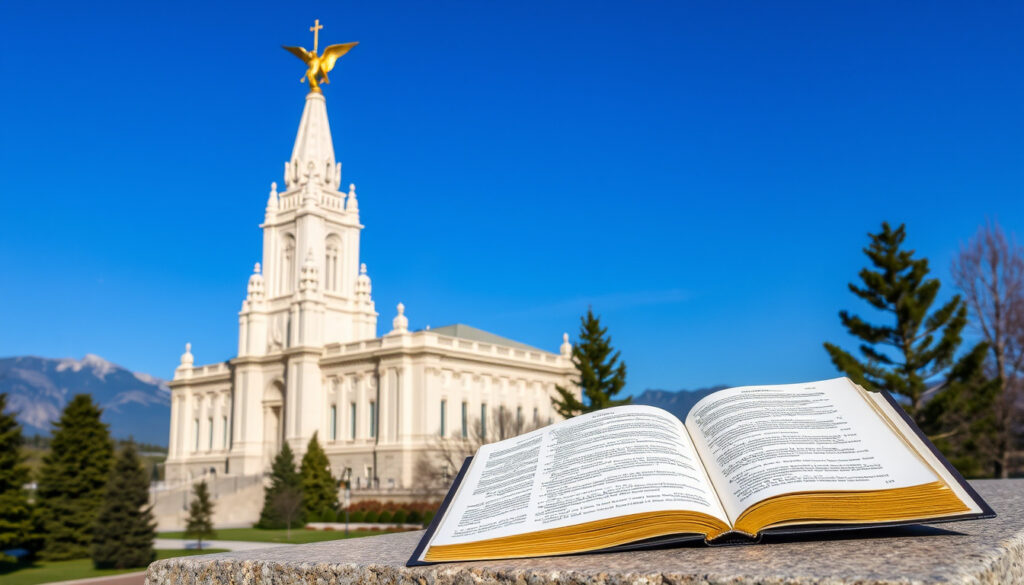
Church of Latter-day Saints: Beliefs, History, Differences
Ask someone to describe the “Mormon Church” and you’ll probably hear about missionaries, Utah, and polygamy — rarely the church’s actual name. That name, The Church of Jesus Christ of Latter-day Saints, has been official since 1838 (BYU Religious Studies Center), with roughly 17 million members worldwide (Wikipedia).
Worldwide membership: ≈17 million (2023) · Headquarters: Salt Lake City, Utah, USA · Founded: 1830 by Joseph Smith · Members in Ireland: 4,923 (2021 estimate) · Temples worldwide: 350+ operating
Quick snapshot
- The official name is The Church of Jesus Christ of Latter-day Saints (BYU Religious Studies Center).
- “Mormon Church” and “LDS Church” are nicknames, not the official title (Common Church Lingo).
- The Church was organized on April 6, 1830, in Fayette, New York (Encyclopaedia Britannica).
- Plural marriage was officially ended in 1890 (BYU Religious Studies Center).
- Ireland’s exact membership total is church-reported and shifts by year (Ireland — Statistics and Church Facts).
- Historic details of early polygamy, including how widely it was practiced, are still debated (Encyclopaedia Britannica).
- How completely the push to drop “Mormon” will change public usage is still unfolding (Common Church Lingo).
- 1820–1844: Joseph Smith’s First Vision, the church’s founding, and his death (Encyclopaedia Britannica).
- 1890: Manifesto ends official polygamy (BYU Religious Studies Center).
- 1978: Priesthood extended to all worthy men (Wikipedia).
- 2000s–present: the church emphasizes its full name (Wikipedia).
- A Dublin Ireland Temple has been announced (LDS Church Temples).
- Six wards currently operate in the Republic of Ireland (Ireland — Statistics and Church Facts).
- President Russell M. Nelson continues to encourage use of the full church name (Wikipedia).
Key facts at a glance
Eight data points, one pattern: a genuinely global church that remains, in Ireland, a deliberately small presence.
| Label | Value |
|---|---|
| Full name | The Church of Jesus Christ of Latter-day Saints (Common Church Lingo) |
| Founded | 1830, by Joseph Smith in Fayette, New York (Encyclopaedia Britannica) |
| Headquarters | Salt Lake City, Utah, USA (Wikipedia) |
| Current president | Russell M. Nelson, since January 2018 (Wikipedia) |
| Members worldwide | ≈17 million (2023) (Wikipedia) |
| Members in Ireland | 4,923 church-reported; six wards (Ireland — Statistics and Church Facts) |
| Sacred texts | Bible, Book of Mormon, Doctrine and Covenants, Pearl of Great Price (Wikipedia) |
| Temples worldwide | 350+ operating; Dublin Ireland Temple announced (LDS Church Temples) |
Is there a difference between Mormons and Latter-day Saints?
No — the two words describe the same people. The Church’s official name is The Church of Jesus Christ of Latter-day Saints; “Mormon” is a nickname that outsiders gave to members because of their belief in the Book of Mormon (Common Church Lingo). “LDS Church” is shorthand for “Latter-day Saint Church” — convenient, but still unofficial.
So a “Mormon,” a “Latter-day Saint,” and a member of the “LDS Church” are the same kind of person in the same organization. What differs is the label a speaker chooses.
If a headline says “Mormon Church” or “LDS Church,” it is reporting on the same denomination as the full name — the label changes, the organization doesn’t (Common Church Lingo).
Why the name matters
- The Church received its official title by revelation on April 26, 1838, and has kept it since (BYU Religious Studies Center).
- Members historically accepted “Mormon” as a common label; the Church now asks people to use the full name (Common Church Lingo).
- “LDS” is an abbreviation that also functions as a nickname; the Church does not treat it as an official title (Common Church Lingo).
The theological reality: no split
- Same leadership, same scripture canon, same doctrine — the labels do not mark separate churches (Wikipedia).
- The Church sees itself as a restored Christian church, not a new religion (BYU Religious Studies Center).
Common misconceptions
- “Mormons aren’t Christians” — false: the Church presents itself as a restored Christian church centered on Jesus Christ (BYU Religious Studies Center).
- “Mormon Church is the official name” — false: the full name is the only official title (Common Church Lingo).
- “The LDS Church and the Community of Christ are the same” — false: Community of Christ is a separate denomination with its own structure and history (Community of Christ).
Do Mormons share wives?
No. Contemporary Latter-day Saints do not practice polygamy, and the Church has not authorized plural marriage since the 19th century. The practice that fuels the myth is historical, not current.
What plural marriage actually was
- Some early LDS members, including top leaders, entered plural marriages in the 1800s (BYU Religious Studies Center).
- The practice was rooted in 19th-century revelations that the Church does not teach as current doctrine (Encyclopaedia Britannica).
- The contemporary Church describes its standard as monogamy (BYU Religious Studies Center).
What changed in 1890
- The 1890 Manifesto officially ended the practice (BYU Religious Studies Center).
- Modern church discipline bars new plural marriages; members who enter them face excommunication (Encyclopaedia Britannica).
Headlines still conflate the LDS Church with independent fundamentalist groups that practice polygamy today. Those groups are not part of the LDS Church, and the Church officially distances itself from them (Encyclopaedia Britannica).
Why the myth persists
- Surveys show the public still connects Mormonism with polygamy: a Pew Research Center survey of American attitudes found polygamy was the most common association with the faith.
- The connection lives on in popular culture and in media shorthand, even though the practice ended more than a century ago (Wikipedia).
The trade-off: the Church’s 19th-century history is public record, but the modern institution has drawn a hard line. Plural marriage is no longer doctrine; it is grounds for church discipline.
How many Mormons live in Ireland?
The Church’s own statistics page reports 4,923 members in the Republic of Ireland and six wards, or local congregations (Ireland — Statistics and Church Facts). Because the Church counts membership through its own records and figures shift from year to year, treat any single total as a church-reported estimate rather than an independent census.
Relative to Ireland’s population, the community is very small — which makes its history surprisingly deep.
The official numbers
- 4,923 members in the Republic (church-reported) (Ireland — Statistics and Church Facts).
- Six wards operate across the country (Ireland — Statistics and Church Facts).
- The Republic of Ireland’s first stake — a regional grouping of congregations — was created in Dublin in 1995 (Dublin, Republic of Ireland).
- Dublin’s first branch dates to 1850 (Dublin, Republic of Ireland).
A small footprint with deep roots
For a church of roughly 5,000 members on the island (Ireland — Statistics and Church Facts), an announced Dublin temple is a heavy investment — a signal that the institution plans to stay, not just visit.
That history runs deeper than most outsiders expect: Irish members have gathered in Dublin since 1850, and the national stake followed 145 years later (Dublin, Republic of Ireland).
Where members worship
- Congregations meet in Dublin, Cork, Limerick, and other urban areas (Ireland — Statistics and Church Facts).
- In the UK, the Church operates wards and branches across the major cities, from London north to Manchester (Wikipedia).
What this means: if you live in Ireland, the LDS Church is likely closer than you think — but with a church-reported figure under 5,000, most people still have never met a member.
What are the beliefs of the Latter-day Saints?
Latter-day Saints describe themselves as Christians who believe the original church was restored through Joseph Smith. The BYU Religious Studies Center summarizes the core as faith in God the Father, Jesus Christ, and the Holy Ghost; the Atonement; baptism by proper authority; continuing revelation through living prophets; and the eternal importance of marriage and family.
Core doctrines
- Belief in God the Father, Jesus Christ, and the Holy Ghost (BYU Religious Studies Center).
- Belief in the Atonement of Jesus Christ as the center of the plan of salvation (BYU Religious Studies Center).
- Continuing revelation through living prophets and apostles (BYU Religious Studies Center).
Jesus Christ and the Book of Mormon
- The Book of Mormon is presented as another testament of Jesus Christ, used alongside the Bible (Wikipedia).
- The Church teaches that the gospel was lost after the apostolic age and restored in the 19th century (BYU Religious Studies Center).
The plan of salvation
- LDS teaching frames existence in three stages: pre-mortal life, mortal life, and the afterlife (Wikipedia).
- Temples are used for sacred ordinances, including baptism for the dead (Wikipedia).
The pattern: the beliefs are Christian in structure but restorationist in logic — everything flows from the claim that the original church was re-established by Joseph Smith in 1830 (Encyclopaedia Britannica).
How to find a Church of Latter-day Saints near me?
The practical route is simple: use the Church’s free meetinghouse locator at churchofjesuschrist.org, which lists addresses and service times. You do not need an invitation or a membership card to attend.
Use the official locator
- Search by town or postal code on the official locator, and the nearest congregation appears with service times.
- Services are open to the public, and visitors are welcome at sacrament meetings (Common Church Lingo).
What a Sunday service looks like
- The main weekly gathering is sacrament meeting, followed by Sunday School and separate priesthood and Relief Society classes (Wikipedia).
- The sacrament service typically runs about an hour, with hymns, prayers, and short talks by members of the congregation (Wikipedia).
Ireland and UK locations
- In Ireland, wards operate in Dublin, Cork, Limerick, and other towns (Ireland — Statistics and Church Facts).
- In the UK, congregations are concentrated in the big cities, with wards and branches across England (Wikipedia).
The practical catch: the official locator lists the Church by its full name, so the full name is the safest search term. Knowing that one phrase is the single most useful step for finding the right congregation.
Mormon vs Latter-day Saints: naming, side by side
Four ways to frame the same organization, one pattern: the labels all describe the same church; what changes is which name the Church asks you to use.
| Aspect | Official name | “Mormon Church” | “LDS Church” |
|---|---|---|---|
| What it refers to | The whole denomination; official title since 1838 (BYU Religious Studies Center) | Nickname for the same denomination (Common Church Lingo) | Abbreviation of “Latter-day Saint,” also unofficial (Common Church Lingo) |
| Who uses it | Church leaders, official materials, formal writing (Wikipedia) | Many members historically; still common in media and casual speech (Encyclopaedia Britannica) | Members and journalists as shorthand (Common Church Lingo) |
| The Church’s stance | Preferred; leadership requested its use (Encyclopaedia Britannica) | Discouraged as a stand-alone name for the Church (Common Church Lingo) | Discouraged as a stand-alone name, though used by members in conversation (Common Church Lingo) |
| Doctrinal difference | None — same doctrine, same leadership, same organization (Wikipedia) | ||
The trade-off: you can keep saying “Mormon Church” and be understood, but the church you’re referring to has made its preference clear. Language is the one thing in this comparison that actually changes over time.
What’s confirmed and what’s still unclear
Confirmed facts:
- The Church’s official name is The Church of Jesus Christ of Latter-day Saints (Common Church Lingo).
- Plural marriage was practiced historically and discontinued in 1890 (BYU Religious Studies Center).
- Worldwide membership exceeds 17 million (Wikipedia).
- The Church teaches that it is a restoration of primitive Christianity (BYU Religious Studies Center).
What’s still unclear:
- Ireland’s exact membership total: the Church reports 4,923 members, but figures have varied across years and are not independently audited (Ireland — Statistics and Church Facts).
- Historical details of early polygamy — including how many marriages were entered by which leaders — remain a subject of debate (Encyclopaedia Britannica).
- How fully the shift away from “Mormon” will reshape everyday language is still unfolding.
- Timing for the announced Dublin temple has not been fixed (LDS Church Temples).
The balance of evidence: the broad facts are solid, but Ireland-specific numbers and the early polygamy record deserve more caution than most headlines give them.
Three voices on naming and polygamy
“The Lord has impressed upon my mind the importance of the name He has given His Church.”
— Russell M. Nelson, President of the Church, October 2018; documented in Wikipedia’s coverage of the name change
Plural marriage was a 19th-century practice, officially ended in 1890; the Church’s standard today is monogamy.
— Paraphrased from the BYU Religious Studies Center, Latter-day Saint Essentials series
The public still associates the faith with polygamy, even though the practice was abandoned more than a century ago.
— Paraphrased from Pew Research Center, “Mormons in America,” 2012
What these voices share: the most important facts about the LDS Church are the ones that contradict the popular image.
The practical takeaway
For an Irish reader, the useful version of this story is simple: the “Mormon Church” in headlines is the same denomination that has met in Dublin since 1850, and it has not practiced polygamy since 1890. The local community is small — under 5,000 church-reported members — but the planned Dublin temple suggests a long-term commitment to the island. For anyone in Ireland or the UK thinking about visiting, the path is clear: look up the nearest congregation through the official locator, attend once with the full name in mind, and judge the church on its current practice rather than its 19th-century history.
churchofjesuschrist.org, local.churchofjesuschrist.org, local.churchofjesuschrist.org, churchofjesuschrist.org, local.churchofjesuschrist.org, local.churchofjesuschrist.org, en.wikipedia.org, churchofjesuschrist.org
Frequently asked questions
What is the Book of Mormon?
The Book of Mormon is a volume of scripture that the Church presents as another testament of Jesus Christ, used alongside the Bible. The Church teaches that Joseph Smith translated it from ancient records and published it in 1830 (Encyclopaedia Britannica).
How is the LDS Church organized?
The Church is led by a president regarded as a prophet, with two counselors and a Quorum of the Twelve Apostles. Locally, members gather in congregations called wards or branches, which are grouped into stakes and districts (Wikipedia).
What is the role of the prophet in the LDS Church?
Latter-day Saints believe the president of the Church is a living prophet who receives continuing revelation, with other volunteer lay leaders serving at every level (BYU Religious Studies Center).
What are the dietary restrictions for Latter-day Saints?
The Church’s health code, called the Word of Wisdom, asks members to avoid alcohol, tobacco, coffee, and tea (Wikipedia).
Does the LDS Church accept tithing?
Yes. Members are asked to donate one-tenth of their income to support Church operations, temples, welfare, and education (Wikipedia).
What is the stance of the LDS Church on same-sex marriage?
The Church teaches that marriage is between one man and one woman, while its leaders have also encouraged love and respect toward people with same-sex attraction (Wikipedia).
How can I attend an LDS Sunday service?
Find the nearest meetinghouse with the Church’s official locator, check the service time, and simply arrive. Services are open to the public; visitors are not asked to participate or identify themselves (Common Church Lingo).
What is the difference between a ward and a branch?
Both are local congregations. A ward is typically larger and has a full set of local leaders; a branch is smaller, often used where membership is sparse. Ireland’s six congregations are currently wards, according to the Church’s statistics (Ireland — Statistics and Church Facts).
Related reading
- Common Church Lingo — official guide to what members of the Church of Jesus Christ of Latter-day Saints call themselves and their meetings.
- Name of the Church — Church history article on how the official name developed.
More related posts
 Glass Bottom Boat Whitianga: Tours to Cathedral Cove
 PAK’nSAVE Palmerston North: Hours, Online Shopping, Specials
 Air NZ Strike Action – Latest Status Cancellations Dates
 House of Chocolate NZ: Auckland Locations, Menu & Products
 Brake Pads Replacement Cost: Ireland Averages & Quotes
 Fiji vs Australia 2025: Match Result and Key Facts
 FC Barcelona vs Inter Milan: Head-to-Head & 2025 Semifinal
 Work to Residence Visa NZ: Salary, Cost, and Requirements