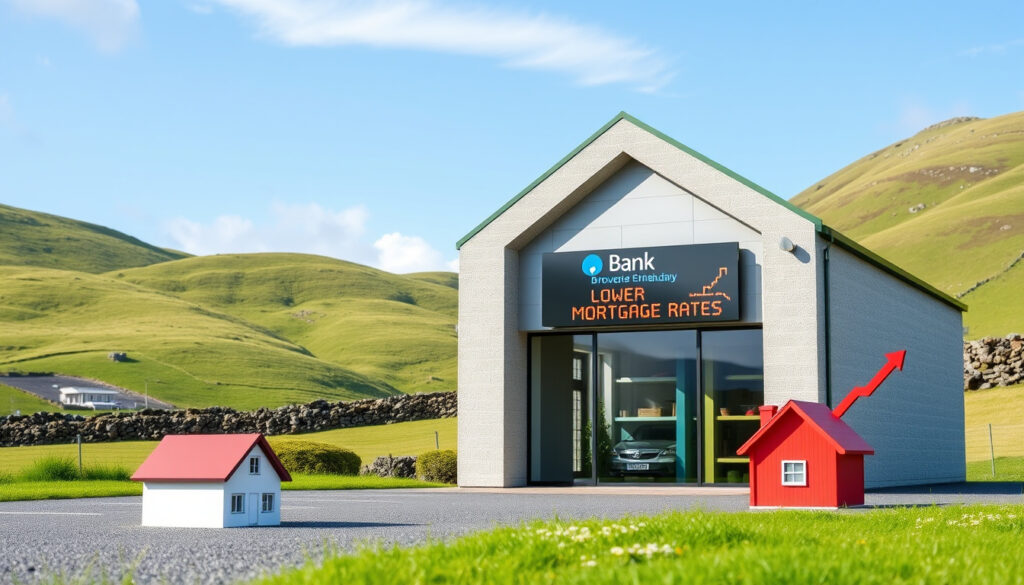
Bank lowers mortgage rates: Irish 2026 guide for borrowers
If you’ve been following Irish mortgage rates this year, you’ve probably noticed the mood shift. In January 2026, Permanent TSB became the first major bank to cut fixed rates, trimming up to 0.45 percentage points.
Current average new mortgage rate (April 2026): 3.50% ·
Median outstanding PDH mortgage rate (March 2026): 3.44% ·
Lowest 90% LTV 4-year fixed (May 2026): 3.1% (Bank of Ireland, BER A3+)
Quick snapshot
- Permanent TSB cut fixed rates by up to 0.45 p.p. in January 2026 (The Irish Times)
- Weighted average new mortgage rate was 3.50% at end-April 2026 (Central Bank of Ireland)
- Bank of Ireland offered a 4-year fixed at 3.1% for 90% LTV with BER A3+ (Money Guide Ireland)
- Whether other banks will follow PTSB with broad cuts in 2026
- How many borrowers actually qualify for the lowest green/BER-linked rates
- Impact of ECB rate decisions on Irish variable rates later this year
- January 2026: PTSB cuts fixed rates by up to 0.45 p.p. (The Irish Times)
- March 2026: Median outstanding mortgage rate falls 31 bps YoY to 3.44% (Central Bank of Ireland)
- Potential rate cuts from AIB, Bank of Ireland, and Avant Money
- ECB policy meeting in June 2026 could influence variable rates
- More borrowers may switch to fixed rates to lock in current lows
The following table compiles the most important mortgage rate data from official sources.
| Label | Value |
|---|---|
| Weighted average new mortgage rate (April 2026) | 3.50% Central Bank of Ireland |
| Median outstanding PDH mortgage rate (March 2026) | 3.44% Central Bank of Ireland |
| Non-bank held mortgages ≤6% (end-March 2026) | 87% Central Bank of Ireland |
| PTSB rate cut, effective Jan 2026 | up to 0.45 p.p. The Irish Times |
| PTSB 7-year fixed, 80-90% LTV (post-cut) | 3.60% The Irish Times |
| PTSB green mortgage rate cut | up to 0.20 p.p. The Irish Times |
| Bank of Ireland 4-year fixed, 90% LTV, BER A3+ | 3.1% Money Guide Ireland |
| Bank of Ireland 4-year fixed, 90% LTV, BER E | 3.3% Money Guide Ireland |
| Avant Money 3-year fixed FTB (March 2026) | 3.40% Irish Property Guide |
| Avant Money variable, 10% deposit | 3.85% Money Guide Ireland |
| Avant Money variable, ≤60% LTV | 3.65% Money Guide Ireland |
Which banks have cut mortgage rates in 2026?
So far, the only major bank to announce a broad rate cut is Permanent TSB. In January 2026, it reduced fixed rates across its three-, four-, five- and seven-year products by up to 0.45 percentage points. The seven-year fixed for borrowers at 80% to 90% loan-to-value dropped to 3.60% (The Irish Times, Ireland’s leading newspaper). Green mortgage rates were lowered by up to 0.20 percentage points at the same time.
PTSB’s move pressures AIB, Bank of Ireland, and Avant Money to follow, but none have committed to broad cuts. The pattern: banks lower rates when they need to attract new business, not because they’re passing on ECB savings.
Other lenders have adjusted selectively. Bank of Ireland, for example, offers a 4-year fixed at 3.1% for 90% LTV borrowers — but only if the property has a BER rating of A3 or better (Money Guide Ireland, consumer finance comparison site). Without that green rating, the same product costs 3.3%. Avant Money’s cheapest 3-year fixed for first-time buyers was 3.40% as of March 2026 (Irish Property Guide, property and mortgage comparison).
The implication: headline cuts are real, but the lowest rates are conditional. Borrowers with poor BER or high LTV pay a premium.
How do current mortgage rates compare across lenders?
Five lenders, one pattern: the cheapest rates come with strings attached.
| Lender | 3-year fixed | 5-year fixed | Notes |
|---|---|---|---|
| Avant Money | 3.40% | 3.50% | Lowest FTB rate per March 2026 guide (Irish Property Guide) |
| Bank of Ireland | 3.45% | 3.50% | Standard FTB; green rates lower (Irish Property Guide) |
| AIB / EBS / Haven | 3.50% | 3.55% | Group rates similar (Irish Property Guide) |
| PTSB | 3.60% | 3.65% | Post-January cut; green rates slightly lower (Irish Property Guide) |
What this means: the gap between the cheapest and most expensive FTB fix is only 0.20 percentage points — but the real difference comes from LTV, BER, and cashback offers. Avant Money’s lack of a cashback option may offset its lower rate for some borrowers.
Pros and cons of switching mortgage lenders in 2026
Upsides
- Lower monthly payments: switching from a 3.8% rate to 3.1% on a €250,000 mortgage saves about €100/month.
- Better terms: lock in a fixed rate before potential ECB cuts reduce variable rates.
- Cashback offers: some lenders (e.g., Bank of Ireland, AIB) offer up to 2% cashback on switching.
Downsides
- Legal and valuation fees: switching can cost €1,500–€2,500 upfront.
- Time and paperwork: the process takes 4–8 weeks on average.
- Rate lock risk: if you fix and rates drop further, you may miss out on lower deals.
Switchers save every month but pay upfront. The break-even point is typically 12–18 months. For a borrower planning to stay in the home for 5+ years, the math almost always favours switching.
For most borrowers with a long-term horizon, the upfront cost is worth the monthly savings.
Timeline: key events in Irish mortgage rates, 2026
- January 2026: Permanent TSB cuts fixed rates by up to 0.45 p.p. (The Irish Times)
- March 2026: Central Bank reports median outstanding rate at 3.44%, down 31 bps YoY (Central Bank of Ireland)
- April 2026: Weighted average new mortgage rate hits 3.50% (Central Bank of Ireland)
- May 2026: Bank of Ireland offers 3.1% 4-year fixed for green-rated homes (Money Guide Ireland)
- June 2026 (expected): ECB monetary policy meeting may influence Irish variable rates
The pattern: rates are trending down, but the pace is slow. The median mortgage rate has fallen 31 basis points year-on-year, which is meaningful but not dramatic.
What’s confirmed and what’s still unclear
Confirmed facts
- PTSB cut fixed rates in January 2026 (The Irish Times)
- Weighted average new mortgage rate was 3.50% in April 2026 (Central Bank of Ireland)
- 87% of non-bank held mortgages are at ≤6% (Central Bank of Ireland)
- Bank of Ireland offers 3.1% 4-year fixed with BER A3+ condition (Money Guide Ireland)
What’s unclear
- Whether AIB or Bank of Ireland will announce broad cuts similar to PTSB
- How many borrowers actually meet the BER A3+ threshold for the lowest rates
- Impact of future ECB decisions on Irish variable rates
The confirmed facts outnumber the uncertainties, but the biggest unknown is how quickly other lenders will respond.
Quotes from the market
“The weighted average interest rate on new Irish mortgage agreements at end-April 2026 was 3.50% and was down 2 basis points from March.”
Central Bank of Ireland (regulator) – Retail Interest Rates Report
“Permanent TSB reduced rates across its three-, four-, five- and seven-year fixed-rate products in January 2026, with cuts of up to 0.45 percentage points.”
Permanent TSB spokesperson, reported by The Irish Times
“The median interest rate on outstanding PDH mortgages held by banks was 3.44% in March 2026, down 31 basis points year on year.”
Central Bank of Ireland (regulator) – Mortgage Interest Rate Distributions
These three statements capture the core data: the market is moving downward, but slowly. The regulator’s numbers are the most authoritative; the bank’s own announcement confirms the cut.
Summary: what this means for Irish borrowers
If you’re a first-time buyer or a switcher, the window is open but narrowing. The cheapest rates require a green BER and a low LTV — conditions many borrowers don’t meet. For the typical buyer, the best available rate is around 3.4–3.5%, and the decision to fix or stay variable depends on your tolerance for ECB uncertainty. For an Irish borrower with a 90% LTV and a BER C-rated home, the clear choice is to compare the 3.3% rate from Bank of Ireland against the 3.6% from PTSB — and act before the next ECB meeting.
propertydata.ie, getsortd.ie, educmortgages.ie, dublinjournal.com, irishpropertyguide.ie, parkfinancial.ie
Borrowers can consult PTSB Mortgage Rate Cuts 2026 for a detailed look at the bank’s recent adjustments.
Frequently asked questions
Are mortgage rates in Ireland falling?
Yes, but slowly. The weighted average new mortgage rate fell to 3.50% in April 2026, and the median outstanding rate dropped 31 basis points year-on-year to 3.44% in March 2026 (Central Bank of Ireland).
Which bank has the lowest mortgage rate in Ireland right now?
As of May 2026, Bank of Ireland offers a 4-year fixed at 3.1% for 90% LTV with a BER A3+ rating. Avant Money’s cheapest 3-year fixed for first-time buyers is 3.40% (Money Guide Ireland).
Did Permanent TSB cut mortgage rates in 2026?
Yes, in January 2026, PTSB cut fixed rates by up to 0.45 percentage points across its 3- to 7-year fixed products (The Irish Times).
Is it a good time to switch mortgage lenders?
For most borrowers, yes. The gap between the best and worst FTB rates is small, but switching from a 3.8% rate to a 3.1% could save around €100 per month on a €250,000 mortgage. Factor in upfront costs of €1,500–€2,500.
What is the current average mortgage rate in Ireland?
The Central Bank of Ireland reported a weighted average of 3.50% on new mortgage agreements in April 2026 (Central Bank of Ireland).
Do green mortgage rates save money?
Yes. Bank of Ireland’s 4-year fixed drops from 3.3% to 3.1% if your home has a BER A3 or better. PTSB also cut green rates by up to 0.20 p.p. in January 2026 (The Irish Times).
Will AIB cut mortgage rates soon?
As of May 2026, AIB has not announced a broad cut. Its FTB rates remain at 3.50% for 3-year fixed and 3.55% for 5-year fixed (Irish Property Guide).
What happens to my mortgage if ECB cuts rates?
If you have a variable-rate mortgage, your payments may decrease. If you’re on a fixed rate, you won’t benefit until the fix ends. The next ECB meeting is in June 2026.
Related reading
More related posts
 Let It Be Lyrics – Full Text, Meaning and Chords
 Wellington to Queenstown Flights: Jetstar Reliability & Fares
 Spark Sport Pay Per View: Shutdown, Costs & Sky Alternatives
 Cast of The Ex-Wife: Full Cast List and Season 2 Recast
 Sutton Foster Movies and TV Shows: Complete Filmography
 The Doctors Ti Rakau: GP Services, Fees & Walk-ins in Burswood
 iOS 26 Public Beta – Install Guide, Features & Risks
 Waiotapu Thermal Wonderland Walk Time & Ticket Guide