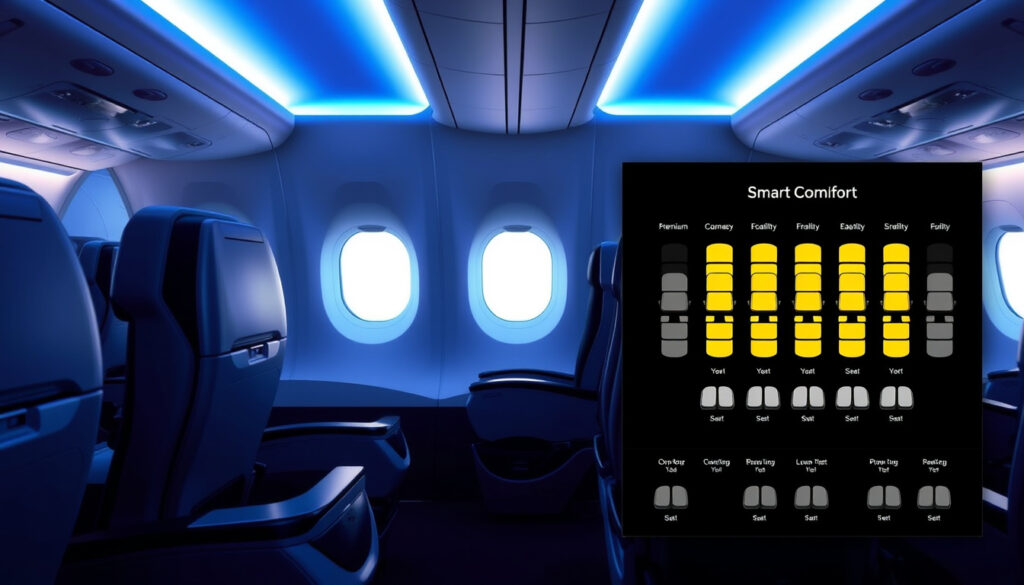
Air NZ 787 Seat Map: Best Economy & Business Seats
Few decisions set the tone for a long-haul flight like your seat, and Air New Zealand’s Boeing 787-9 gives you more to weigh up than most wide-bodies — lie-flat Business Premier, a dedicated Premium Economy cabin, and the Skycouch that turns three economy seats into a sofa. Air New Zealand publishes five different 787-9 seat maps (Air New Zealand, official seat maps), so here’s what to pay for, what to skip, and how to pull up the exact layout for your flight before you buy.
Primary aircraft: Boeing 787-9 ·
Seat classes: 3 (Business, Premium Economy, Economy) ·
Total seats: 311 ·
Business seats: 27 ·
Premium Economy seats: 21 ·
Economy seats: 263
Quick snapshot
- Three classes: Business Premier, Premium Economy, and Economy (Air New Zealand, 787-9 V3 seat map)
- Business Premier is fully lie-flat with direct aisle access (Air New Zealand, 787-9 V3 seat map)
- The official seat maps cover the whole wide-body fleet (Air New Zealand, official seat maps)
- Which of the five variants your flight gets depends on the aircraft assigned to the route (Air New Zealand, official seat maps)
- Row ranges for the same cabin shift between variants, so generic advice often misses (Air New Zealand, official seat maps)
- Skycouch and Stretch pricing isn’t shown on the seat map itself (Air New Zealand, seat selection policy)
- Five published 787-9 seat-map versions: the original, V2, V3, V4, and V5 (Air New Zealand, official seat maps)
- Business Premier Luxe rows appear only from V3 onward (Air New Zealand, official seat maps)
- Economy Stretch becomes a named product on V3, V4, and V5 (Air New Zealand, official seat maps)
- Seat selection can be purchased at booking or through Manage Booking (Air New Zealand, seat selection policy)
- International flights: paid seat selection stays open until three hours before departure (Air New Zealand, seat selection policy)
- Skycouch blocks sell out early on popular routes, so book them as soon as your flight is confirmed (Air New Zealand, seat selection policy)
The seat-count picture for Air New Zealand’s 787-9 comes from the airline’s published seat maps and seat-selection pages (Air New Zealand, 787-9 V3 seat map; Air New Zealand, seat selection policy).
| Spec | Value |
|---|---|
| Total seats | 311 |
| Cabin classes | 3 (Business, Premium Economy, Economy) |
| Business seats | 27 |
| Premium Economy seats | 21 |
| Economy seats | 263 |
| Premium Economy pitch | 41 inches |
| Economy pitch | 31-32 inches |
| Economy seat width | 17 inches |
What is the seat map for Air New Zealand 787?
Seat map overview
- Air New Zealand’s official seat-maps page lets you choose an aircraft type and inspect each seat’s features, pitch, and position (Air New Zealand, official seat maps).
- The Boeing 787-9 is the wide-body at the center of the airline’s long-haul fleet, and its seat map comes in five published versions (Air New Zealand, official seat maps).
- All five versions share the same three-class structure: Business Premier, Premium Economy, and Economy (Air New Zealand, 787-9 V3 seat map).
When you open the 787-9 seat map on Air New Zealand’s site, you land on a cabin diagram with color-coded rows. Each row shows whether it’s Business Premier Luxe, Business Premier, Premium Economy, Economy, Economy Stretch, or Economy Skycouch, and the map notes seats with restrictions such as limited recline (Air New Zealand, official seat maps).
The tricky detail is that the map you see depends on which variant your aircraft uses. The original 787-9 layout, plus V2, V3, V4, and V5, all exist in Air New Zealand’s own documentation, so the phrase “Air NZ 787 seat map” actually points to five different diagrams (Air New Zealand, official seat maps; Wikipedia, Boeing 787 Dreamliner reference).
Cabin configuration
- The standard 787-9 layout seats 311 passengers across the three cabins — 27 in Business, 21 in Premium Economy, and 263 in Economy (Air New Zealand, 787-9 V3 seat map).
- Business Premier occupies the forward cabin, Premium Economy sits behind it, and the economy cabin runs to the tail (Air New Zealand, 787-9 V3 seat map).
- On the newer V4 layout, Premium Economy begins at row 22; on the original map it starts at row 23 — a small but real difference between variants (Air New Zealand, official seat maps).
Five published variants, one pattern: a cabin that keeps shifting forward and shrinking in the back. The row ranges below come straight from Air New Zealand’s published seat maps (Air New Zealand, official seat maps).
| Seat-map version | Business rows | Premium Economy rows | Economy rows | Stretch / Skycouch blocks |
|---|---|---|---|---|
| Original 787-9 map | 1-6 | 23-25 | 34-65 | Skycouch: 36-43 ABC, 36-41 HJK |
| V2 | 1-9 | 23-27 | 35-61 | Skycouch: 37-44 ABC, 36-40 HJK |
| V3 | Luxe 1, 9; Premier 2-7, 10-12 | 23-30 | 35-49 | Stretch: 36 ABC, 36-40 HJK; Skycouch: 37-39 ABC, 41-46 HJK |
| V4 | Luxe 1; Premier 2-7 | 22-27 | 34-60 | Stretch: 34-36, 37 ABC; Skycouch: 38-42 ABC, 37-40 HJK, 47-48 ABC/HJK |
| V5 | Luxe 1, 9; Premier 2-7, 10-12 | 23-30 | 35-49 | Stretch: 36 ABC, 36-40 HJK; Skycouch: 37-39 ABC, 41-46 HJK |
The pattern is clear: newer variants push the economy cabin forward and shorten the tail section, and they introduce named products like Economy Stretch that the original map didn’t list (Air New Zealand, 787-9 V3 seat map).
Seat numbers
- Air New Zealand uses standard row numbers across the 787-9, with Business at the front and economy rows continuing to the rear (Air New Zealand, official seat maps).
- The letters on the map read A-C, D-F, H-K from left to right in economy, giving the three 3-3-3 blocks their ABC / DEF / HJK labels (Air New Zealand, official seat maps).
- Skycouch blocks are sold as a group of three seats rather than individually, so the booked “seat number” is the block (Air New Zealand, seat selection policy).
That omitted “I” in the lettering is the clue many passengers miss: if you see HJK on the right side of the diagram, you’re looking at an economy cabin laid out nine across. The window seats are A and K, and the middle block is DEF (Air New Zealand, official seat maps).
Why this matters: the same row numbers appear on different variants, but the products inside those rows differ. Row 36 is a standard economy row on the original map, an Economy Stretch row on V3 and V5, and a Stretch row on V4 too — same number, different legroom (Air New Zealand, 787-9 V3 seat map).
| Cabin | Seat count | Pitch | Key features |
|---|---|---|---|
| Business Premier Luxe | Included in 27 Business seats | Lie-flat bed | Rows 1 and 9 on V3/V5 |
| Business Premier | 27 | Lie-flat bed | Direct aisle access, 1-2-1 layout |
| Premium Economy | 21 | 41 inches | Dedicated cabin, rows 22-30 depending on variant |
| Economy | 263 | 31-32 inches | 3-3-3 layout, 17-inch width |
| Economy Stretch | Part of Economy count | Extra legroom | Rows 34-37 depending on variant |
| Economy Skycouch | Part of Economy count | Extends to flat surface | Three-seat blocks, rows 37-48 depending on variant |
Which seats are best in economy on Air New Zealand 787-9?
Best economy seats
- Economy Stretch rows — for example row 36 ABC and rows 36-40 HJK on V3 and V5 — give you the extra-legroom product without leaving economy (Air New Zealand, 787-9 V3 seat map).
- Economy Skycouch blocks — rows 37-39 ABC and 41-46 HJK on V3 and V5 — convert three seats into a flat surface, which is the best value for couples or parents (Air New Zealand, official seat maps).
- The front of the economy cabin starts at row 34 on the original map and row 35 on V3/V5, so the best-pitch economy seats cluster right behind Premium Economy (Air New Zealand, 787-9 V3 seat map).
The math favors the front of the economy cabin: 31 to 32 inches of pitch is the baseline everywhere, but the Stretch rows at the front buy you extra legroom for a fee (Air New Zealand, 787-9 V3 seat map).
Seats to avoid
- Seats marked with recline restrictions — usually the rows directly before an exit row and the last row of a block — are flagged on Air New Zealand’s map (Air New Zealand, official seat maps).
- The rearmost economy rows sit closest to the galley and lavatories, and Air New Zealand marks several rear rows for restricted recline (Air New Zealand, 787-9 V3 seat map).
- Middle seats in the 3-3-3 layout put you between two neighbors with a 17-inch seat on both sides — the narrowest width on the aircraft (Air New Zealand, 787-9 V3 seat map).
If you’re tall, an aisle seat in a Stretch row is the safest call; if you’re flying with a partner, the Skycouch blocks beat two single economy seats on any long sector (Air New Zealand, seat selection policy).
Economy seat pitch and width
- Economy pitch: 31 to 32 inches on the current V3 configuration (Air New Zealand, 787-9 V3 seat map).
- Economy seat width: 17 inches in the nine-abreast layout (Air New Zealand, 787-9 V3 seat map).
- Premium Economy pitch: 41 inches, which is why the premium cabin is worth a look for longer routes (Air New Zealand, 787-9 V3 seat map).
A 17-inch seat width on a 787-9 is a direct consequence of the 3-3-3 layout. Air New Zealand chose nine-abreast economy for this aircraft, so the trade-off for that extra revenue seat is less shoulder room than a wider-layout competitor would give you.
Economy on Air New Zealand’s 787-9 is a nine-across cabin with a standard 31-32 inch pitch. The seats you can actually influence are the Stretch rows and the Skycouch blocks — everything else is a lottery of who sits next to you (Air New Zealand, 787-9 V3 seat map).
The trade-off: the extra-legroom rows sit at the front of economy, but the cheapest fares usually don’t include them, so the real decision is whether the fee is worth a better seat on a 10-hour sector. For most tall travelers, it is (Air New Zealand, seat selection policy).
What is the business class layout on Air New Zealand 787-9?
Business class layout
- Business Premier uses a 1-2-1 configuration, so every seat has direct aisle access (Air New Zealand, 787-9 V3 seat map).
- On V3 and V5, Business Premier Luxe takes rows 1 and 9, while Business Premier fills rows 2-7 and 10-12 (Air New Zealand, 787-9 V3 seat map).
- Every Business Premier seat is a fully lie-flat bed (Air New Zealand, 787-9 V3 seat map).
In a 1-2-1 layout, the cabin reads window, aisle, window, with a pair of center seats in the middle. The center pairs are the ones to remember if you’re traveling with someone: you get direct aisle access plus a companion on the other side of a small divider (Air New Zealand, 787-9 V3 seat map).
Best business seats
- The Luxe rows (1 and 9 on V3/V5) are the clear standouts — fewer seats in the cabin means more privacy and less traffic (Air New Zealand, official seat maps).
- Center pairs in rows 2-7 are the best business choice for couples (Air New Zealand, 787-9 V3 seat map).
- Rows 7 and 12 sit next to the gaps where the cabin transitions — row 7 backs onto the Luxe row 9 on V3, and row 12 is the last business row before Premium Economy — so you may see more crew movement there (Air New Zealand, official seat maps).
There’s no bad seat in a fully lie-flat 1-2-1 cabin, but there are better seats. If privacy is the priority, the Luxe rows on V3 and V5 are the reason to check which variant is on your route before paying for an upgrade (Air New Zealand, official seat maps).
Business class seat features
- Fully lie-flat bed, direct aisle access, and a larger personal area are the standard features in Business Premier (Air New Zealand, 787-9 V3 seat map).
- Business Premier Luxe is a distinct seat type on V3 and V5, positioned at rows 1 and 9 (Air New Zealand, 787-9 V3 seat map).
- The seat map identifies seat type, pitch, and position so you can compare Luxe, Premier, and the 41-inch Premium Economy cabin before you pay (Air New Zealand, official seat maps).
Business Premier on the 787-9 is essentially a flat bed with aisle access from every seat. The Luxe rows are the refinement on newer variants, and they’re worth hunting for on longer sectors (Air New Zealand, 787-9 V3 seat map).
Business Premier Luxe only exists on the newer V3 and V5 variants. An upgrade to “business” isn’t always the same product — check the variant on your booking before you spend the miles (Air New Zealand, official seat maps).
The implication: the gap between Business Premier and Premium Economy is large — 41-inch pitch versus a lie-flat bed — so the upgrade is real. The catch is confirming your flight actually has the Luxe rows before you pay a premium for them (Air New Zealand, 787-9 V3 seat map).
How does Air New Zealand 787-9 seat map compare to American Airlines’ 787-9?
Comparison with American Airlines 787-9
- Both airlines fly the 787-9, but Air New Zealand’s published seat maps for the type run to five variants, while American’s 787-9 fleet is configured around its own three-class layout (Air New Zealand, official seat maps; Wikipedia, American Airlines fleet reference).
- American’s 787-9 cabins use a different class mix: Flagship Business, Premium Economy, and Main Cabin, with Main Cabin Extra as the paid extra-legroom tier (Wikipedia, American Airlines fleet reference).
- Air New Zealand’s equivalent extra-legroom options are Economy Stretch and the Skycouch — a block-of-three product American doesn’t offer on the 787-9 (Air New Zealand, official seat maps).
Three columns, one pattern: each airline trades the same platform differently — Air New Zealand adds flexible economy space; American runs a denser, more conventional layout. The table uses Air New Zealand’s published seat maps for the Air NZ column and American’s fleet documentation for the American column (Air New Zealand, 787-9 V3 seat map; Wikipedia, American Airlines fleet reference).
| Feature | Air New Zealand 787-9 | American Airlines 787-9 |
|---|---|---|
| Cabin classes | 3 — Business Premier, Premium Economy, Economy (Air New Zealand, 787-9 V3 seat map) | 3 — Flagship Business, Premium Economy, Main Cabin (Wikipedia, American Airlines fleet reference) |
| Business seat | Fully lie-flat with direct aisle access (Air New Zealand, 787-9 V3 seat map) | Lie-flat Flagship Business seat (Wikipedia, American Airlines fleet reference) |
| Economy pitch | 31-32 inches (Air New Zealand, 787-9 V3 seat map) | Varies by subfleet (Wikipedia, American Airlines fleet reference) |
| Extra-legroom economy | Economy Stretch rows and Skycouch blocks (Air New Zealand, official seat maps) | Main Cabin Extra (Wikipedia, American Airlines fleet reference) |
| Seat map source | Official interactive maps for 5 variants (Air New Zealand, official seat maps) | Widely documented fleet configurations (Wikipedia, American Airlines fleet reference) |
Similarities and differences
- Both airlines run a three-class 787-9, so the cabin-count math is similar; the difference is in the products inside each class (Air New Zealand, 787-9 V3 seat map; Wikipedia, American Airlines fleet reference).
- The biggest practical difference sits in economy: Air New Zealand can sell you a flat-ish Skycouch block, which American simply doesn’t have on this aircraft (Air New Zealand, official seat maps; Wikipedia, American Airlines fleet reference).
For most passengers, the comparison comes down to one question: do you want flexibility in economy (Skycouch, Stretch) or a more conventional three-class layout with the same lie-flat business bed? Air New Zealand is the only one of the two selling the Skycouch (Air New Zealand, official seat maps).
Seat-map screenshots from forums mix up Air New Zealand’s variants and American’s entirely different 787-9 layout. The official Air New Zealand seat maps are the only source that distinguishes the five versions (Air New Zealand, official seat maps).
The trade-off: Air New Zealand’s 787-9 is optimized for a flexible three-class long-haul layout with unique economy options, while American’s 787-9 runs a denser standard layout. The better choice depends on whether you value the Skycouch’s extra space or simply want the most conventional wide-body seat (Air New Zealand, official seat maps; Wikipedia, American Airlines fleet reference).
Upsides
- Lie-flat Business Premier with direct aisle access on every row (Air New Zealand, 787-9 V3 seat map).
- Dedicated Premium Economy cabin with 41-inch pitch (Air New Zealand, 787-9 V3 seat map).
- Skycouch gives economy passengers a genuine stretch-out option (Air New Zealand, official seat maps).
Downsides
- Economy is nine-abreast, so 17-inch seat width is tight for long-haul (Air New Zealand, 787-9 V3 seat map).
- Five published variants means your flight’s exact seat map can change until the aircraft is assigned (Air New Zealand, official seat maps).
- Economy Stretch and Skycouch cost extra on top of the fare (Air New Zealand, seat selection policy).
How can I choose the best seat on Air New Zealand 787-9?
Steps to view the seat map
- Open Air New Zealand’s official seat-maps page (Air New Zealand, official seat maps).
- Select the Boeing 787-9 to load the interactive diagram.
- Check which variant applies to your flight — the seat-map page lists the original, V2, V3, V4, and V5 layouts.
- Compare the row ranges for your cabin against the variant table above.
- Use Manage Booking to select the seat before you pay.
The whole process takes about two minutes, and it’s the only way to be sure you’re not relying on a seat map screenshot from an older aircraft (Air New Zealand, official seat maps).
Choosing seats at booking time
- Seat selection can be purchased at booking or through Manage Booking afterward (Air New Zealand, seat selection policy).
- For international flights, paid seat selection stays available until three hours before departure; for domestic flights, until 30 minutes before (Air New Zealand, seat selection policy).
- Stretch and Skycouch seats are only released in specific rows, so the earlier you book, the better the choice (Air New Zealand, official seat maps).
If your fare includes seat selection, lock it in early. If it doesn’t, decide what the Stretch fee is worth against the risk of getting a middle seat at check-in (Air New Zealand, seat selection policy).
The variant attached to your flight can change when the airline swaps aircraft. A seat you picked on a V3 layout might be a different product if your flight moves to an original-configuration 787-9, so re-check the map a few days before departure (Air New Zealand, official seat maps).
Using seat map tools
- The official Air New Zealand map is the only source covering all five 787-9 variants (Air New Zealand, official seat maps).
- Third-party seat-map sites often show only one version of the 787-9 and can lag behind Air New Zealand’s newest layouts (SeatGuru, third-party seat map directory; Air New Zealand, official seat maps).
- Cross-check any third-party recommendation against the official map before paying for a specific seat (Air New Zealand, official seat maps).
A quick sanity check: if a third-party map doesn’t mention Economy Stretch or Business Premier Luxe, it’s showing an older variant (Air New Zealand, 787-9 V3 seat map; Air New Zealand, official seat maps).
The catch: the official map is authoritative, but only if you check the right variant before you pay. The layout you saw in a forum post from last year may not match the aircraft at your gate (Air New Zealand, official seat maps).
Confirmed facts
- Air New Zealand operates Boeing 787-9 aircraft with a three-class layout (Air New Zealand, official seat maps).
- Business Premier seats are fully lie-flat with direct aisle access (Air New Zealand, 787-9 V3 seat map).
- Premium Economy pitch is 41 inches; economy pitch runs 31 to 32 inches (Air New Zealand, 787-9 V3 seat map).
- Air New Zealand publishes official interactive seat maps for the 787-9 across five published variants (Air New Zealand, official seat maps).
What’s unclear
- Which variant you fly depends on the aircraft assigned to your route, and that can change closer to departure (Air New Zealand, official seat maps).
- Exact seat totals shift slightly between the original layout and the newer variants (Air New Zealand, official seat maps).
- Air New Zealand doesn’t publish a single official comparison between its 787-9 and American Airlines’ 787-9 (Air New Zealand, official seat maps).
- Skycouch and Stretch pricing changes by route and season (Air New Zealand, seat selection policy).
- Premium Economy row ranges differ between variants — row 22 on V4, row 23 on V3 and V5 — so seat-specific advice online is often out of date (Air New Zealand, official seat maps).
Here’s what Air New Zealand and Boeing say in their own published materials.
“Business Premier Luxe and Business Premier are fully lie-flat bed products.”
“The seat-maps page lets passengers choose an aircraft type and inspect individual seat features, pitch, and position.”
“Seat selection can be purchased at booking or up until three hours before departure for international flights.”
“The 787-9 is positioned between the 787-8 and 787-10 in the Dreamliner family, built for long-haul routes.”
The seat you pick on Air New Zealand’s 787-9 can be the difference between landing refreshed and landing stiff, and the five published variants mean last year’s seat map may no longer match the aircraft you board. The official seat-maps page tracks every change, so make it the final stop before you confirm any seat (Air New Zealand, official seat maps). For long-haul travelers on this aircraft, the choice is clear: verify the variant on your booking and select from the official map, or hand your comfort to whatever seat is left at check-in.
Related reading: Air New Zealand seat maps – official overview · Boeing 787-9 main seat map
airnewzealand.com, airnewzealand.com, airnewzealand.com, airnewzealand.com, airnewzealand.com, airnewzealand.com, airnewzealand.com, airnewzealand.com
Frequently asked questions
Can I pay for extra legroom on Air NZ 787-9?
Yes. Economy Stretch rows are the paid extra-legroom product in the economy cabin, and Economy Skycouch blocks give you a different kind of space that converts three seats into a flat surface. Air New Zealand’s seat maps mark the exact rows for each variant (Air New Zealand, 787-9 V3 seat map).
What is the best seat for a couple on Air NZ 787-9?
In economy, the Skycouch blocks are the standout choice because a row of three converts into a couch-like space for two people. In Business Premier, the center pairs in the 1-2-1 layout sit side by side (Air New Zealand, official seat maps).
Does Air NZ 787-9 have Wi-Fi?
Connectivity varies by route and aircraft on the 787-9, so check your booking details before you rely on it. The official seat-maps page shows the features for each aircraft type (Air New Zealand, official seat maps).
Are there any seats without a window on Air NZ 787-9?
Some rows align with fuselage sections where window positions don’t match the seat position, usually near exit doors and the rearmost rows. Air New Zealand’s official map marks individual seat features, so check the window position for your specific row before choosing (Air New Zealand, official seat maps).
How early can I select a seat on Air NZ?
Seat selection is available at booking or through Manage Booking. For international flights, paid selection stays open until three hours before departure; for domestic flights, until 30 minutes before (Air New Zealand, seat selection policy).
More related posts
 3 Tablespoons Butter to Grams – Exact Conversion and Chart
 Call of Duty Warzone – Free Download, Season 03 and Beginner Guide
 Auckland to Brisbane Flights – Cheap Deals, Direct Schedules
 Dragon Boat Restaurant Liquidation – Auckland Closure Explained
 Duck Island Ice Cream: Where to Buy, Flavors & More
 Current Home Loan Rates Ireland: Compare Fixed & Variable