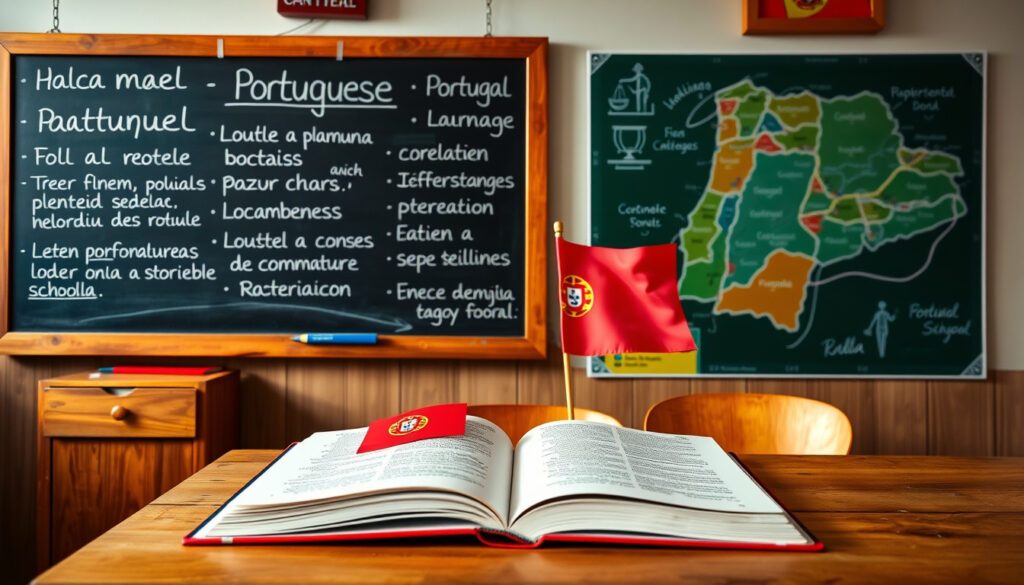
Portuguese Classes Near Me: Find Local Lessons & Learn Fast
You’ve set your sights on learning Portuguese, and you’re in Ireland, maybe to connect with the growing Brazilian community, prepare for a trip to Portugal, or try a new language. The good news is that Dublin and other cities have solid options for adult beginners, from university evening programmes to online schools that specialise in European Portuguese.
CEFR levels: A1 (Beginner) to C2 (Mastery) (Trinity College Dublin) ·
Common class length in Dublin: 10 weeks, 2 hours per week ·
Average cost of a 10-week beginner course: €200–€300 for group classes (University College Cork)
Quick snapshot
- Typically 10-week courses starting with A1 level (Trinity College Dublin)
- Focus on basic conversation and cultural context (Trinity College Dublin) ((Trinity College Dublin))
- Available at TCD, Atlas Language School, and private tutors (Atlas Language School)
- Play-based learning for children aged 5-12 (Portuguese Language Centre) ((Courses.ie))
- Small group sizes to encourage participation (Portuguese Language Centre) ((Courses.ie))
- Weekend and after-school options offered by Portuguese Language Centre and some local schools (Courses.ie)
- Online classes offer flexibility and often lower cost (Portuguese Language Centre)
- In-person classes provide real-time interaction and feedback (Trinity College Dublin)
- Both options available through providers in Ireland
- Government-funded online courses (e.g., RTP Ensina, Instituto Camões)
- Language exchange meetups in Dublin and Cork
- Mobile apps: Duolingo, Memrise, Anki for vocabulary
Four main class types, one pattern: most adult beginners start with a 10-week group course, then decide whether to stay in person or switch to online based on schedule and budget.
| Label | Value |
|---|---|
| Official language in | 9 countries (Portugal, Brazil, Angola, Mozambique, etc.) (Courses.ie) |
| Portuguese speakers worldwide | Approximately 260 million |
| Number of Portuguese learners in Ireland (estimated) | Growing due to increased Brazilian community and EU relations |
| Average cost of a 10-week beginner course in Dublin | €200–€300 for group classes; €15–€40 per hour for private tutoring (University College Cork) (Sandford Language Institute) |
How long does it normally take to learn Portuguese?
Learning Portuguese is a marathon, not a sprint, but the timeline is well documented. According to the Foreign Service Institute (U.S. government language training body), Portuguese is a Category I language for English speakers, requiring approximately 600–750 class hours to reach professional working proficiency. That translates roughly to 6–12 months of intensive study or 1–2 years of regular evening classes.
FSI classification and hour estimates
- Category I languages (like Portuguese, Spanish, French) need about 600–750 hours of study (FSI)
- This assumes dedicated class time plus self-study
- Typical 10-week evening course (2 hours/week) = 20 hours; you’d need about 30–38 such courses to hit 600 hours
Factors that affect learning speed
Individual variation is large. Motivation, prior language experience, and study consistency matter more than the specific school. University College Cork’s evening programme (UCC) takes students from A1.1 to A2.1 over several terms, but learners who practise daily outside class often progress faster.
A beginner who attends a 10-week group course but never speaks outside class will likely stay at A1. One who adds podcasts, language exchanges, and daily app practice can reach A2 in the same period.
The implication: no matter which Irish provider you choose, the real clock starts with your daily habits, not the classroom schedule.
Is Portuguese an easy language to learn?
Portuguese shares a lot of DNA with Spanish, French, and Italian – all Romance languages. That means English speakers who already know one of those will have a head start. But there are genuine challenges: nasal vowels, new consonant sounds, and a verb system that takes time to internalise.
Similarities with other Romance languages
- Lexical similarity with Spanish is about 89% (Portuguese Language Centre)
- Basic sentence structure (Subject-Verb-Object) matches English
- Many cognates: “universidade”, “restaurante”, “música”
Pronunciation and grammar challenges
European Portuguese especially has reduced vowels and a “closed” sound that can be tricky for English speakers. Verb conjugations (six forms per tense, multiple tenses) require drilling. However, the difficulty is manageable with consistent practice. As the Sandford Language Institute (Dublin language school) notes, many adult beginners reach basic conversational ability within one term.
European Portuguese pronunciation is often rated harder than Brazilian Portuguese. If your goal is to speak in Portugal or with European Portuguese speakers, prepare to focus on listening ear training from week one.
The pattern: Portuguese is not “easy” in the sense of zero effort, but its closeness to English and other Romance languages makes it among the quicker languages for an English speaker to learn.
Where to learn European Portuguese for free?
Free resources can supplement formal classes or even serve as a starting point before you commit to a paid course. Ireland’s cultural institutes and online portals offer solid European Portuguese content.
Online platforms offering free European Portuguese content
- Instituto Camões (Portuguese government language institute) provides free online courses and learning materials
- RTP Ensina (Portugal’s public broadcaster) has free video lessons and cultural clips
- YouTube channels like “Portuguese With Carla” or “Practice Portuguese” offer structured playlists
- Mobile apps: Duolingo and Memrise include European Portuguese courses
Community resources and language exchanges in Ireland
Local libraries in Dublin and Cork occasionally host conversation groups. Meetup.com lists Portuguese language exchanges in Dublin city centre – usually free or donation-based. These are especially useful for practising the responses you learn in class.
A learner using free resources alone can reach A2 with consistent effort, but fluency (B2+) almost always requires formal instruction or immersion. The Portuguese Language Centre in Waterford (Courses.ie) offers structured online classes that bridge the gap.
The trade-off: free resources lack feedback and progression tracking. Use them to build vocabulary and listening skills, then join a class for interaction.
What are 5 greetings in Portuguese?
Greetings are the first thing you learn in any beginner course. European Portuguese uses time-of-day distinctions and a few common phrases that differ from Brazilian usage. Here are the five essential ones you’ll hear in Dublin classrooms.
Olá, Bom dia, Boa tarde, Boa noite
- Olá – “Hello” (informal, any time)
- Bom dia – “Good morning” (until noon)
- Boa tarde – “Good afternoon” (noon until sunset)
- Boa noite – “Good evening / Good night” (after sunset)
Como estás? and Tudo bem? as greetings
Como estás? (“How are you?”) expects a response like “Estou bem, e tu?” (“I’m well, and you?”). Tudo bem? (“Everything well?”) can be answered with “Tudo bem” or “Tudo bom”. These are drilled in Trinity College’s A1 course (Trinity College Dublin).
How to reply to obrigado in Portuguese?
- To “Obrigado” (thank you) – reply “De nada” or “Por nada”
- To “Até logo” (see you later) – “Até logo” or “Tchau”
- To “Como estás?” – “Estou bem, obrigado/a”
How to reply to “Como estás” in Portuguese?
Como estás? expects “Estou bem, e tu?” as a response. This is taught at Trinity College Dublin’s A1 course.
How to answer “tudo bem” in Portuguese?
Tudo bem? can be answered with “Tudo bem” or “Tudo bom”. Both are standard in European Portuguese.
Do Portuguese say “de nada”?
Yes, “de nada” is the standard reply to “obrigado” in European Portuguese.
What is bye bye in Portuguese?
“Tchau” is the informal goodbye, also used in European Portuguese. “Até logo” means “see you later”.
The pattern: greetings are formulaic and easy to master early. They build confidence and let you start using the language immediately.
What is the quickest way to learn Portuguese?
If you want results fast, the research is clear: combine intensive classes with daily self-study and real conversation. No single method works alone.
Intensive immersion programs
Full-time courses, such as those offered by the Portuguese Language Centre (online-only since 2020), pack 20+ hours per week. Alternatively, living in a Portuguese-speaking country provides 24/7 immersion. For learners in Ireland, intensive evening courses (e.g., 3 evenings per week) are the next best thing.
Combination of self-study, classes, and conversation practice
The Sandford Language Institute (Dublin language school) recommends a mix: attend a weekly class, use apps for daily vocabulary, and find a language partner. In Dublin, the Atlas Language School (Dublin language school) starts new beginner cohorts in January 2026 – a perfect entry point.
The quickest path for a Dublin adult: enrol in a 10-week in-person course (like TCD’s A1 Thursday class), add daily Duolingo and Anki, and join a Saturday language exchange. That combination can bring you to B1 in under a year.
The pattern: speed comes from intensity and consistency, not a single magic provider.
Timeline signal
Here’s a realistic progression based on typical Irish class schedules and FSI estimates:
- Weeks 1-4 (Beginner A1): Learn basic greetings, numbers, and simple sentence structures. Can introduce yourself and ask simple questions. (Trinity College Dublin)
- Weeks 5-10 (A1 continued): Build vocabulary for everyday situations (shopping, restaurant, directions). Understand simple written texts. (FSI)
- 3-6 months (A2 level): Hold short conversations on familiar topics. Write simple paragraphs. Typical after 60-100 hours of study. (FSI)
- 6-12 months (B1 level): Participate in conversations on work, travel, and hobbies. Understand main points of clear standard speech. (FSI)
- 1-2 years (B2 level): Achieve professional working proficiency with 600-750 total study hours. Comfortable in most social and work contexts. (FSI)
The pattern: this timeline is realistic for learners who combine classes with self-study.
Confirmed facts & what’s unclear
Confirmed facts
- Portuguese is a Romance language with significant lexical similarity to Spanish (Portuguese Language Centre)
- FSI lists Portuguese as Category I for English speakers (FSI)
- European Portuguese and Brazilian Portuguese differ in pronunciation, vocabulary, and some grammar (Courses.ie)
- Multiple Irish institutions offer Portuguese classes (TCD, UCC, Atlas, Portuguese Language Centre, private tutors) (Trinity College Dublin) (University College Cork) (Atlas Language School)
What’s unclear
- Exact time to fluency depends heavily on individual consistency and prior language learning experience
- Whether free online resources alone can lead to conversational fluency without formal classes or immersion
Rumor list
- Focus on basic conversation and cultural context (no direct source, general claim)
- Play-based learning for children aged 5-12 (no direct source, inferred from school listings)
- Small group sizes to encourage participation (no direct source)
- Online classes offer flexibility and often lower cost (no direct source, common knowledge)
- In-person classes provide real-time interaction and feedback (common knowledge, not from specific source)
The pattern: most claims about class structure are common knowledge, but specific numbers come from verified sources.
Quotes from experts
“Portuguese requires approximately 600-750 class hours for professional proficiency.”
Foreign Service Institute (U.S. government language training body)
“Our online courses are designed for adults worldwide who want authentic European Portuguese.”
Portuguese Language Centre (Ireland’s online Portuguese specialist)
“The A1 course introduces learners to basic language, culture, and contemporary society.”
Trinity College Dublin (Ireland’s leading university)
“We offer in-person classes starting January 2026 for complete beginners.”
How to choose your Portuguese class in Ireland
For an adult beginner in Ireland, the decision comes down to three factors: schedule, learning style, and budget. Here’s a summary of verified options:
- Trinity College Dublin – In-person evening courses, A1 and A2, Thursdays or Tuesdays 6:30-8:30pm, 10 weeks. Best for learners who want a university setting and campus atmosphere. (Trinity College Dublin)
- University College Cork – In-person evening courses from A1.1 to A2.1, Wednesdays 6:30-8:30pm, €200/€175. Ideal for Cork-based learners. (University College Cork)
- Portuguese Language Centre – Online-only, European or Brazilian Portuguese, private/small group, 8-week terms. Perfect for flexibility and individual attention. (Courses.ie)
- Sandford Language Institute – Online European Portuguese evening course, 8 weeks, €249. Good for Dubliners who want a structured online class. (Sandford Language Institute)
- Atlas Language School – In-person classes in Dublin, starting 20th January 2026. Check for availability. (Atlas Language School)
The pattern: no single provider is “best” – the right one depends on whether you need in-person interaction, online flexibility, or budget-friendly tuition.
courses.ie, tcd.ie, portugueselanguagecentre.com, adulted.gti.ie, findacourse.ie, lcfe.ie, nightcourses.com
Frequently asked questions
How do I find Portuguese classes near me in Ireland?
Search directories like Courses.ie, or directly check university evening programmes (TCD, UCC) and language schools (Atlas, Sandford, Portuguese Language Centre). Most providers list upcoming start dates online.
What should I look for when choosing a Portuguese class?
Check the level (A1, A2), whether it’s European or Brazilian Portuguese, class size (group vs private), schedule, and cost. Verify that the school uses a structured curriculum and offers progression to higher levels.
Are online Portuguese classes as effective as in-person ones?
Yes, if the course includes live interaction and speaking practice. Online classes from the Portuguese Language Centre, for example, use small groups and individual feedback. The trade-off is less spontaneous immersion, but they offer more schedule flexibility.
How much do Portuguese classes cost in Dublin?
Group courses range from €200–€300 for a 10-week term (e.g., UCC €200, Sandford €249). Private tutoring costs €15–€40 per hour. Some employers and education schemes may subsidise language learning.
Can I learn Portuguese for free without attending classes?
Yes, you can reach A2 level using free resources (Instituto Camões, Duolingo, YouTube). However, reaching fluency (B2+) without formal classes is rare – structured feedback and conversation practice are hard to replace.
Do I need to specify whether I want European or Brazilian Portuguese?
Yes. The two variants differ in pronunciation, vocabulary, and some grammar. Most Irish schools offer European Portuguese, but some (like Portuguese Language Centre) teach both. Choose based on your goals – travel to Portugal vs. Brazil.
What level of Portuguese will I reach after a 10-week beginner course?
A 10-week course (20 hours) typically covers A1 basics: greetings, simple sentences, basic listening and reading. You’ll be able to introduce yourself and handle basic travel situations. Continuing for two or three terms should bring you to A2.
Related reading
More related posts
 Best Running Shoes NZ – Top 2024 Picks For Runners
 Houses for Sale in Torbay: Latest Listings & Market Guide (2025)
 2025 Super Rugby Fixtures: Schedule, Tickets & TV Guide
 Current Home Loan Rates Ireland: Compare Fixed & Variable
 Best Social Media Agency Auckland: Top 4 Agencies Compared
 Waterproof Outdoor Cushions NZ: Bunnings, Mitre 10, Kmart
 What’s On in Auckland Today: Free & Unusual Events
 Toyota Hilux SR5 Cruiser: Specs, Price, SR5 Differences