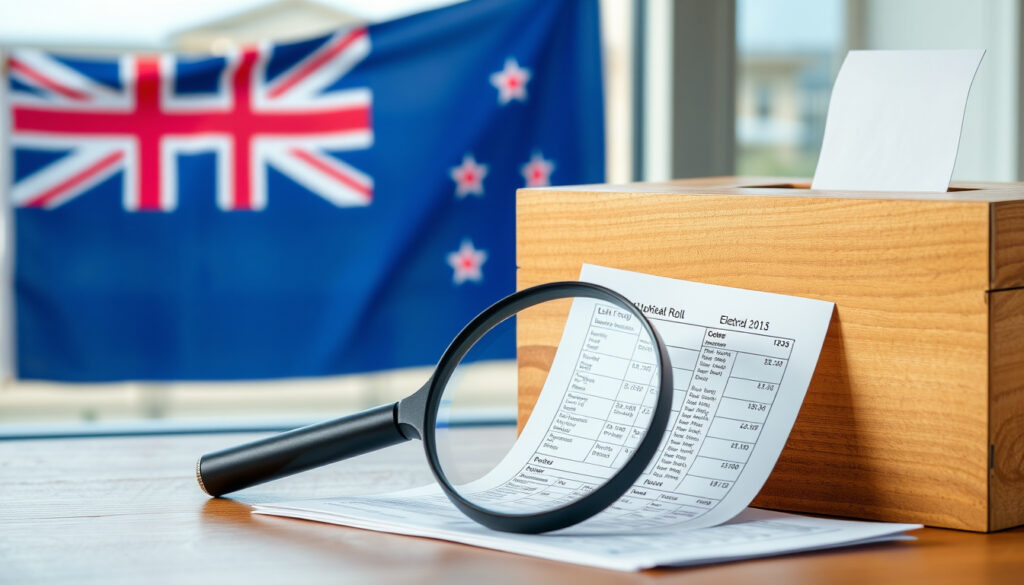
Public Access to Electoral Roll NZ: How to Find Someone
The electoral roll is a public document by law, but finding someone on it requires knowing where to look — and understanding why a free online search of the current roll doesn’t exist. This guide walks through every lawful route, from in-person browsing at libraries to online name searches in historical records, plus the privacy options that let people opt out.
Public access status: Legal right under Electoral Act 1993 ·
Where to view for free: Selected public libraries & Electoral Commission offices ·
Online search availability: Ancestry Library Edition (library computers) and commercial sites (subscription) ·
Privacy opt-out: Yes – unpublished roll for safety reasons
Quick snapshot
- Anyone can view printed electoral rolls at libraries and Electoral Commission offices (Elections NZ (electoral authority))
- Historical rolls (1853‑1981) are searchable on Ancestry Library Edition inside libraries (Christchurch City Libraries (public library network))
- Individuals at risk can apply for the unpublished roll (Health and Safety guidance (NZ government))
- No official free online search for the current roll exists; only historical rolls are digitised
- The exact cost of purchasing a printed copy from the Electoral Commission is not published upfront — you must contact them
- Printed rolls are updated before each general election and by‑election
- Historical rolls on Ancestry cover up to 1981; later years require browsing library microfiche
- If you need a copy for genealogical research, check your local library first — many have free Ancestry access (Vote NZ (official enrolment service))
- If you have safety concerns, apply for the unpublished roll before the next election update (Vote NZ (official enrolment service))
Six key facts that shape how you can access the electoral roll, from the law to the practical options.
| Fact | Detail |
|---|---|
| Legal basis | Electoral Act 1993 |
| Who can access | Any member of the public |
| Free viewing locations | Selected public libraries & Electoral Commission offices |
| Online historical rolls | Ancestry Library Edition (free at libraries), Ancestry.com & Findmypast (subscription) |
| Current online search | Not publicly available in real time (privacy restrictions) |
| Opt‑out option | Unpublished roll – available for safety reasons |
How do I find someone on the electoral roll?
Search by name: available methods
- Visit a public library or Electoral Commission office and ask for the printed roll. You can browse it for free — no appointment needed (Elections NZ (electoral authority)).
- At libraries with Ancestry Library Edition (free), search by name in historical rolls from 1853 to 1981 (Christchurch City Libraries (public library network)).
- On commercial sites like Ancestry.com or Findmypast, you pay a subscription but can search many years from home.
Using the unpublished roll option
If the person you’re looking for is on the unpublished roll, their name won’t appear in any public search. The unpublished roll is strictly confidential and can only be viewed by a Registrar of Electors and a small number of Electoral Commission staff (Health and Safety guidance (NZ government)).
Location‑based searches (Auckland, Christchurch)
Many public libraries in larger cities hold complete series of rolls. For instance, Christchurch City Libraries let you access Auckland and Christchurch rolls on library computers (Christchurch City Libraries (public library network)). Dunedin Public Library holds hard copies from 1984 onward (Dunedin Public Library (municipal library service)). Contact your local library to confirm what’s available.
General electoral roll NZ
What the general electoral roll contains
The general electoral roll lists every registered voter in New Zealand. The public version includes each person’s name, address, and occupation (Records NZ (national archives)). It does not include date of birth or contact details beyond the address.
Who is included
All enrolled voters appear — unless they have opted for the unpublished roll. The electoral roll is updated before each general election and by‑election. According to the Elections NZ (electoral authority), the roll is compiled from enrolment forms submitted by citizens and permanent residents aged 18 and over.
How the roll is compiled and updated
The Electoral Commission maintains the roll continuously. Before an election, a qualifying period runs, after which the roll is printed and made available at viewing points. The same printed copies also go to libraries.
Electoral roll search by name
Using the online index at elections.nz
Elections NZ does not offer a live name search for the current roll. However, Vote NZ provides an online enrolment check — you can search whether a person is enrolled, but only if you enter their exact name, date of birth, and address (Vote NZ (official enrolment service)). This tool does not reveal addresses or other roll data.
Searching through library databases
Many libraries subscribe to Ancestry Library Edition. You can walk into any Christchurch City Library, use a library computer, and search the electoral roll index by name for rolls dating from 1853 to 1981 (Christchurch City Libraries (public library network)). Dunedin Public Library offers the same on microfiche for 1853–1981 and hard copies from 1984 (Dunedin Public Library (municipal library service)).
Third‑party genealogy platforms (e.g. Ancestry, Findmypast)
Ancestry.com and Findmypast both hold extensive New Zealand electoral rolls. Their collections overlap with library editions but include searchable indexes from 1853 up to 2010. You need a paid subscription (about NZ$20–50 per month depending on the plan). For occasional searches, the free library version is the better option.
The online enrolment check only tells you if a person is enrolled — it won’t show their address or occupation. For detailed name searches, you must use historical roll databases or visit a library.
Search electoral roll online
Free online access points
No official New Zealand government website offers a free, direct online search of the current electoral roll by name. The only free online route is through library‑managed databases, which require you to be physically present in the library building. According to Elections NZ (electoral authority), privacy rules prevent an online public directory.
Subscription services for detailed searching
Ancestry.com and Findmypast both let you search by name across decades of rolls. Ancestry’s New Zealand collection includes electoral rolls from 1853 to 1981 and the Māori Voter Rolls 1908 and 1919 (Christchurch City Libraries (public library network)). Findmypast covers similar years but may offer different search filters.
Using the electoral roll on mobile devices
Ancestry Library Edition is a desktop application and cannot be accessed on mobile phones inside libraries. The commercial sites work on mobile browsers, but searching on a small screen is less practical. If you need to search on the go, plan to use a library computer or bring a tablet to connect to the library’s Wi‑Fi (though the database itself may restrict access to library terminals).
What this means: For anyone without a subscription, the only online option is the library database — and you must be inside the library to use it. That’s why the “online search” expectation is often met with a physical visit.
Is the electoral roll public information?
What the law says (Electoral Act 1993)
Yes, the electoral roll is a public document. The Electoral Act 1993 guarantees any person the right to inspect or purchase printed copies (Elections NZ (electoral authority)). This includes journalists, genealogists, researchers, and ordinary citizens. The data cannot be used for commercial or marketing purposes.
Exemptions for safety (unpublished roll)
Individuals who face a genuine risk to their safety can apply for their details to be moved to the unpublished roll. Once approved, their name, address, and occupation are removed from all publicly available copies. The unpublished roll is accessible only to a Registrar of Electors and a small number of Electoral Commission staff (Health and Safety guidance (NZ government)).
How to opt out of the public roll
You apply through the Electoral Commission and must provide evidence of risk — for example, a protection order or a police reference. Once accepted, the unpublished roll status remains in effect until you request removal. Note that older printed rolls kept in libraries may still contain your old address if you only recently moved to the unpublished roll (Health and Safety guidance (NZ government)).
The unpublished roll gives privacy, but it also means your name won’t appear for legitimate searches — such as when a genealogist or a friend is trying to find you. And if you were on the public roll before, older library copies may still have your details.
What’s confirmed vs what’s unclear
Confirmed facts
- Electoral rolls are public documents under the Electoral Act 1993 (Elections NZ (electoral authority))
- Free physical viewing at libraries and Electoral Commission offices (Elections NZ (electoral authority))
- Historical rolls are available on Ancestry.com and Findmypast (Christchurch City Libraries (public library network))
- Individuals can apply for an unpublished roll for safety reasons (Vote NZ (official enrolment service))
What’s unclear
- Whether a completely free, official online search for the current roll exists — no government source provides one
- Exact cost of purchasing a printed copy — must contact Electoral Commission directly
Expert perspectives
“Anyone can look at or buy electoral rolls. It’s a public document.”
Elections NZ (electoral authority)
“The electoral roll is available for anyone to view at their local library. You can also get a copy from the Electoral Commission.”
For New Zealanders, the choice between privacy and public visibility is real. The unpublished roll protects those at risk, but it also removes their details from a record that is otherwise open by law. Anyone researching family history or verifying an enrolment must navigate both the legal right and the practical gateways — a balance that the Electoral Act intended, but that takes effort to use.
Related reading: New Zealand Passport Application · Realestate.co.nz Guide
findmypast.com, elections.nz, records.nz, natlib.govt.nz, familysearch.org
Frequently asked questions
How do I view the electoral roll for free?
Walk into any selected public library or Electoral Commission office and ask for the printed electoral roll. Viewing is free and no appointment is needed (Elections NZ (electoral authority)).
Can I search the current electoral roll online for free?
No. The current roll is not available online for public name searches. The only online search tools cover historical rolls and are either library‑restricted (Ancestry Library Edition) or require a paid subscription (Vote NZ (official enrolment service)).
Is the electoral roll public information in New Zealand?
Yes, under the Electoral Act 1993 the roll is a public document. Anyone can inspect it in person or buy a printed copy (Elections NZ (electoral authority)).
What is the unpublished roll?
It’s a confidential version of the electoral roll for people who face safety risks. Their name and address are removed from all publicly available copies (Health and Safety guidance (NZ government)).
Can I find someone on the electoral roll by name?
You can search historical rolls by name at libraries using Ancestry Library Edition or on subscription sites like Ancestry.com. For the current roll, you must visit a library or Electoral Commission office in person to browse (Christchurch City Libraries (public library network)).
How much does a printed copy cost?
The Electoral Commission sets the fee, which varies by format. You must contact them directly for a current quote. The price is not publicly listed online.
How do I correct my details on the electoral roll?
Use the online enrolment update at vote.nz, or fill in an enrolment form at any PostShop. You’ll need your name, date of birth, and current address (Vote NZ (official enrolment service)).
Can I access the roll from outside New Zealand?
No free online access exists for the current roll from abroad. Historical rolls can be searched via subscription services like Ancestry.com or Findmypast from any location.
Do I need to register to view the electoral roll at a library?
No registration is required. Walk in, ask for the printed electoral roll, and browse it on the premises.
How often is the electoral roll updated?
The roll is updated continuously by the Electoral Commission, with printed versions produced before each general election and by‑election.
More related posts
 Puppies for Sale Christchurch: Buying Guide & Breeder Tips
 Wedding Guest Dress NZ – Etiquette, Colours and Seasonal Tips
 What Time Is It in Germany? Current Time, Time Zone & DST
 Stores Open Near Me: Easter Hours & Store Guide
 English to Te Reo Māori Translator: Best Tools & Guide
 Arsenal vs Olympiacos Lineups: Starting XI & Match Recap
 North Shore Police Station: Contact, Phone Number, and Location
 Daily Post Deaths Today: Find Obituaries & Death Notices