How to Cook Bok Choy: Preparation, Cooking Times & Best Methods
Bok choy has a split personality: the white stalks need a few minutes to soften, while the green leaves can go from raw to wilted in a flash. Most cooking disappointments come from treating the whole head as one vegetable when it cooks like two.
Boil: 2 min stalks + 2 min leaves · Stir-fry: 2 min leaves, 5 min stalks · Steam: 2–3 min leaves, ~5 min stalks — Purdue University Extension FoodLink (university food-safety guidance) · Roast: 12–16 min at 425°F — Texas Real Food (cooking resource) · Calories (per 100 g): ~13 — The Spruce Eats (food journalism outlet) · Vitamin C (per raw cup): ~31.5 mg — Medical News Today (health-and-nutrition publisher)
Quick snapshot
- Wash bok choy carefully — soil collects around the stems and leaves — University of Florida IFAS Extension (university crop guidance) (University of Illinois Extension (university nutrition guidance))
- Stems are denser than leaves and need longer cooking, which is why reliable methods stagger them — Purdue University Extension FoodLink (university food-safety guidance) (University of Illinois Extension (university nutrition guidance))
- Bok choy supplies vitamins A, C, and K, plus folate, calcium, and potassium — University of Illinois Extension (university nutrition guidance)
- Whether raw or cooked gives you more nutrition depends on individual absorption and the rest of the meal — Medical News Today (health-and-nutrition publisher)
- Stomach discomfort after bok choy has no single proven cause — sensitivity or improperly washed soil are both plausible — University of Florida IFAS Extension (university crop guidance)
- How much tougher flowering stems get depends on how far the plant has bolted
- Whole or halved heads: about 3–5 minutes in a steamer — Texas Real Food (cooking resource)
- Leaves flash bright green when they’re nearly done — watch them, not the clock — Purdue University Extension FoodLink (university food-safety guidance)
- Stalks take the longest, so they always go in first — Purdue University Extension FoodLink (university food-safety guidance)
- Try it raw in salads — the leaves are edible and slightly bitter — University of Illinois Extension (university nutrition guidance)
- Master the stalk-first stir-fry and weeknight dinners get easier
- Pair it with oyster sauce, mushrooms, soups, or hotpot for a Chinese-style meal
Bok choy looks like a leafy green, but it cooks on two clocks; these key facts cover the parts you can eat, the times you need, and the nutrition you keep.
| Label | Value |
|---|---|
| Cooking time range | 2 to 16 minutes, from the fastest blanch to a full oven roast |
| Edible parts | Stalks and leaves; trim the dense base if it’s fibrous |
| Flowering heads | Still edible, but stems can be tougher — adjust cooking time |
| Common cooking methods | Boil, blanch, stir-fry, steam, simmer, grill, or raw |
| Stalk-first sequence | Cook sliced stems before the leaves so the stems soften without overcooking the greens — Texas Real Food (cooking resource) |
| Steam (whole) | Whole or halved heads: about 3–5 minutes |
| Nutrition (raw) | About 95% water and roughly 13 calories per 100 g |
How to prepare and cut bok choy?
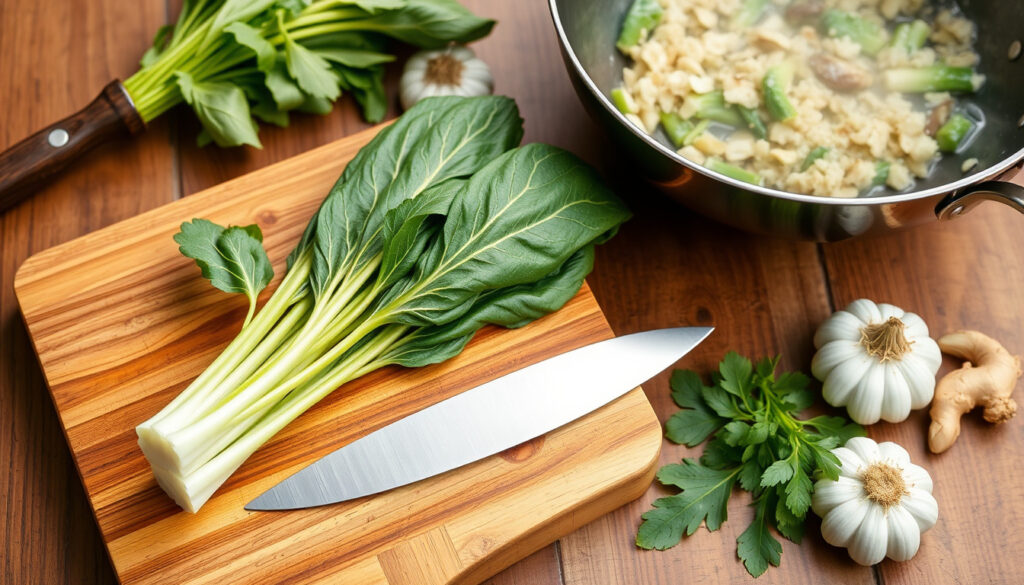
Most of the work happens before the pan heats up: wash, cut, dry, and separate the stalks from the leaves. Get this right and the cooking times almost look after themselves.
Trimming the base and separating leaves
- Cut off the root end and pull the stalks apart rather than slicing straight through the whole head; baby bok choy can be halved or quartered instead.
- For larger heads, separate the white stalks from the green leaves before cooking, because the two parts don’t finish at the same time.
- If the base feels woody or fibrous, slice it off — the dense core won’t soften at the same pace as the leaves.
Washing and drying
- Bok choy traps soil where the leaves meet the stems, and the guidance from the University of Florida IFAS Extension is to wash carefully, paying attention to the stems and leaves.
- Dry thoroughly after washing — excess water makes hot oil splatter and steams the vegetables before they can brown.
- If bok choy is joining your regular rotation, see our grocery shopping tips and tricks for how to handle a produce-heavy list.
Cutting stalks from leaves (optional)
- Slice the stalks on a diagonal and keep the leaves in larger, bite-size pieces.
- If a recipe calls for whole halves, leave the head intact and rinse well between the layers.
The stalk-leaf split isn’t a chef’s affectation — it’s the difference between a bright, crunchy vegetable and a pile of gray leaves. Cook the two parts on their own clocks and every method for preparing them gets easier.
The pattern: treat bok choy as two vegetables with one harvest date. The stalks get the head start; the leaves catch up in the final minute.
How long does bok choy need to be cooked for?
The short answer: leaves in about 2 minutes, stalks in about 5, for most stove-top methods. The longer answer is about order, not just time — the stats line above gives the exact clocks.
The two-clock rule
- Leaves: 2–3 minutes, until just wilted and still bright green.
- Stalks: about 5 minutes, until tender-crisp.
- Whole heads or halves: 3–5 minutes in a steamer.
How to tell when it’s done
- The leaves turn a deeper, brighter green and collapse slightly — that’s the visual cue.
- The thickest part of the stalk should yield to a knife with a little resistance — not a raw crunch, not wet paper.
- In soups and stir-fries, the stalks look slightly translucent at the edges when they’re close.
Method-by-method notes
- Blanch: stalks in first, leaves second, then a cold-water shock to stop the cooking.
- Stir-fry: high heat, little water, and the leaves will be done seconds after they hit the pan.
- Steam: keep the lid on and the water at a steady boil.
- Simmer: add the stalks at the start of a soup or noodle dish, and the leaves in the last 2 minutes.
What this means: the exact number matters less than the sequence. Once the leaves are bright green and glossy, the dish is on the edge of done — and the stalks are the ones that tell you when to stop.
Is it better to boil or pan fry bok choy?
Both work — they just optimize for different things. Boiling is the gentler, faster route to tender leaves; pan-frying keeps more crunch and concentrates flavor.
Comparison of texture and nutrition retention
- Boiling softens the stalks quickly and suits soups, but water-soluble vitamins can end up in the cooking liquid.
- Pan-frying (or stir-frying) keeps the leaves bright and the stalks juicy, as long as the stalks go in first.
- Steaming sits in the middle: minimal water contact and a clean, vegetable-forward flavor.
Three methods, one pattern: the wetter the cook, the more nutrients leave the vegetable; the hotter and faster the cook, the more texture survives.
| Method | Texture result | Nutrient trade-off |
|---|---|---|
| Boil or blanch | Soft, tender leaves and stalks — the classic soup-and-noodle prep | Water-soluble vitamins can leach into the cooking water; use that liquid in the dish to keep them (Medical News Today (health-and-nutrition publisher)) |
| Pan-fry / stir-fry | Bright leaves and crisp-juicy stalks when cooked stalk-first | Little or no water in the pan, so nutrient loss into liquid is minimal |
| Steam | Moist, tender, and neutral — the vegetable’s own flavor | The vegetable isn’t immersed, so this tends to preserve more than boiling |
When to choose each method
- Choose boiling for soups, noodle bowls, and hotpot, where the cooking liquid becomes part of the dish.
- Choose pan-frying for weeknight stir-fries, when you want flavor, color, and speed in one pan.
- Choose steaming when you want the vegetable to taste like itself, with nothing added and little lost.
Boiling is the friendliest method for stubborn stalks but the hardest on vitamin C and other water-soluble nutrients. If you boil, treat the cooking water as part of the meal — pour it into the soup, the sauce, or the noodles instead of down the sink.
What’s the tastiest way to cook bok choy?
If one recipe had to win a popularity contest, it would be the garlic-and-ginger stir-fry: hot oil, alliums, a splash of soy sauce, and a very short cooking time. No wok? A wide skillet works exactly the same.
Stir-fry with garlic and oyster sauce
- Trim, separate, wash, and dry the bok choy; slice the stalks on a diagonal.
- Heat a wok or wide pan over high heat, add a little oil, then garlic and ginger.
- Add the stalks first and toss until they start to soften at the edges.
- Add the leaves and toss until wilted and bright green — the leaves take about 2 minutes on top of the stalks’ head start.
- Finish with a splash of soy sauce (or oyster sauce), plus salt and pepper to taste.
Blanch then toss in soy sauce
- Boil the stalks briefly, add the leaves, then drain and toss with soy sauce and a little hot oil.
- The result sits between steamed and stir-fried: tender stalks, glossy leaves, less oil than a full stir-fry.
Grill or roast for a charred twist
- Halve or quarter the head, coat with oil and seasoning, and cook at 425°F (220°C) until the edges char and the centers are tender.
- Texas Real Food suggests a 12–16 minute oven route, turning once — the longest cook on this page and the one with the biggest flavor payoff.
The upshot: garlic, ginger, soy, and heat do the heavy lifting; the vegetable only has to be cooked on two clocks. Once that sequence clicks, any of these recipes is about 10 minutes from pan to plate.
What is the healthiest way to eat bok choy?
The healthiest method is the one that gets the nutrients into your bowl instead of down the drain. Steaming holds up best, because it never immerses the leaves in water.
Steaming vs raw vs stir-fry
- Steaming keeps the vegetable out of the cooking water, so water-soluble vitamins stay in the plant rather than the pot.
- Raw bok choy keeps everything intact, though the leaves can carry a slight bitterness.
- Stir-frying uses very little water and adds flavor; the small amount of oil also helps your body absorb fat-soluble vitamins like vitamin K.
- Boiling reduces water-soluble vitamins the most — unless the leftover liquid becomes part of the meal.
What the numbers say about raw bok choy
- A 100 g serving is about 95% water with roughly 13 calories, 1.5 g protein, 2 g carbs, and 1 g fiber — The Spruce Eats (food journalism outlet)
- The same portion also supplies vitamins A, C, and K, folate, calcium, and potassium, according to the University of Illinois Extension.
- Since a raw cup (about 70 g) carries roughly 31.5 mg of vitamin C, a single serving makes a real dent in the daily target.
The “healthiest” method and the “tastiest” method turn out to be the same dish. Steam or stir-fry the stalks first, add the leaves last, and the nutrient story and the dinner story both end well.
Why this matters: if you’re eating bok choy for its vitamin C and potassium, the cooking method changes how much of it actually reaches you. A steaming basket does more for your plate than a pot of boiling water ever will.
What’s confirmed, what’s still unclear
Confirmed facts
- The entire head — stalks and leaves — is edible; the dense base just needs trimming — University of Illinois Extension (university nutrition guidance)
- Bok choy is commonly stir-fried and appears in soups, hotpot, and oyster-sauce dishes, per the University of Florida IFAS Extension.
- Boiling can reduce water-soluble vitamins; steaming keeps the vegetable out of the water — a distinction Medical News Today draws in its cooking-notes.
What’s unclear
- Why some people get stomach discomfort after eating bok choy isn’t pinned down — individual sensitivity and improperly washed soil are both plausible — University of Florida IFAS Extension (university crop guidance)
- Whether raw or cooked is “healthier” depends on individual absorption and the rest of the meal.
- How much tougher flowering stems get depends on how far the plant has bolted.
- Exact nutrient-retention percentages per method aren’t published in the sources reviewed here — the guidance is directional, not lab-measured per batch.
The pattern: the reliable advice is thick on basic kitchen care and thin on precise numbers — wash well, cook the parts separately, and don’t waste the cooking water.
What the sources say
Wash bok choy carefully before cooking, paying particular attention to soil trapped around the stems and leaves.
— University of Florida IFAS Extension (university crop guidance)
Separate or stagger the stems and leaves because stems are denser and generally require longer cooking than leaves.
— Purdue University Extension FoodLink (university food-safety guidance)
Cooking vegetables can reduce nutrient levels, with the extent depending on the nutrient and cooking method.
— Medical News Today (health-and-nutrition publisher)
The through-line: every reliable source lands on the same two moves — wash well, and cook the stalks and leaves on separate clocks.
The takeaway
Bok choy rewards a simple mental model: wash it well, cut the stalks from the leaves, and give the stalks a head start. Steaming protects the nutrients best, stir-frying delivers the most flavor per minute, and boiling is only a compromise if the cooking water ends up down the drain. The same dense-first, delicate-last logic applies to other vegetables — our guide on how to cook beetroot works the same way. For the home cook who wants both taste and nutrition, the choice is clear: steam or stir-fry the stalks first, add the leaves last, and reserve the boiling water for soup — or skip the water bath entirely.
ask.ifas.ufl.edu, extension.purdue.edu, verywellhealth.com, us.harmanapps.com
Frequently asked questions
Can you eat bok choy that has flowered?
Yes. Flowered (bolted) bok choy is still edible, though the stems can be tougher than in young heads. Give the stalks extra cooking time and add the leaves at the end, as usual.
What part of bok choy can you not eat?
No part of the head is inedible, but the dense base is usually trimmed because it can be fibrous. Cut off the root end, separate the stalks, and wash well, since soil collects where the leaves meet the stems.
Why does my stomach hurt after eating bok choy?
The sources reviewed don’t name one proven cause. Individual sensitivity and improperly washed leaves are both plausible, which is why thorough washing — especially around the stems — is the safest first step.
Which is healthier, bok choy or spinach?
Both are nutrient-dense greens, and a strict head-to-head score isn’t provided by the sources reviewed here. For bok choy, a raw cup (about 70 g) delivers roughly 31.5 mg vitamin C, 74 mg calcium, 176 mg potassium, and 31.9 mcg vitamin K. The healthier choice is the green you’ll actually cook and eat regularly.
Why do Chinese eat bok choy?
Bok choy is a staple in Chinese cooking because it cooks quickly and takes on flavor well: it appears in stir-fries, soups, hotpot, and simple plates with oyster sauce and mushrooms. Its short cooking time makes it an everyday vegetable rather than a special-occasion one.
More related posts
 KFC Menu with Prices NZ – Bucket, Meal & Catering Costs
 North Otago Motor Group Oamaru Guide – Reviews, Staff, Used Cars
 Chris Martin and Dakota Johnson Split: Timeline and What’s Next
 How Did Bob Marley Die? The Real Cause at 36
 Personal Loan Repayment Calculator: Rates & Monthly Payments
 Manu Restaurant and Bar Reviews: Honest Verdict for Christchurch