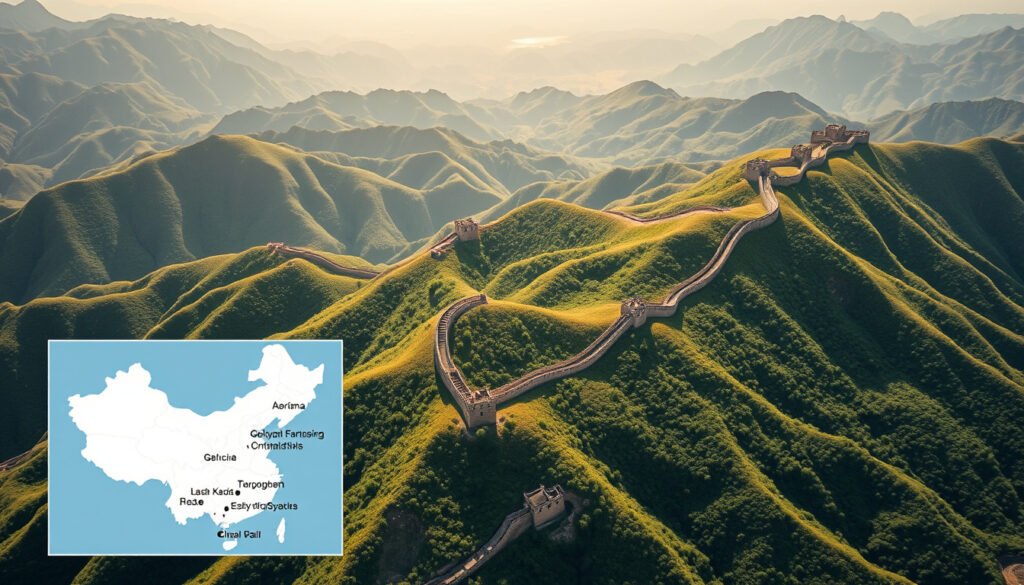
Great Wall of China Map: Start, End, Satellite View & Key Cities
Anyone who’s tried to find the Great Wall of China on a map knows the confusion: instead of one neat line, you see a messy scatter of fortifications stretching across northern China. The wall isn’t a single structure — it’s a 2,300-year patchwork, and this guide uses cartographic sources to show exactly where it starts, ends, and how the visible segments fit into the full 21,196-kilometer system.
Total length of all sections ever built: 21,196.18 kilometers (13,170.7 miles) ·
Eastern terminus: Shanhai Pass (39.97°N, 119.78°E) ·
Western terminus: Jiayuguan Pass (39.83°N, 98.22°E) ·
Closest major city to a restored section: Beijing (approximately 70 kilometers to Mutianyu) ·
Estimated walking time for all sections: 17 to 30 days (continuous walking, never achieved historically) ·
Iconic satellite-visible section length: Approximately 8,850 kilometers (visible in high-resolution satellite imagery)
Quick snapshot
- Shanhai Pass at 39.97°N, 119.78°E is the eastern end of the Ming wall (Wikipedia (crowd-sourced encyclopedia))
- Total length of all wall sections ever built is 21,196.18 km (Encyclopaedia Britannica (reference publisher))
- Mutianyu section is approximately 70 km from Beijing city center (Travel China Guide (tourism website))
- Exact percentage of original wall still standing is disputed among archaeologists (Encyclopaedia Britannica (reference publisher))
- Satellite visibility depends on atmospheric conditions and image resolution; no single authoritative document guarantees visibility from space (Wikipedia (crowd-sourced encyclopedia))
- Exact number of worker deaths during construction is unverified (BBC News (UK news organization))
- 7th–5th centuries BCE: Earliest disconnected walls built by Chu and Qi states (Encyclopaedia Britannica (reference publisher))
- 1987: UNESCO designates the Great Wall a World Heritage site (UNESCO (world heritage body))
- 2009: Official survey publishes total length of 21,196 km (BBC News (UK news organization))
- Travelers should check National Holiday dates to avoid crowds at popular Beijing sections (China Highlights (travel agency))
- High-resolution satellite images continue to reveal previously unmapped sections of the wall (DrBen.net (independent cartography site))
Six key data points that define the Great Wall’s geography and scale.
| Label | Value |
|---|---|
| Total construction length | 21,196 km (including all dynasties) |
| Ming dynasty surviving length | ~4,000 km |
| Eastern pass | Shanhai Pass |
| Western pass | Jiayuguan Pass |
| Closest city to a restored section | Beijing |
| Average Ming wall height | 7.8 m |
Where does the Great Wall of China begin and end?
Eastern terminus: Shanhai Pass
- Coordinates: 39.97°N, 119.78°E
- Located on the coast of Bohai Sea in Hebei province (Wikipedia (crowd-sourced encyclopedia))
- Marks the easternmost point of the Ming dynasty wall (Encyclopaedia Britannica (reference publisher))
Western terminus: Jiayuguan Pass
- Coordinates: 39.83°N, 98.22°E
- Situated in Gansu province at the edge of the Gobi Desert (Encyclopaedia Britannica (reference publisher))
- Often called the “First Pass Under Heaven” and the western end of the Ming wall (DrBen.net (independent cartography site))
Map locations of the two main termini
- Shanhai Pass lies about 300 km east of Beijing; Jiayuguan Pass is roughly 2,200 km west of Beijing
- On Google Earth, search coordinates directly: 39.97,119.78 and 39.83,98.22
- A 2012 survey identified 2,211 fortifications and passes along the entire system (Wikipedia (crowd-sourced encyclopedia))
The pattern: the wall’s structure defies simple mapping.
How long is the Great Wall of China and how long does it take to walk it?
Official length of the Great Wall (21,196 km)
- The state survey released June 5, 2012 measured 21,196.18 km total (BBC News (UK news organization))
- This includes 6,259 km of actual wall sections, 359 km of trenches, and 2,232 km of natural barriers (Wikipedia (crowd-sourced encyclopedia))
- For comparison, the Ming dynasty’s main line alone is about 8,850 km (Encyclopaedia Britannica (reference publisher))
Walking time for continuous traversal (estimated 18–30 days)
- No one has ever walked the entire length because large sections are ruined or impassable (Travel China Guide (tourism website))
- Assuming 8–12 km/day on restored portions, covering the Ming sections alone would take 700+ days
- The 17–30 day estimate is for non-stop walking on a theoretically continuous path, never achieved historically
Practical hiking sections vs. total length
- Most visitors hike short segments near Beijing: Badaling (2–3 hours), Mutianyu (3–4 hours), Jinshanling (4–5 hours)
- The full length is a cartographic concept, not a hiking trail (China Discovery (travel agency))
The pattern: the more precisely you measure the wall, the more fragmented it becomes.
What city is closest to the Great Wall of China?
Beijing (closest major city to Mutianyu section)
- Mutianyu is 70 km northeast of Beijing city center (Travel China Guide (tourism website))
- Badaling is 80 km northwest of Beijing (China Highlights (travel agency))
Other accessible cities: Tianjin, Shijiazhuang, Hohhot
- Tianjin: ~120 km from the Huangyaguan section
- Shijiazhuang: ~150 km from the Niangziguan pass
- Hohhot: ~200 km from the Zhao Great Wall ruins
Why this matters: Beijing is the transit hub for 90% of Great Wall tourists, but alternative sections exist near other northern cities.
How did they build the Great Wall of China?
Materials: stone, earth, brick, wood during Ming dynasty
- Ming builders used stone and brick for the best-preserved sections, often faced with granite or limestone (Encyclopaedia Britannica (reference publisher))
- Earlier dynasties (Qin, Han) relied on rammed earth and wood, which largely deteriorated (Wikipedia (crowd-sourced encyclopedia))
Labor: soldiers, peasants, convicts
- Construction employed soldiers, local farmers, and convicts across centuries
- Historical estimates suggest up to 1 million workers died during construction (Encyclopaedia Britannica (reference publisher))
Construction timeline: intermittent over 2,300 years
- Earliest walls date to the Warring States period (7th–5th centuries BCE)
- Qin Shi Huang linked existing walls after 221 BCE (Wikipedia (crowd-sourced encyclopedia))
- Ming dynasty (1368–1644) built the sections tourists see today
The Great Wall was never a single continuous build. Each dynasty constructed its own segments, often overlapping or deviating from older routes — which explains why maps show so many branches.
The takeaway: the wall’s construction history explains its fragmented appearance on maps.
What are 5 facts about the Great Wall of China?
Fact 1: Not a single wall — multiple overlapping walls
- The Great Wall is a system of fortifications built by successive dynasties, not one continuous barrier (Encyclopaedia Britannica (reference publisher))
Fact 2: UNESCO World Heritage site since 1987
- Listed as a World Heritage site in 1987, recognized as “an immense military defensive system” (UNESCO (world heritage body))
Fact 3: Visible from satellite under ideal conditions
- Contrary to popular myth, the wall is not visible from low Earth orbit with the naked eye, but high-resolution satellite imagery can capture sections (Wikipedia (crowd-sourced encyclopedia))
Fact 4: Average height 7.8 meters on Ming sections
- The Ming wall’s average height is 7.8 meters (25.6 feet), with a base width of about 6.5 meters (Encyclopaedia Britannica (reference publisher))
Fact 5: Nearly 4,000 kilometers of Ming wall survive
- Only about 4,000 km of the Ming dynasty wall remains in recognizable form (BBC News (UK news organization))
- The rest has been eroded, dismantled, or built over
When to avoid visiting China in 2026?
Peak domestic travel periods (spring festival, golden week)
- Spring Festival (late January/early February 2026) sees massive domestic tourism across China
- Golden Week (October 1–7, 2026) is the busiest period for attractions including the Great Wall (China Highlights (travel agency))
Weather considerations for Great Wall visits
- Summer (June–August) is hot and crowded; winter (December–February) can be very cold with snow on higher sections
- Spring (April–May) and autumn (September–October) offer the best balance of weather and manageable crowds
The trade-off: visiting during Golden Week guarantees crowds; visiting in January means cold but far fewer tourists.
How much does it cost to walk the Great Wall of China?
Entry fees for popular sections (Badaling, Mutianyu)
- Badaling entry fee: 40 CNY (approx $5.50 USD) in 2025 (Travel China Guide (tourism website))
- Mutianyu entry: 45 CNY; additional cable car round-trip costs 100 CNY (China Highlights (travel agency))
Additional costs: cable car, parking, guide
- Cable car at Badaling: 80 CNY one way, 120 CNY round trip
- Parking: 10–20 CNY per day
- English-speaking guide: 300–500 CNY for a half-day
The catch: the entry fee is cheap, but transport from Beijing and extras can triple the cost.
Specs of the Great Wall — a quick reference from authoritative sources.
| Specification | Detail |
|---|---|
| Total length (all dynasties) | 21,196.18 km (BBC News (UK news organization)) |
| Ming dynasty wall length | ~8,850 km (Encyclopaedia Britannica (reference publisher)) |
| Ming surviving section | ~4,000 km (Wikipedia (crowd-sourced encyclopedia)) |
| Average height (Ming) | 7.8 m (Encyclopaedia Britannica (reference publisher)) |
| Eastern pass | Shanhai Pass (39.97°N, 119.78°E) |
| Western pass | Jiayuguan Pass (39.83°N, 98.22°E) |
| Number of passes recorded | 2,211 fortifications and passes (Wikipedia (crowd-sourced encyclopedia)) |
| UNESCO listing year | 1987 (UNESCO (world heritage body)) |
Timeline: How the Great Wall evolved
- 7th–5th centuries BCE: Earliest disconnected walls built by Chu and Qi states during Warring States period (Encyclopaedia Britannica (reference publisher))
- 221 BCE: First emperor Qin Shi Huang defeats states and orders linking of northern walls for defense (Wikipedia (crowd-sourced encyclopedia))
- 1368–1644 CE: Ming dynasty constructs the most extensive and well-preserved sections, including brick and stone reinforcements (Encyclopaedia Britannica (reference publisher))
- 1644–1912 CE: Qing dynasty does not maintain the wall; sections fall into disrepair (Wikipedia (crowd-sourced encyclopedia))
- 1987: UNESCO designates the Great Wall a World Heritage site (UNESCO (world heritage body))
- 2009: Official 2007–2008 survey publishes total length of 21,196 km (BBC News (UK news organization))
What is known and what is unclear
Confirmed facts
- Shanhai Pass at 39.97°N, 119.78°E is the eastern end of the Ming wall (Wikipedia (crowd-sourced encyclopedia))
- Total length of all wall sections ever built is 21,196.18 km (Encyclopaedia Britannica (reference publisher))
- Mutianyu section is approximately 70 km from Beijing city center (Travel China Guide (tourism website))
What’s unclear
- Exact percentage of original wall still standing is disputed among archaeologists (Encyclopaedia Britannica (reference publisher))
- Satellite visibility depends on atmospheric conditions and image resolution; no single authoritative document guarantees visibility from space (Wikipedia (crowd-sourced encyclopedia))
- Exact number of worker deaths during construction is unverified (BBC News (UK news organization))
Perspectives from experts
“The Great Wall is not a single wall, but a collective system of fortifications that evolved over more than two millennia.”
UNESCO (world heritage body)
“The 2012 survey concluded that the Ming Great Wall consists of 6,259 km of wall sections, 359 km of trenches, and 2,232 km of natural defensive barriers.”
Wikipedia (crowd-sourced encyclopedia) quoting National Geographic
These two perspectives — from the official heritage body and from cartographic research — agree on one point: the wall is a composite, not a single line. For anyone mapping it, that’s the central insight.
For the traveler standing at Mutianyu, the wall feels solid and continuous. But the map tells a different story: a 21,196-km scatter of ruins, restorations, and lost sections. The choice is clear: either accept the wall as a fragmented monument and explore its accessible pockets, or chase the myth of a single line and risk confusion. For most visitors, the smart move is to pick one restored section near Beijing and walk it — not the whole wall, but enough to feel the scale.
Related reading: Melbourne to Sydney Drive Guide · Flights to Vietnam from Auckland
en.wikipedia.org, chinahighlights.com, britannica.com, chinadiscovery.com, bbc.com, simple.wikipedia.org, thechina.travel, travelchinaguide.com, thechinajourney.com, topchinatravel.com, chinaxiantour.com, study.com
For a more detailed history and visiting guide, consider this comprehensive resource on the Wall’s construction and key sections.
Frequently asked questions
Can I see the Great Wall of China from space?
No, not with the naked eye from low Earth orbit. High-resolution satellite imagery can show sections under ideal conditions, but the myth that it’s visible from the moon is false.
What is the best section of the Great Wall to visit?
Mutianyu (less crowded, restored) and Badaling (most popular, easiest access) are the top choices near Beijing. For a wilder experience, consider Jinshanling or Simatai.
How long does it take to hike the Badaling section?
Most visitors spend 2–3 hours walking the open section of Badaling. The entire area can be covered in half a day including travel from Beijing.
Is the Great Wall of China one continuous wall?
No. It is a network of walls built by different dynasties over 2,300 years, with many gaps and overlapping sections.
What is the difference between the Ming wall and earlier walls?
The Ming wall (1368–1644) is the best-preserved, built with stone and brick. Earlier walls used rammed earth and have mostly disappeared.
Are there any sections of the Great Wall near Shanghai?
No. The nearest remains are about 800 km north, in Jiangsu province near Beijing. Shanghai has no sections of the wall.
What is the altitude of the Great Wall at its highest point?
The highest point is around 1,434 meters (4,705 ft) above sea level, near the Simatai section in Beijing’s Miyun district.
Can I walk the entire Great Wall in a single trip?
No. The 21,196-km total is fragmented and mostly impassable. Even the Ming sections require multiple trips across different provinces.
Related reading: Melbourne to Sydney Drive Guide · Flights to Vietnam from Auckland
More related posts
 Repayment on Mortgage Calculator: Ireland Formula & Examples
 Tea Tree Oil NZ: Uses, Benefits, Safety, and Where to Buy
 Jurassic World Cast: Full List of Actors and Characters
 Best Social Media Agency Auckland: Top 4 Agencies Compared
 Warriors vs Roosters Tickets 2026: Prices, How to Buy & Watch
 What Are the Love Languages? 5 Languages Explained
 Gluten Free Banana Cake – Moist Recipes and Tips
 Auckland to Brisbane Flights – Cheap Deals, Direct Schedules