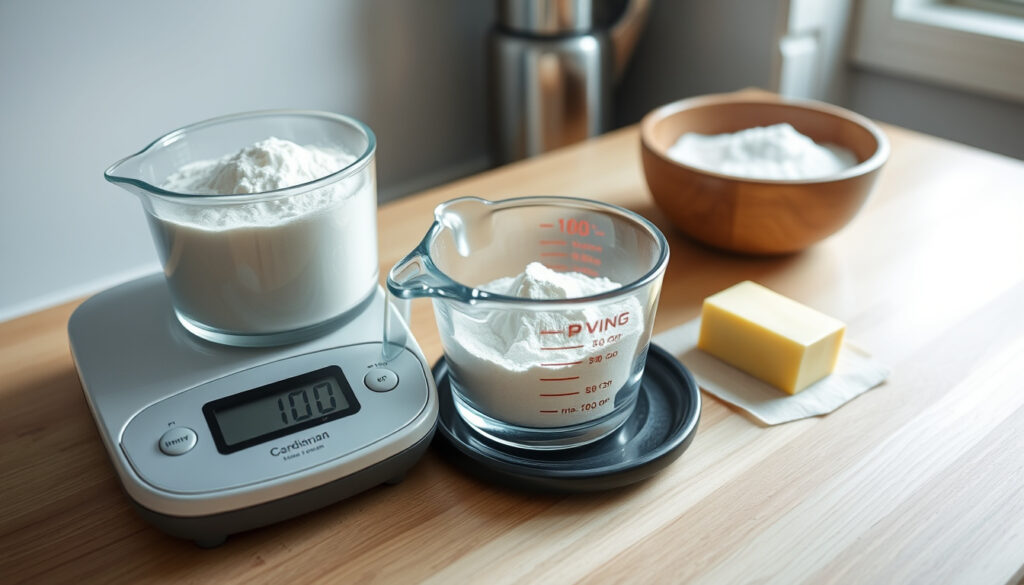
100 Grams to Cups: Exact Conversions for Flour, Sugar, Butter
One recipe calls for 100 grams of flour, but your measuring cups are staring back at you. The quick answer? 100 grams of all-purpose flour fills about 0.8 US cups, but that same weight of sugar gives you half a cup, and butter lands even lower. This guide breaks down exact conversions for four common ingredients and shows you how to measure without a scale.
100g all-purpose flour: ≈ 0.8 US cups ·
100g granulated sugar: ≈ 0.5 US cups ·
100g butter: ≈ 0.44 US cups ·
100g water: ≈ 0.42 US cups ·
Standard US cup: 240 ml
Quick snapshot
- 100g = ~0.8 US cups (4/5 cup) (King Arthur Baking, a leading baking resource)
- Spoon and level for best accuracy (PastryCal, a baking calculator site)
- King Arthur Baking: 1 cup = 120g
- 100g = ~0.5 US cups (1/2 cup) (King Arthur Baking, a leading baking resource)
- Scoop and level or use spoon (Allrecipes)
- Allrecipes: 1 cup = 200g (Allrecipes, a top recipe platform)
- 100g = ~0.44 US cups (Weekend Bakery, a baker-run conversion site)
- 1 stick butter = 113g = ~1/2 cup (Weekend Bakery)
- Use markings on butter wrapper (Doves Farm)
- 100g = ~0.42 US cups (2/5 cup) (The CalculatorSite, a popular conversion utility)
- 1 cup water = 236g (King Arthur Baking, a leading baking resource)
- Density 1g/ml simplifies conversion (The CalculatorSite)
Six common ingredients, one key takeaway: the cup volume for 100 grams depends entirely on how dense the ingredient is.
| Ingredient | 100 grams in US cups |
|---|---|
| All-purpose flour | 0.8 cups (4/5 cup) |
| Granulated sugar | 0.5 cups (1/2 cup) |
| Butter | 0.44 cups |
| Water | 0.42 cups (2/5 cup) |
| Honey | 0.3 cups |
| Standard US cup | 240 ml (8.45 fl oz) |
A home baker in the US who reaches for a cup measure assuming 100g equals 1 cup will overshoot flour by 25% and undershoot sugar by 50%. Density isn’t a trivia point — it’s the difference between a fluffy cake and a brick.
How many cups is 100 grams?
The short answer depends on ingredient density
- All-purpose flour: 100g = 0.8 US cups (King Arthur Baking, a leading baking resource)
- Granulated sugar: 100g = 0.5 US cups (Allrecipes, a top recipe platform)
- Butter: 100g = 0.44 US cups (Weekend Bakery, a baker-run conversion site)
- Water: 100g = 0.42 US cups (The CalculatorSite, a popular conversion utility)
Universal rule: density = mass / volume
Because 1 US cup has a fixed volume (240 ml), the gram weight of a cup changes with ingredient density. For example, a cup of all-purpose flour weighs about 120g, while a cup of granulated sugar weighs about 200g (King Arthur Baking, a leading baking resource). So 100g of flour takes up almost a full cup (0.8), but 100g of sugar only fills half a cup.
The implication: never treat 100g as a fixed cup amount. Always check the specific ingredient’s density.
Is 100 grams equal to 1 cup?
Why 100 grams is not always 1/2 cup either
Only a few very dense ingredients — like honey or molasses — come close to 100g per cup. A cup of honey weighs about 340g, so 100g of honey is roughly 0.3 cups (The CalculatorSite, a popular conversion utility). For most baking staples, the gap is large. One half-cup of all-purpose flour weighs about 60g, not 100g (King Arthur Baking, a leading baking resource).
Examples: flour vs. sugar vs. water
The table below illustrates how the same weight translates to different cup volumes depending on ingredient.
| Ingredient | 1 cup weighs | 100g = ? cups |
|---|---|---|
| All-purpose flour | 120g | 0.8 cups |
| Granulated sugar | 200g | 0.5 cups |
| Butter | 227g | 0.44 cups |
| Water | 236g | 0.42 cups |
The pattern: 100 grams equals roughly 0.4 to 0.8 cups depending on whether the ingredient is heavy (water) or light (flour).
How to measure 100 grams in a cup?
Use a kitchen scale for accuracy
Recipes written by weight are inherently more precise than those using cups (King Arthur Baking, a leading baking resource, explains). A digital scale that reads grams lets you measure exactly 100g of any ingredient, regardless of density. This is the gold standard.
If you must use cups: spoon and level method
- For flour: spoon it lightly into the cup, then level with a straight edge. Scooping directly from the bag can pack in 150g instead of 120g (PastryCal, a baking calculator site).
- For granulated sugar: scoop and level, or spoon and level. A cup of sugar should be 200g, not more.
- For butter: use the wrapper markings — 1 stick = 113g = ~1/2 cup. 100g is just under a full stick.
- For water: use a liquid measuring cup. 100g of water = 100 ml.
Using the spoon-and-level method for flour typically yields about 120g per cup, but some charts list 125g or even 150g (Inch Calculator; Anna Olson). This variation means your 100g target could be off by 10–20% depending on the recipe writer’s assumption. A scale resolves this.
Step-by-step: measuring 100 grams without a scale
- Identify the ingredient in your recipe.
- Look up its cup weight from a reliable chart (use the table above or a source like Doves Farm).
- Calculate cups needed: Cups = 100 ÷ (grams per cup). Example: flour (120g/cup) → 100 ÷ 120 = 0.83 cups.
- Measure using the appropriate method (spoon-and-level for dry, liquid cup for wet).
- Check your result against the conversion chart. Adjust if necessary.
What this means: with a known density, you can convert any ingredient from grams to cups without a scale — but the margin of error is wider than weighing. For exact conversions, check out this Guida all’intelligenza artificiale in Italia. Guida all’intelligenza artificiale in Italia
Confirmed facts
- 100g of all-purpose flour = 0.8 US cups (King Arthur Baking, a leading baking resource)
- 100g of granulated sugar = 0.5 US cups (The CalculatorSite, a popular conversion utility)
- 1 US cup = 240 ml (Weekend Bakery, a baker-run conversion site)
- Butter, 1 cup = 227g (Weekend Bakery, a baker-run conversion site)
What’s unclear
- Exact conversion for gluten-free flour blends may vary by brand composition.
- Packed vs. unpacked brown sugar yields different cup volumes for the same gram weight.
Expert perspectives
“A cup of all-purpose flour weighs about 120 grams. We strongly recommend weighing your ingredients for consistent results.”
— King Arthur Baking, Ingredient Weight Chart
“Granulated sugar: 1 cup = 200 grams. Brown sugar: 1 cup = 220 grams. These values are standard for most recipes.”
— Allrecipes, Cup to Gram Conversions
“100 grams of all-purpose flour is 0.8 US cups. The same weight of granulated sugar is 0.5 cups. Density makes all the difference.”
— The CalculatorSite, Grams to Cups Converter
For home bakers in the US who rely on cup measurements, the trade-off is clear: either commit to memorizing a handful of key conversion ratios, or spend $15 on a kitchen scale and eliminate guesswork entirely.
industrykitchens.com.au, pastrycal.com, inchcalculator.com, youtube.com, dovesfarm.co.uk, reddit.com, annaolson.ca, reddit.com, facebook.com
För en annan uppsättning mått som ger samma slutsatser, se en liknande guide för 100 gram till koppar.
Frequently asked questions
How many cups is 100 grams of flour?
100 grams of all-purpose flour equals about 0.8 US cups (4/5 cup). For best accuracy, use the spoon-and-level method with a standard 240 ml cup.
How many cups is 100 grams of sugar?
100 grams of granulated sugar equals exactly 0.5 US cups (1/2 cup). Brown sugar (packed) is slightly less, about 0.45 cups.
How many cups is 100 grams of butter?
100 grams of butter is roughly 0.44 US cups, just under 1/2 cup. One stick of butter is 113g, so 100g is slightly less than a full stick.
Is 100 grams the same as 1/2 cup?
Only for ingredients that weigh exactly 200g per cup. All-purpose flour weighs 120g per cup, so 100g is about 0.8 cups — not 1/2 cup. Granulated sugar weighs 200g per cup, so 100g is exactly 1/2 cup.
How do I measure 100 grams without a scale?
Use a conversion chart for the specific ingredient. For flour, spoon into a measuring cup and level. For sugar, scoop and level. For butter, use wrapper markings. A kitchen scale is more reliable.
Does 100 grams of water equal 100 ml?
Yes. Water has a density of 1 g/ml, so 100 grams of water is exactly 100 milliliters. This is an exception — most other ingredients are not 1-to-1.
Why do different ingredients give different cups for 100 grams?
Because cup volume is constant (240 ml) but ingredient density varies. Dense ingredients (honey, butter) weigh more per cup, so 100g fills less of the cup. Light ingredients (flour, powdered sugar) weigh less per cup, so 100g fills more of the cup.
For home bakers in the US and UK who frequently convert recipes, the choice is clear: use a digital scale for 100-gram precision, or keep this conversion chart handy for flour, sugar, butter, and water — the four most common ingredients where getting the cup count wrong can ruin a batch.
Related reading
More related posts
 Fulham vs Nottingham Forest Lineups: Score & Starting XI
 Seek Jobs New Zealand: How to Find Work in 2025
 Web Security Best Practices for Developers
 Cheap Flights to Fiji from Auckland: Compare Prices & Deals
 The Gone Season 3 Release Date: Latest News & Updates
 Bee Swarm Simulator Codes (May 2026): Active Codes & Rewards
 Apple Cider Vinegar Gummies: Benefits, Evidence & Best Brands (Ireland)
 What Time Is It in Germany? Current Time, Time Zone & DST