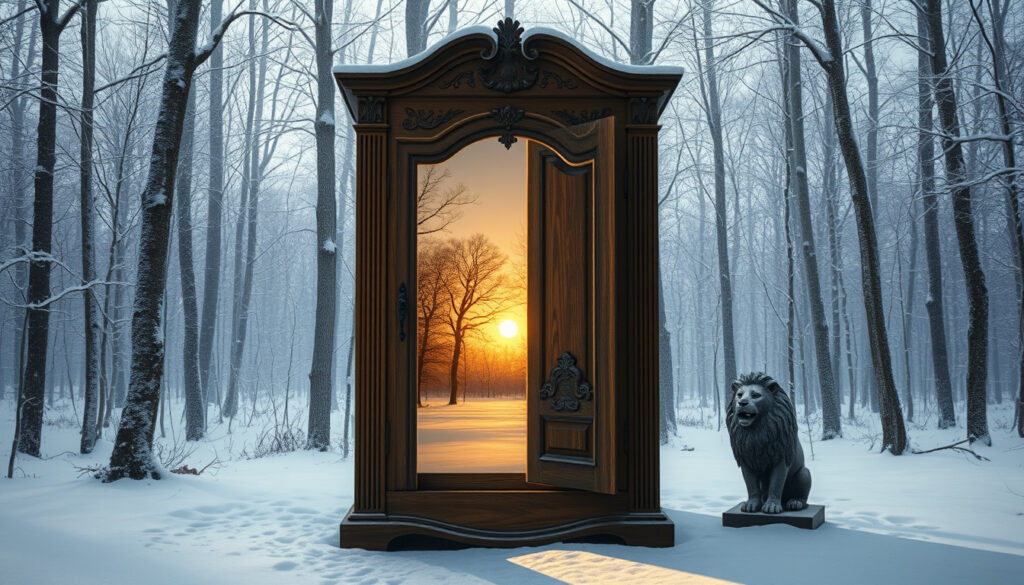
The Lion, the Witch and the Wardrobe: Age, Symbolism & Banned
Few children’s books carry the same weight of devotion and controversy as C.S. Lewis’s The Lion, the Witch and the Wardrobe. Published in 1950, it has sold over 100 million copies, yet it is also one of the most challenged books in school libraries, and this guide explores why the story of four siblings stepping into Narnia remains a flashpoint for both Christian readers and those who seek to ban it.
Published: 1950 (Wikipedia) ·
Author: C.S. Lewis ·
Pages: ~208 ·
Sales: over 100 million copies ·
Translations: 47 languages ·
Awards: Carnegie Medal nominee
Quick snapshot
- Narnia is a Christian allegory per Lewis (University of Connecticut Library)
- Published 16 October 1950 (University of Connecticut Library)
- Four Pevensie children are the main characters (University of Connecticut Library)
- The Stone Table breaks after Aslan’s sacrifice (University of Connecticut Library)
- Whether Lewis intended the Pevensies to represent specific virtues (Newberry Library)
- Exact number of school bans varies widely by source (ScreenRant)
- Whether the White Witch is a direct Satan allegory or a broader evil figure (Newberry Library)
- 1950: Book first published
- 1988: BBC TV series airs
- 2005: Theatrical film release
- 2025 stage production tour in Dublin (Portsmouth Public Library)
- Ongoing debate over school challenges (Portsmouth Public Library)
The nine most frequently referenced details about the book, one pattern: the blend of precise publication data and its famously layered symbolism.
| Detail | Value |
|---|---|
| Full Title | The Lion, the Witch and the Wardrobe |
| Author | C. S. Lewis |
| Illustrator | Pauline Baynes |
| Series | The Chronicles of Narnia (Book 2 chronologically, Book 1 published) |
| Genre | Children’s fantasy, portal fantasy |
| Publisher | Geoffrey Bles |
| Publication Date | 16 October 1950 |
| Pages | 208 (first edition) |
| ISBN | 978-0-00-330009-3 |
What are the 7 Chronicles of Narnia in order?
The chronological order of Narnia books
- The Magician’s Nephew (1955) – Chronologically first, tells the creation of Narnia.
- The Lion, the Witch and the Wardrobe (1950) – First published, second chronologically.
- The Horse and His Boy (1954) – Takes place during the reign of the Pevensies.
- Prince Caspian (1951) – The Pevensies return to help restore the throne.
- The Voyage of the Dawn Treader (1952) – Edmund, Lucy, and Eustace sail to the edge of the world.
- The Silver Chair (1953) – Eustace and Jill Pole search for Prince Rilian.
- The Last Battle (1956) – The final battle and end of Narnia.
The chronological order differs from the publication order, a fact that sparks debate among fans. C.S. Lewis himself suggested reading chronologically, though the first published book remains the most famous entry point.
Publication order vs. chronological order
Reading in publication order preserves Lewis’s original reveal of Narnia, while chronological order follows the in-world timeline. The choice dictates whether readers encounter the White Witch or the creation story first.
The implication: Readers often debate the ideal reading order, and knowing the difference between publication and chronological sequence sets the foundation for understanding how Lewis built his world.
Who are the four main characters in Narnia?
Peter Pevensie
- Role: The eldest, High King of Narnia.
- Symbolism: Often associated with courage and leadership.
- Key act: Kills the wolf Maugrim in defense of his siblings.
Susan Pevensie
- Role: The gentle queen.
- Symbolism: Representing gentleness and maturity.
- Key act: Receives Queen Susan’s Horn, a magical aid.
Edmund Pevensie
- Role: The betrayer turned redeemer.
- Symbolism: Parallels the biblical figure Judas Iscariot, representing betrayal and forgiveness.
- Key act: Betrays his siblings to the White Witch for Turkish delight, then repents.
Lucy Pevensie
- Role: The youngest, first to enter Narnia.
- Symbolism: Represents faith and unwavering belief.
- Key act: Becomes Queen Lucy the Valiant.
While the children are widely interpreted as representing virtues, Lewis himself reportedly remained ambiguous on a strict one-to-one mapping, leaving room for varied interpretation.
The pattern: Each sibling embodies a distinct trait, but the lack of a fixed mapping invites readers to find their own meanings.
What age is The Lion, the Witch and the Wardrobe suitable for?
Recommended reading age
- Typical age range: 8–12 years old, classified as middle-grade.
- Suitable for younger children if read aloud because the accessible plot compensates for challenging vocabulary.
- The 2005 film adaptation is rated PG for battle sequences and frightening moments.
Content considerations
- Contains scenes of violence, including the killing of wolves and the sacrifice of Aslan.
- Themes of betrayal and temptation (Edmund and the Turkish delight).
- Some younger readers may find the White Witch intimidating or the crucifixion scene distressing.
Themes and maturity
- Debates continue online about the appropriate age, with some parents noting the language can be challenging for younger independent readers.
- The religious allegory may be missed by children but deeply felt by adult readers, creating a dual audience.
The trade-off: The book’s simple narrative and deep subtext make it a crossover title, equally cherished by children and adults, complicating any single age label. For parents, reading alongside the child and discussing the themes is often recommended.
Why was Chronicles of Narnia banned?
Reasons for censorship
- Challenged for promoting the occult, mysticism, Wicca, and graphic violence.
- Reportedly banned in some schools in 1990 for violence, mysticism, and gore.
Religious allegory controversy
- Protested in 2005 for religious symbolism that some find offensive to non-Christians.
- Criticized for its depiction of Aslan as a Christ figure, which some educators feel imposes a specific religious viewpoint.
- Considered politically incorrect for its portrayal of gender roles and ethnic groups.
Violence and dark themes
- Parents and religious groups have expressed concern over the violence, including a stone altar crucifixion and battles.
- The American Library Association’s Office for Intellectual Freedom consistently ranks the Narnia series among the most challenged classics for its religious viewpoint.
- The book is not universally banned, but it remains widely available alongside periodic censorship attempts.
A book cherished for its moral clarity is condemned for its moral framework. The very same Christian allegory that makes it a staple in religious households makes it a target in secular public schools.
The consequence: The debate over the book reflects broader cultural tensions about the role of religion in public education.
What is the hidden meaning of The Lion, the Witch and the Wardrobe?
Christian allegory
- Lewis, a Christian theologian, wrote the series to help children understand Christian ideas.
- The most widely accepted interpretation is the Christian allegory: Aslan as Christ, the White Witch as Satan, the Stone Table as the altar of sacrifice and resurrection.
Symbolism of Aslan
- Aslan represents Jesus Christ. He is a creator, sacrificial lamb, and resurrected king.
- His sacrifice on the Stone Table and subsequent return mirrors the crucifixion and resurrection.
- Lewis stated that the character of Aslan came to him as a vision of what Christ might look like in a fantasy world.
Themes of sacrifice and redemption
- Edmund’s betrayal and redemption parallels the biblical story of Judas, though Edmund is forgiven.
- The Deep Magic and the Deeper Magic represent the concepts of justice (Law) and mercy (Grace) in Christian theology.
Why this matters: Understanding the allegory explains why the book is both deeply revered by religious readers and systematically challenged by secular institutions.
Timeline of The Lion, the Witch and the Wardrobe
Four key dates, one pattern: the story’s cultural influence has expanded through each adaptation while the debate over its content has intensified.
| Date | Event |
|---|---|
| The Lion, the Witch and the Wardrobe published | |
| First television adaptation (BBC) | |
| BBC TV series (The Lion, the Witch and the Wardrobe) | |
| Theatrical film release by Disney/Walden Media | |
| Stage production tour (Bord Gáis Energy Theatre, Dublin) |
The pattern: Each adaptation reignites public interest and, with it, the cycle of praise and censorship.
Confirmed facts vs. What remains unclear
Confirmed facts
- Narnia is a Christian allegory according to Lewis’s own statements
- The book was published in 1950
- The four Pevensie children are the main characters
- The Stone Table breaks after Aslan’s sacrifice
What remains unclear
- Whether Lewis intended the Pevensies to represent specific virtues (e.g., Peter as courage)
- The exact number of school bans; figures vary by source and reporting agency
- Whether the White Witch is a direct allegory for Satan or a more general embodiment of evil
- The full justification for many local-level challenges remains poorly documented
The takeaway: The line between known and unknown underscores the complexity of interpreting a work that operates on multiple levels.
Voices on the book
“Since I myself was at one time a most bitter atheist, I know that the arguments of atheists are often very good and should be listened to. But I also know that the experience of God is self-authenticating.”
C.S. Lewis, in a letter quoted by the Newberry Library
“The Chronicles of Narnia are a perennial target for censorship because they operate on multiple levels—a simple adventure story for children and a deeply theological text for adults.”
Alan Jacobs, literary critic and author of The Narnian
“Challenged, but not banned. The ALA’s Office for Intellectual Freedom consistently ranks the Narnia series among the most challenged classics for its religious viewpoint.”
American Library Association, Office for Intellectual Freedom
The pattern: These voices capture the book’s dual identity as a work of faith and a target of secular critique.
Summary
The Lion, the Witch and the Wardrobe remains a singular achievement in children’s literature, beloved for its adventure and dissected for its allegory. It is a book that has sold over 100 million copies yet is routinely challenged in classrooms. For the parent, educator, or reader deciding whether to open the wardrobe, the choice is clear: engage with its rich context and dual legacy, or risk missing why this story has captivated and divided audiences for over seven decades.
thehopefulheroine.wordpress.com, primaryfocus.tv, reddit.com, reddit.com, en.wikipedia.org, community.narniaweb.com, narniafans.com, guides.libs.uga.edu
Frequently asked questions
Is Narnia a series of 7 books?
Yes, the Chronicles of Narnia consists of seven novels, published between 1950 and 1956.
What is the reading level of The Lion, the Witch and the Wardrobe?
It is typically classified as a middle-grade (MG) book, suitable for ages 8–12, though the vocabulary and themes make it a crossover read for adults.
How long is the 2005 movie?
The 2005 Disney/Walden Media adaptation has a runtime of 2 hours 23 minutes (143 minutes).
Who is the White Witch?
The White Witch, Jadis, is the primary antagonist who has cast Narnia into a perpetual winter. She is often interpreted as a Satan figure or a symbol of evil and temptation.
What is the role of Aslan?
Aslan is the creator and true king of Narnia, acting as a Christ-like figure who sacrifices himself to save Edmund and later resurrects to defeat the White Witch.
Does the book have a happy ending?
Yes, the children defeat the White Witch, become kings and queens of Narnia, and rule for many years before returning to their own world.
Where can I watch the 2005 film?
The 2005 film is available on various streaming platforms, including Disney+, and for digital purchase or rental on Amazon Prime Video and Apple TV.
More related posts
 Grave of the Fireflies: Is It the Saddest Film Ever
 Waterproof Outdoor Cushions NZ: Bunnings, Mitre 10, Kmart
 Spider Solitaire 2 Suits: Rules, Tips & Free Online Play
 Woolworths Beef Mince Recall July 2025: What to Do
 New Zealand Bed Company – Reviews Warranty Buying Guide
 Best Running Shoes for Women with Wide Feet and Plantar Fasciitis
 0% Interest Credit Cards NZ: Best Offers, Traps & Tips
 10 NZD to AUD: Convert New Zealand Dollars to Australian Dollars