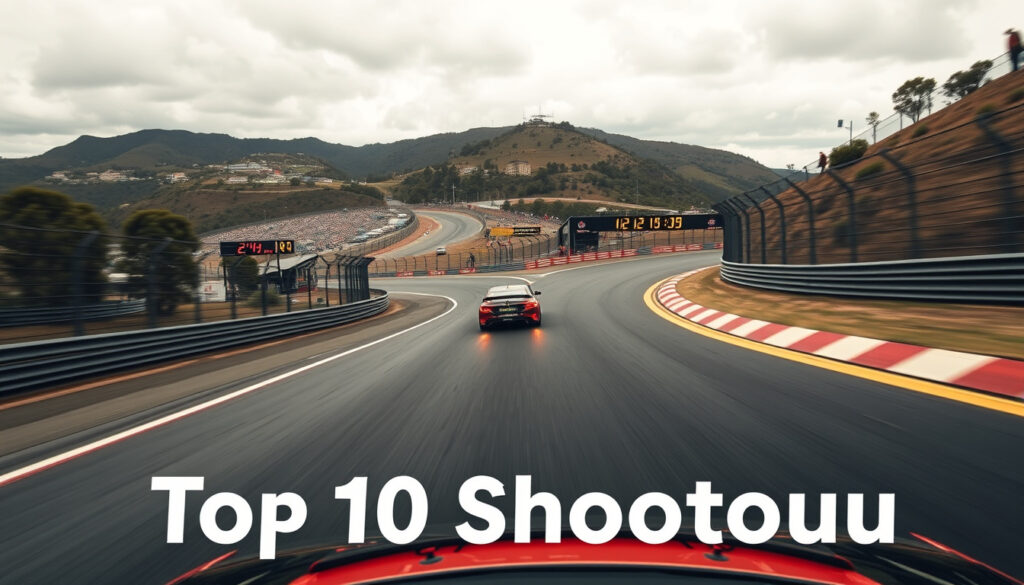
Bathurst Top 10 Shootout: Winners, Format, Deaths & Top Speed
One clean lap is all Bathurst asks of a Top 10 Shootout contender — ten drivers, one flying lap each, and the difference between pole and a mid-pack start can come down to a few tenths of a second. The format began in 1978 as Hardies Heroes, and its 2023 edition ended with Brodie Kostecki setting a Shootout record of 2:04.271, a mix of extreme speed and Saturday-afternoon pressure that still draws more attention than standard qualifying.
Shootout lap record: 2:04.271 (Brodie Kostecki, 2023) ·
Debuted: 1978 ·
Driver deaths at Mount Panorama since 1960: 10 ·
Conrod Straight top speed: 307 km/h (191 mph) ·
Runs every year since: 1978
Quick snapshot
- Brodie Kostecki won the 2023 Shootout with a 2:04.271 lap, beating Broc Feeney by 0.483s (Supercars’ official history).
- The Shootout debuted in 1978 as Hardies Heroes (Fox Sports Australia’s Bathurst records report).
- Peter Brock took the first Shootout pole in 1978 with a 2m20.0s lap (Supercars’ official history). (Supercars’ official history)
- At least 10 racing drivers have died at Mount Panorama since 1960 (Wikipedia’s Mount Panorama entry).
- 1978: the first Shootout, then called Hardies Heroes (Fox Sports Australia’s Bathurst records report).
- 2003: Greg Murphy’s 2:06.8594 lap was described as one that stunned fans and competitors (Supercars Travel’s Bathurst history guide). (Fox Sports Australia’s Bathurst records report)
- 2019: Scott McLaughlin set the fastest qualifying lap ever at Bathurst — 2:03.3782 (Supercars Travel’s Bathurst history guide). (Fox Sports Australia’s Bathurst records report)
- 2023: Kostecki’s 2:04.271 became the current Shootout lap record (Supercars’ official history). (Fox Sports Australia’s Bathurst records report)
- The Shootout has been part of every Bathurst 1000 weekend since 1978, and the Saturday-afternoon session remains the grid-decider (Supercars’ Shootout retrospective).
- Wet weather has repeatedly reshaped the Shootout: Wayne Gardner won in the rain in 2000, David Reynolds in 2015 (Supercars’ Shootout retrospective).
- McLaughlin’s 2019 benchmark (2:03.3782) is the qualifying target any new Shootout winner will be measured against (Team Penske’s race report).
Ten key figures, one pattern: the Shootout’s records are rare and hard-won — several have stood for decades, and the two most recent landmarks were set four years apart.
| Fact | Value | Reference |
|---|---|---|
| Shootout debuted | 1978, as Hardies Heroes | Fox Sports Australia |
| First Shootout winner | Peter Brock, 2m20.0s (1978) | Supercars |
| Most Shootout wins | Peter Brock — 9 | Supercars |
| Current Shootout lap record | 2:04.271 — Brodie Kostecki (2023) | Supercars |
| Outright Bathurst qualifying record | 2:03.3782 — Scott McLaughlin (2019) | Supercars Travel |
| Fastest race lap at Bathurst | 2:04.7602 — Shane van Gisbergen (2021) | Supercars Travel |
| Top speed on Conrod Straight (race trim) | 307 km/h (191 mph) | Fox Sports Australia |
| Closest Shootout win | 0.087s — Gary Scott over Allan Grice (1986) | Supercars |
| Largest Shootout win margin | 1.533s — Dick Johnson (1992) | Supercars |
| Driver deaths at Mount Panorama since 1960 | 10 | Wikipedia |
Read those numbers together and the Shootout’s character appears: the margins are tiny — Gary Scott’s 1986 win came by 0.087s — and the records are long-lived, with several standing for years before a new benchmark arrives.
Who won the top 10 shootout today?
The most recent Bathurst Top 10 Shootout result in the books is Brodie Kostecki’s 2023 win — a 2:04.271 lap that stands as the current Shootout lap record (Supercars’ official history).
Most recent winner details
- Winner: Brodie Kostecki, 2023 (Supercars’ official history)
- Lap time: 2:04.271 — a Shootout lap record (Supercars’ official history)
- Margin: 0.483s over Broc Feeney (Supercars’ official history)
Kostecki’s lap came at the end of a weekend in which the Supercars field was pushing the circuit’s limits. The 0.483s margin is roughly the time it takes to blink — and at Bathurst, a blink is enough to miss the braking point for the Chase.
The 2023 Shootout followed a format that has been part of the event since 1978: the ten fastest drivers from regular qualifying go out one at a time for a single flying lap.
Kostecki’s 2:04.271 tells the field exactly what a Bathurst Shootout lap requires: every corner must be clean, every kerb a controlled risk, because the difference between pole and the second row is measured in hundredths.
Why this matters: the 2023 Shootout did more than put Kostecki on pole — it reset the benchmark that every Supercars driver will chase until someone beats it.
Winning lap time and margin
A Shootout record is built on exit speed, not straight-line power alone. The driver who carries the most momentum through the final corners before Conrod is the one who arrives at the braking zone with the lap on the board.
- Kostecki’s winning time: 2:04.271, a new Shootout lap record (Supercars’ official history)
- Runner-up Broc Feeney was 0.483s behind (Supercars’ official history)
For comparison, the outright qualifying record at Mount Panorama is Scott McLaughlin’s 2:03.3782 from 2019 — still the fastest lap ever recorded around the mountain (Supercars Travel’s Bathurst history guide). That is why official summaries list Kostecki’s 2:04.271 as the current Shootout lap record while McLaughlin’s 2:03.3782 stands as the fastest qualifying lap ever recorded at Bathurst.
Impact on the race and championship
- The Shootout sets the top 10 for the Bathurst 1000 grid (Supercars Travel’s Bathurst history guide).
- Pole position means leading the field into the first corner on Sunday (Supercars Travel’s Bathurst history guide).
Starting first at Bathurst gives a crew the cleanest possible first lap and the freedom to run their own race — an advantage that can carry through a 1000-kilometre day. That is why teams treat the Shootout as a mini-race, not a formality.
The pattern: the Shootout rewards drivers who treat the lap as a race in itself — the ones who save something for Sunday tend to start further back.
The pattern: winning the Shootout is not just about speed, but about executing a perfect lap under the highest pressure of the weekend.
What is the top 10 shootout in Supercars?
The Top 10 Shootout is a single-lap qualifying session reserved for the ten fastest drivers after regular qualifying. The fastest lap wins pole position for the Bathurst 1000 (Supercars Travel’s Bathurst history guide).
Definition and purpose
- One-lap qualifying format for the top 10 (Supercars Travel’s Bathurst history guide)
- Reserved for the ten fastest drivers after regular qualifying (Supercars Travel’s Bathurst history guide)
- Fastest lap wins pole position for the Bathurst 1000 (Supercars Travel’s Bathurst history guide)
It debuted in 1978 under the name Hardies Heroes, and Peter Brock won that first Shootout with a 2m20.0s lap. Fox Sports notes that was a full minute quicker than the benchmark from 1964 (Fox Sports Australia’s Bathurst records report).
Since then the Shootout has been part of the Bathurst 1000’s identity — a compressed, high-stakes qualifying session that gives fans one clean lap from every contender.
History (starting in 1978)
- 1978: the Shootout launched as Hardies Heroes (Fox Sports Australia’s Bathurst records report)
- 1978–1985: drivers had two separate runs against the clock (Supercars’ Shootout retrospective)
- 1979–2002: held on Saturday morning (Supercars’ Shootout retrospective)
- Since 2003: held on Saturday under the setting sun (Supercars’ Shootout retrospective)
- 1986: Gary Scott became the first single-lap Shootout winner, beating Allan Grice by 0.087s (Supercars’ Shootout retrospective)
Those two-run years created a very different Shootout. The single-lap era that began in 1986 made every corner count, and the record book shows how fine the margins became: Dick Johnson holds the largest winning margin, 1.533s in 1992, with Klaus Ludwig’s 1.499s in 1987 close behind (Supercars’ Shootout retrospective).
Wet weather has also decided several Shootouts. Wayne Gardner won in the rain in 2000 with a 1.2306s margin, and David Reynolds did the same in 2015 with 1.1545s (Supercars’ Shootout retrospective).
Greg Murphy’s 2003 lap — 2:06.8594 — is still described by Supercars Travel as one that stunned fans and competitors (Supercars Travel’s Bathurst history guide).
The speed that makes the Shootout famous is the same speed that has made Mount Panorama dangerous: at least 10 racing drivers have died at the circuit since 1960 (Wikipedia’s Mount Panorama entry), and every record lap is set on a track modified in the wake of those deaths.
That history is why the Shootout format has stayed so tight. Bathurst shootouts have been a regular part of the Supercars championship over time, and the mountain remains its most famous stage (Supercars’ official history).
How the Shootout determines pole position
- Ten cars, one flying lap each (Supercars’ Shootout retrospective)
- The fastest lap wins pole for the Bathurst 1000 (Supercars Travel’s Bathurst history guide)
- Since 1986, no driver gets a second run (Supercars’ Shootout retrospective)
In practice, the Shootout is a qualifying race against the mountain. A driver who is fastest through the first two sectors can lose everything if the rear steps out on the way down Conrod. The car that wins is usually the one whose driver hit every apex — not necessarily the one with the most power.
The Saturday slot is part of the challenge: since 2003 the session has run as the sun drops over the circuit, which is why Shootout laps are remembered as evening runs in the official histories (Supercars’ Shootout retrospective).
Comparison to other qualifying formats
- 1978–1985: two runs against the clock (Supercars’ Shootout retrospective)
- 1986 onward: a single lap decides the grid (Supercars’ Shootout retrospective)
- Standard qualifying sessions allow repeated laps; the Shootout deliberately removes that margin for error
Greg Murphy’s 2003 lap of 2:06.8594 was so fast for its era that it earned the “lap of the gods” label in Supercars lore; Scott McLaughlin’s 2019 time of 2:03.3782 reset the benchmark for the modern generation (Supercars Travel’s Bathurst history guide). The difference between those laps — about three and a half seconds — shows how much the cars and the track changed in 16 years.
The trade-off: a format that gives fans pure one-lap drama also punishes the smallest mistake. The Shootout is the one session where a driver can be fastest all weekend and still start tenth.
The implication: the Shootout is a microcosm of Bathurst — a test of nerve, precision, and the ability to perform when a single mistake costs everything.
How many drivers were killed at Bathurst?
The most commonly cited toll for Mount Panorama is 10 racing drivers killed since 1960 (Wikipedia’s Mount Panorama entry). It is a number that appears in almost every serious discussion of the circuit’s safety record — and it shapes how the Shootout’s speed is perceived.
Fatalities at Mount Panorama circuit
- At least 10 racing drivers have died at Bathurst since 1960 (Wikipedia’s Mount Panorama entry)
- The toll is a minimum, not a complete ledger of everyone who has died at the circuit
The 10-driver toll counts racing drivers. It does not attempt to count non-drivers such as spectators or officials, whose deaths at the circuit are recorded separately and are harder to pin down in public summaries.
Those 10 deaths are why the circuit’s safety programme is part of the Shootout story — the same corners that produce 300 km/h runs have produced tragedy.
Notable driver deaths
- Mike Burgmann — killed during the 1986 Bathurst 1000 (Wikipedia’s Mount Panorama entry)
- Denny Hulme — died at the wheel in 1992 after a heart attack (Wikipedia’s Mount Panorama entry)
- Jon Davison and Mark Porter — killed in separate incidents at Mount Panorama (Wikipedia’s Mount Panorama entry)
The distinction between those cases matters. Burgmann died from injuries sustained in a crash; Hulme suffered a fatal medical emergency while driving. Both deaths are recorded in the circuit’s fatality list, but they represent different kinds of risk — the risk of impact, and the risk of the human body failing at speed.
Safety improvements over time
- The circuit has been modified to increase safety since the 1960s (Wikipedia’s Mount Panorama entry)
- 2005: safety barriers upgraded after further incidents (Wikipedia’s Mount Panorama entry)
- Modern Shootout record laps run on a track that has been continuously modified around the mountain’s most dangerous corners
Safety upgrades rarely make headlines, but they are the reason a 307 km/h lap down Conrod is not the death-defying gamble it was in 1986. The mountain’s danger has not disappeared — it has been managed.
The implication: when the Shootout sends a driver out for one lap at record speed, the car, the circuit and the medical response are all products of a safety evolution that began with those 10 deaths.
The catch: the speed that makes the Shootout famous is built on a foundation of safety lessons learned the hardest way.
What race car driver was killed at Bathurst?
Two names dominate that grim record: Mike Burgmann and Denny Hulme. Their deaths, in 1986 and 1992, bracket the era in which the Shootout grew from a novelty into a Bathurst institution.
High-profile cases: Burgmann and Hulme
- Mike Burgmann — killed during the 1986 Bathurst 1000 (Wikipedia’s Mount Panorama entry)
- Denny Hulme — died at the wheel in 1992 after a heart attack (Wikipedia’s Mount Panorama entry)
Burgmann’s crash happened in the Great Race itself, at a time when the Shootout was still young and the mountain’s speeds were climbing. Hulme’s death came six years later, also at the wheel.
Circumstances of each incident
- 1986: Burgmann’s crash occurred during the Bathurst 1000 (Wikipedia’s Mount Panorama entry)
- 1992: Hulme suffered a fatal heart attack while driving (Wikipedia’s Mount Panorama entry)
- Both deaths preceded the 2005 safety barrier upgrade (Wikipedia’s Mount Panorama entry)
The difference between a crash and a medical emergency matters when talking about circuit safety. Barriers, run-off and crash structures cannot prevent a heart attack; they can only make the aftermath survivable for other drivers. That distinction is part of why the death toll is treated as a record of risk, not as a simple list of crashes.
Legacy and memorials
- The circuit’s safety programme — including the 2005 barrier upgrades — is the main legacy of those deaths (Wikipedia’s Mount Panorama entry)
- The Shootout continues to run at record speeds — Kostecki’s 2023 lap record came 45 years after Brock’s first Shootout win (Supercars’ official history)
In the sources covered here, the legacy is the circuit itself — modified and hardened so the mountain can keep hosting the fastest show in Australian motorsport.
Why this matters: the Shootout’s record lap numbers are measured in seconds and kilometres per hour, but the history behind them is measured in driver lives — and the safety conversation around Bathurst never fully closes.
The legacy: every driver who steps onto the mountain for a Shootout lap runs on a circuit hardened by decades of tragedy and safety reform.
What is the top speed at Bathurst Conrod Straight?
Conrod Straight is the fastest section of Mount Panorama. The benchmark most often cited for a Supercar in race trim is 307 km/h (191 mph) (Fox Sports Australia’s Bathurst records report).
The official top speed record
- 307 km/h (191 mph) — top speed recorded in a Supercar on Conrod Straight (Fox Sports Australia’s Bathurst records report)
- Conrod Straight is the fastest section at Mount Panorama (Supercars Travel’s Bathurst history guide)
- The Shootout gives drivers a clear lap to set that kind of speed — no traffic, one flying lap (Supercars’ Shootout retrospective)
At that speed, a Supercar crosses the length of a football field every second. The Shootout’s fastest laps are built on the exit speed from the final corners before Conrod, and the braking point for the Chase at the end of the straight is where those races for pole are won or lost.
Factors that shape Conrod speed
- Gearing limits how fast a Supercar can go on Conrod (Fox Sports Australia’s Bathurst records report)
- Aerodynamics and downforce set how much speed the car can carry into the Chase (Fox Sports Australia’s Bathurst records report)
- Conrod Straight and the Chase are listed among the circuit’s most dangerous sections (Wikipedia’s Mount Panorama entry)
A car set up for more downforce will be slower on the straight but safer through the Chase; a car stripped of downforce will show a higher speed-trap number but arrive at the braking zone with less control. That trade-off is why the Shootout is not simply a horsepower contest.
Comparison to other straights in Supercars
- 307 km/h is the top speed cited for Supercars at Bathurst (Fox Sports Australia’s Bathurst records report)
- The fastest race lap around the full circuit is Shane van Gisbergen’s 2:04.7602 (2021) (Supercars Travel’s Bathurst history guide)
- The fastest qualifying lap is Scott McLaughlin’s 2:03.3782 (2019) (Supercars Travel’s Bathurst history guide)
The speed trap at the end of Conrod is the Shootout’s real scoreboard. The balance between straight-line speed and Chase braking is the difference between winning the Shootout and starting tenth — at 307 km/h, the braking zone is measured in metres, not car lengths.
The trade-off: every extra kilometre per hour on Conrod is a kilometre per hour that has to be scrubbed off before the Chase. That is the equation the Shootout asks every pole contender to solve in a single lap.
The takeaway: Conrod Straight is where the Shootout is won, but the Chase is where it can be lost.
The Shootout at Mount Panorama: a timeline
The Shootout’s history is also the mountain’s history. These are the dates that define both.
- — Mount Panorama circuit opens (Wikipedia’s Mount Panorama entry)
- — The Bathurst 1000, originally the Armstrong 500, is introduced (Supercars’ official history)
- — First Top 10 Shootout (Hardies Heroes); Peter Brock takes pole in 2m20.0s (Supercars’ official history)
- — Mike Burgmann killed during the Bathurst 1000 (Wikipedia’s Mount Panorama entry)
- — Denny Hulme dies of a heart attack at the wheel (Wikipedia’s Mount Panorama entry)
- — Shootout moves to Saturday afternoon; Greg Murphy records 2:06.8594 (Supercars Travel’s Bathurst history guide)
- — Safety barriers upgraded after further incidents (Wikipedia’s Mount Panorama entry)
- — Scott McLaughlin wins the Shootout with 2:03.3782, the fastest qualifying lap ever at Bathurst (Supercars Travel’s Bathurst history guide)
- — Brodie Kostecki sets the current Shootout lap record: 2:04.271 (Supercars’ official history)
The pattern: every speed milestone in the Shootout has arrived alongside a safety lesson, from the 1986 and 1992 deaths to the 2005 barrier upgrades. The lap record keeps moving; the mountain’s cautionary history stays fixed.
What’s confirmed and what’s still unclear
Separating verified fact from open question keeps the Shootout’s story honest — especially when the topic turns to speed and safety.
Confirmed facts
- Kostecki won the 2023 Shootout with 2:04.271, beating Feeney by 0.483s (Supercars’ official history)
- The Shootout has run every year since 1978 (Supercars’ official history)
- At least 10 racing drivers have died at Bathurst since 1960 (Wikipedia’s Mount Panorama entry)
What’s unclear
- The full number of non-driver deaths at Mount Panorama — spectators and officials included — is not consolidated in the widely cited toll.
- No public record in the sources reviewed here confirms or rules out a fatal crash during a Top 10 Shootout session itself.
- The current Shootout lap record (2:04.271) and the 2019 outright qualifying record (2:03.3782) are listed separately in official summaries, so direct cross-era comparisons are not explicit.
- Whether Brock’s nine pole wins are a universally reconciled count across both the two-run and single-lap eras is not fully explicit in widely cited sources.
- Whether McLaughlin’s 2019 qualifying lap can be directly compared to Shootout laps is a matter of record, as official summaries list them in separate categories.
Figures for driver deaths at Mount Panorama are drawn from publicly compiled histories and may not include every non-driver death at the circuit; the 10-driver toll is the figure cited in those records.
The confirmed list is stronger than the unclear list, and that is the right balance: the Shootout’s structure, winners and safety record are well documented, while the gaps are mostly about edge cases and non-driver incidents.
What this means: readers can trust the headline numbers — winners, records, lap times — while treating the broader fatality count as a minimum rather than a complete ledger.
Voices from the Shootout era
“Between 1978 and 1985, Bathurst Top 10 Shootout drivers had two separate runs against the clock.”
— Supercars’ Shootout retrospective
“A lap that stunned fans and competitors.”
— Supercars Travel’s Bathurst history guide, on Greg Murphy’s 2003 Shootout lap
“Scott McLaughlin wins Bathurst Top 10 Shootout.”
— Team Penske’s race report, 2019
Those voices span different decades, but they describe the same competition: the Shootout is where Bathurst’s speed becomes a story — and where the story stays written in tenths of a second.
The takeaway
The Bathurst Top 10 Shootout is the purest expression of what Mount Panorama demands: one lap, flat out, with a 307 km/h straight, a braking zone that punishes hesitation, and a record book that includes both triumph and tragedy. For any Supercars team chasing a Bathurst 1000 win, the choice is clear: master the one-lap format and start Sunday from the front — or leave the Shootout with an untidy lap and spend the entire 1000 kilometres fighting through traffic.
en.wikipedia.org, teampenske.com, en.wikipedia.org, foxsports.com.au, supercars.com, supercars.com, foxsports.com.au, aapnews.aap.com.au, 7news.com.au
Frequently asked questions
How many laps is the Bathurst Top 10 Shootout?
One. Each of the ten Shootout contenders gets a single flying lap. Between 1978 and 1985 drivers had two separate runs against the clock, but the one-lap format has applied since 1986 (Supercars’ Shootout retrospective).
What happens if a driver crashes during the Shootout?
The run is over — there is no second attempt in the modern format. Because each driver gets only one flying lap, a crash or off-track moment ends that driver’s Shootout (Supercars’ Shootout retrospective).
Can a driver improve their time in the Shootout?
No. Since 1986 the Shootout has been decided by a single lap per driver, so there is no opportunity to bank a lap and then try again (Supercars’ Shootout retrospective).
Is the Bathurst Top 10 Shootout used in any other race?
The Top 10 Shootout format has been a regular part of the Supercars championship over time, but Bathurst’s version has run every year since 1978 (Supercars’ official history).
Who has the most pole positions from the Shootout?
Peter Brock, with nine Shootout wins. Brock also won the inaugural 1978 Shootout, then called Hardies Heroes, with a 2m20.0s lap (Supercars’ official history).
Related reading
More related posts
 The Times Death Notices: UK Obituaries & Irish Times Guide
 Bee Swarm Simulator Codes (May 2026): Active Codes & Rewards
 Book a Bach Taupo: Holiday Homes & Rentals Guide 2025
 Alex Warren ‘Carry You Home’: Story, Meaning & Hypermobility
 Property Brokers New Plymouth: Houses, Rent & Real Estate
 Brake Pads Replacement Cost: Ireland Averages & Quotes
 How Many Tablespoons in 1/4 Cup? 4 Tbsp Chart & Guide
 Puppies for Sale Christchurch: Buying Guide & Breeder Tips