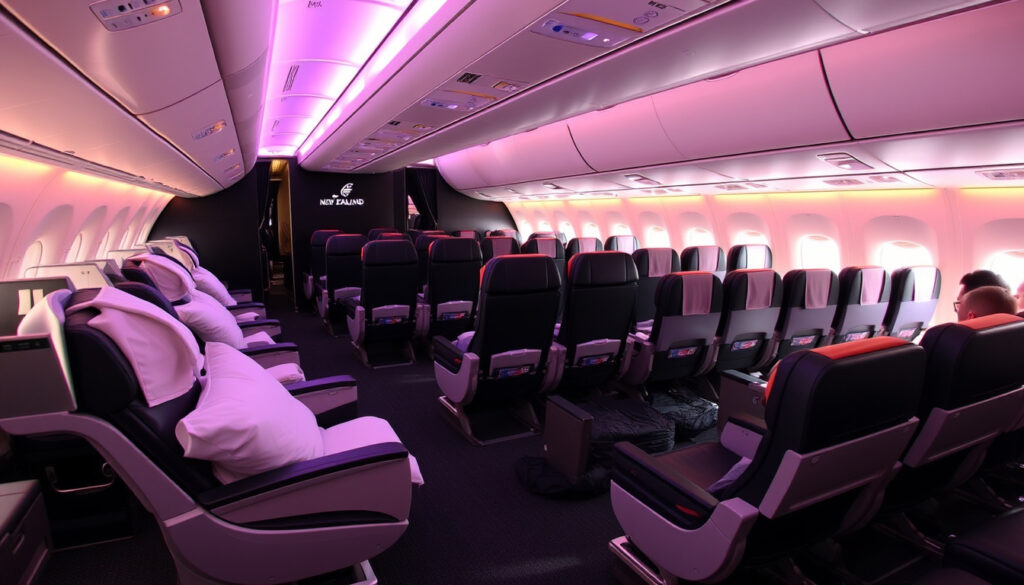
Air NZ 787-9 Seat Map: Economy, Business & Premium Economy
Few things matter more on a long-haul flight than the seat you end up in. If you’re booked on an Air New Zealand Boeing 787-9 Dreamliner, the seat map you see during booking might not tell the full story — the airline operates multiple cabin variants (V1, V2, V4, V5) that change seat counts and layouts. This guide breaks down the standard 302-seat configuration and explains how to spot the differences across variants, so you can pick the seat that actually fits your trip.
Total seats: 302 ·
Business class seats: 18 ·
Premium Economy seats: 21 ·
Economy seats: 263 ·
Variants: V1, V2, V4, V5
Quick snapshot
- Air New Zealand’s standard 787-9 has 302 seats in three classes (Air New Zealand (official seat map page))
- Business class has 18 lie-flat seats in rows 1-6 (Air New Zealand (official seat map page))
- Premium Economy has 21 seats in rows 23-25 (Air New Zealand (official seat map page))
- Exact Premium Economy seat pitch may vary by variant (Air New Zealand (official seat map page))
- Some seats may be designated as crew rest or have limited availability on certain variants (Air New Zealand (seat maps hub))
- First nine 787-9s delivered with 302 seats; later five arrived with 275 seats (Wikipedia (fleet summary))
- V3 variant introduces Business Premier Luxe and different cabin totals (Air New Zealand (official V3 map))
- Always check the official seat map before selecting seats – variants change seat counts and layouts (Air New Zealand (seat maps hub))
- Third-party aggregators list multiple variant configurations but may not be up to date (SeatMaps (third-party seat aggregator))
Six key specifications define the standard layout across all variants, but the numbers shift depending on which configuration you’re flying.
| Specification | Value | Source |
|---|---|---|
| Aircraft | Boeing 787-9 Dreamliner | Air New Zealand (official seat map page) |
| Total seats | 302 | Air New Zealand (official seat map page) |
| Business class seats | 18 (rows 1-6) | Air New Zealand (official seat map page) |
| Premium Economy seats | 21 (rows 23-25) | Air New Zealand (official seat map page) |
| Economy seats | 263 (rows 34-65) | Air New Zealand (official seat map page) |
| Variants | V1, V2, V4, V5 | Wikipedia (fleet summary) |
What is the seat map for Air New Zealand Boeing 787-9 economy class?
Economy cabin layout and row numbers
The standard 787-9 economy cabin occupies rows 34 through 65, with 263 seats in a 3-3-3 configuration. The official seat map from Air New Zealand (official seat map page) shows Economy Skycouch in rows 36–43 ABC and 36–41 HJK, offering a row of three seats that convert into a couch. On the V3 variant, Skycouch rows shift to 37–39 ABC and 41–46 HJK, and Economy Stretch (extra-legroom seats) appears in row 36 ABC and rows 36–40 HJK with 35-inch pitch (Air New Zealand (official V3 map)).
Seat pitch and width details
On the standard layout, economy seats have a pitch of 31 to 33 inches (78 to 83 cm) (Air New Zealand (official seat map page)). The V3 variant narrows the range slightly to 31–32 inches (78–81 cm) (Air New Zealand (official V3 map)). Standard seat width on the 787-9 Dreamliner is roughly 17.5 inches, though Air New Zealand does not publish exact width per variant.
Best economy seats and seats to avoid
- Best: Rows 34 (bulkhead – extra legroom, but near galley) and exit rows (typically rows 34–36 on standard layout, though exact exit row varies by variant).
- Avoid: Seats near lavatories (rows 48–50 area on standard map) and last rows (64–65) that may have limited recline.
- Skycouch seats (rows 36–43 ABC on standard) are great for couples/families but cost a premium.
“Frequent travelers note that economy seats in row 34 have extra legroom but are near the galley.” – anecdotal user reports
SeatGuru user reviews (aggregated from frequent flyer forums)
The biggest trap in economy: assuming all 787-9 maps are identical. On the V5 variant, some rows may be blocked for crew rest, reducing available seat selection.
The implication: if you’re after legroom, target exit rows or bulkhead – but check the variant, because seat positions shift between V1 and V3.
What is the seat map for Air New Zealand Boeing 787-9 business class?
Business class cabin layout rows 1-6
The standard business class cabin (called Business Premier) has 18 seats arranged in a 1-2-1 configuration across rows 1 to 6 (Air New Zealand (official seat map page)). On the V3 variant, Air New Zealand introduces Business Premier Luxe in row 1 and row 9, raising the total Business seat count to 42 (Air New Zealand (official V3 map)).
Lie-flat bed configuration and privacy
All standard Business Premier seats convert to fully lie-flat beds, 200 cm (78.7 inches) long (Air New Zealand (official seat map page)). The 1-2-1 layout means every seat has direct aisle access – a key advantage over older 2-2-2 configurations. The Luxe seats on V3 add a privacy door and a larger entertainment screen.
Which business class seats offer direct aisle access
- All 18 standard Business Premier seats offer direct aisle access.
- For window-seat privacy: choose odd-numbered rows (1A, 3A, 5A on left side; 1K, 3K, 5K on right) as they are more secluded.
- Bulkhead seats 1A and 6K have extra footwell space but may be closer to the galley.
Business on the standard 787-9 is consistent and private. But if you book a V3 flight, the extra Luxe seats in row 9 are a material upgrade in privacy – worth paying for if available.
The trade-off: Business Premier Luxe is only offered on V3-configured aircraft. Check your flight equipment before splurging on a seat upgrade.
What is the seat map for Air New Zealand Boeing 787-9 premium economy?
Premium Economy cabin rows 23-25
Premium Economy on the standard 787-9 has 21 seats in rows 23 to 25, in a 2-3-2 configuration (Air New Zealand (official seat map page)). The cabin is a dedicated section between Business and Economy. On the V3 variant, Premium Economy expands to 52 seats (rows 22–26 plus additional rows) (Air New Zealand (official V3 map)).
Seat specifications and amenities
Standard Premium Economy pitch is 41 inches (104 cm) (Air New Zealand (official seat map page)), identical on the V3 variant (Air New Zealand (official V3 map)). Seats have a width of about 18.5 inches, a footrest, and a larger entertainment screen. All Premium Economy seats have power outlets and USB ports.
Best premium economy seats
- Row 23 (bulkhead): extra legroom and no reclining seat in front, but tray table folds from the armrest.
- Window seats (A and K) are preferred for privacy and storage.
- Avoid row 25 (last row of the cabin) as recline may be limited and seats are near the galley curtain.
The pattern: Premium Economy is the most consistent cabin across variants – pitch stays at 41 inches, but seat count doubles on V3. If you book on a V3 aircraft, choose a seat in the dedicated section (rows 22–26) to avoid being near the Economy curtain.
Now that we’ve toured each class individually, a head-to-head comparison makes the trade-offs clearer.
Three classes, one trade-off: more legroom costs more, but the right seat can change an overnight flight from painful to restful.
| Feature | Business Premier | Premium Economy | Economy |
|---|---|---|---|
| Seats (standard) | 18 | 21 | 263 |
| Pitch | Lie-flat (200 cm) | 41 in (104 cm) | 31–33 in (78–83 cm) |
| Configuration | 1-2-1 | 2-3-2 | 3-3-3 |
| Aisle access | All seats | 88% of seats | 44% of seats |
| Power outlets | Yes | Yes | In select rows |
| Skycouch available | No | No | Yes (rows 36–43) |
What this means: Business and Premium Economy are predictable across variants, but Economy’s Skycouch and Stretch zones shift seat-by-seat depending on the aircraft configuration.
Beyond class-based specs, two material differences affect seat choice: seat count and pitch in the same cabin can differ by variant.
| Specification | Standard (V1/V2/V4/V5) | V3 Variant |
|---|---|---|
| Total seats | 302 | 272 (approx.) |
| Business seats | 18 | 42 (incl. Luxe) |
| Premium Economy seats | 21 | 52 |
| Economy seats | 263 | 125 (+ Stretch + Skycouch) |
| Economy pitch | 31–33 in | 31–32 in |
| Economy Stretch pitch | N/A | 35 in |
| Skycouch rows | 36–43 ABC / 36–41 HJK | 37–39 ABC / 41–46 HJK |
The takeaway: V3 aircraft pack more premium seats and fewer economy seats, but with tighter standard-economy pitch. If you’re flying economy on a V3, be sure to book an Economy Stretch seat for the extra few inches.
Clarity check
Confirmed facts
- Air New Zealand operates 787-9 aircraft with 302 seats in a three-class layout (Air New Zealand (official seat map page))
- Business class has 18 lie-flat seats (Air New Zealand (official seat map page))
- Premium Economy has 21 seats with 41-inch pitch (Air New Zealand (official seat map page))
- Economy has 263 seats with 31-33 inch pitch (Air New Zealand (official seat map page))
What’s unclear
- Exact Premium Economy seat width is not published per variant
- Some seats may be designated as crew rest on certain variants, limiting passenger selection
“View the Boeing 787-9 seat map with cabin layout, seating configuration, and position details.” – Air New Zealand (official seat map page)
Air New Zealand seat maps hub
“Business Premier seats convert to fully lie-flat beds, offering direct aisle access in a 1-2-1 configuration.” – Air New Zealand (official seat map page)
Air New Zealand business class overview
For travelers flying Air New Zealand’s 787-9, the choice of variant matters more than the class name. A seat that looks like a great pick on a V1 map could be a poor choice on a V5. The concrete consequence: check your flight’s specific seat map before paying extra for seat selection, or risk ending up in a seat with less recline or more foot traffic than you bargained for.
airnewzealand.com, airnewzealand.com, seatrecon.com, aerolopa.com, cabin.coach, aucklandjournal.nz, seatmaps.com, seatcompare.ai, aerolopa.com
Frequently asked questions
How many seats are on the Air New Zealand 787-9?
302 seats in the standard configuration (18 Business, 21 Premium Economy, 263 Economy). Some variants (V3) have different counts.
What is the best seat on Air New Zealand 787-9 for couples?
In Economy, choose a Skycouch row (36–43 ABC on standard) for a row of three seats that converts into a couch. In Business, window seats (A or K) in odd-numbered rows offer privacy.
Does Air New Zealand 787-9 have power outlets?
Yes – all Business and Premium Economy seats have power outlets and USB ports. In Economy, outlets are available in select rows (check the seat map for your specific flight).
Are there any seats to avoid on the Air New Zealand 787-9?
Avoid last-row seats in any cabin (limited recline, near lavatories) and seats near the galley (row 34 in Economy, row 6 in Business).
What is the seat pitch in business class on Air New Zealand 787-9?
Business Premier seats convert to fully lie-flat beds (200 cm / 78.7 inches). There is no standard seat pitch measurement – the seat itself becomes a bed.
Can I select my seat for free on Air New Zealand 787-9?
Seat selection is free for Business and Premium Economy passengers and for those on certain fare types. Economy passengers on flexible fares or with elite status may also select seats for free. Basic fares charge a fee.
How do the seat map variants (V1, V2, V4, V5) differ?
The main variants (V1–V5) differ in seat counts, cabin product (e.g., Business Premier Luxe on V3), and arrangement of Skycouch and Stretch rows. The standard 302-seat configuration applies to V1, V2, V4, V5; V3 introduces higher-density premium seating with fewer economy seats.
More related posts
 Bank lowers mortgage rates: Irish 2026 guide for borrowers
 Motel for Sale NZ: Complete Guide to Buying in 2025
 Personal Loan Repayment Calculator: Rates & Monthly Payments
 A Good Girls Book Series: Order, Age Rating, Netflix Guide
 Full Moon February 2026 – Snow Moon Date Time Viewing Guide
 Seahawks vs 49ers Match Player Stats: 2026 Playoff Breakdown
 Waiotapu Thermal Wonderland Walk Time & Ticket Guide
 ANZ Floating Interest Rate 2025: Current Rates and Guide