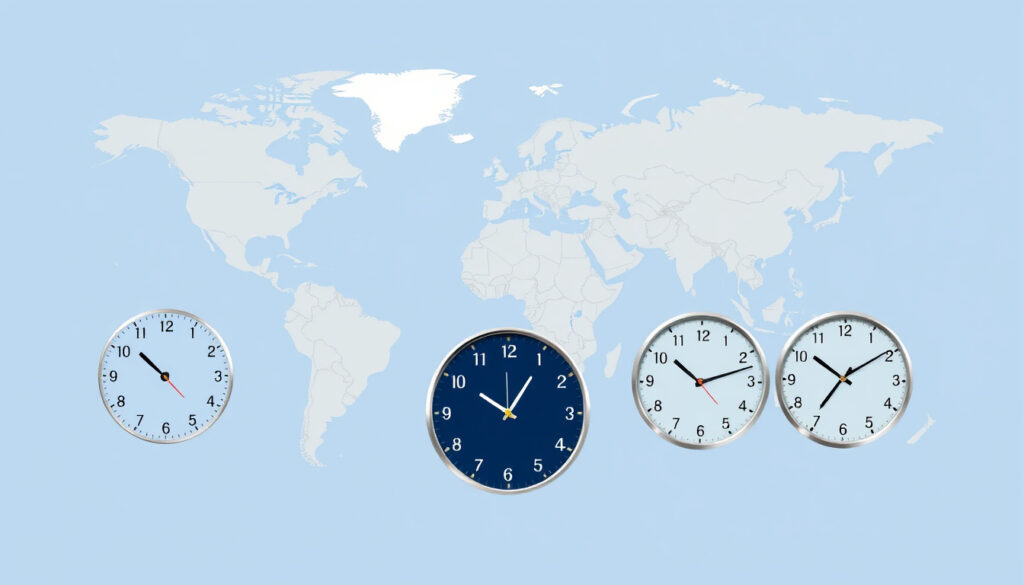
Time Difference Between NZ and UK: 11, 12, or 13 Hours
Anyone who’s tried to schedule a call between New Zealand and the UK quickly learns the answer is never just one number — the time difference shifts between 11, 12, and 13 hours depending on the season, and misjudging it means waking someone at 3 AM. This guide lays out exactly why the gap varies, with concrete conversion examples and the official clock-change dates from both countries.
Standard time difference (NZST vs GMT/BST): New Zealand is 11 to 12 hours ahead of the UK, depending on daylight saving ·
Daylight saving offset (NZDT vs GMT/BST): During New Zealand daylight saving, the difference can be 12 or 13 hours ahead ·
Common conversion example: When it is 9:00 AM in London (winter), it is 8:00 PM the same day in Auckland
Quick snapshot
- New Zealand uses NZST (UTC+12) from early April to late September (New Zealand Government – official DST page)
- New Zealand uses NZDT (UTC+13) from late September to early April (New Zealand Government – official DST page)
- The UK uses GMT (UTC+0) from late October to late March (GOV.UK – official clock-change schedule)
- The UK uses BST (UTC+1) from late March to late October (GOV.UK – official clock-change schedule)
- Exact transition dates vary each year – NZ uses last Sunday in September / first Sunday in April; UK uses last Sunday in March / last Sunday in October (New Zealand Government, GOV.UK)
- Chatham Islands (UTC+12:45) are 45 minutes ahead of mainland NZ, adding complexity for UK conversions (New Zealand Government)
- The 13-hour gap occurs when NZ is on NZDT (UTC+13) and the UK is on GMT (UTC+0) – typically November, December, January (timeanddate – Auckland/London conversion)
- Next UK clock change: 29 March 2026 (forward) and 25 October 2026 (back) (GOV.UK JSON – upcoming dates)
- Next NZ clock change: 5 April 2026 (back) and 27 September 2026 (forward) (New Zealand Government)
- After 5 April 2026, NZ moves to NZST; UK remains on GMT until 29 March (BST starts) – gap becomes 13 hours. (New Zealand Government, GOV.UK)
- After 27 September 2026, NZ moves to NZDT; UK still on BST – gap becomes 11 hours. (New Zealand Government, GOV.UK)
- After 25 October 2026, UK moves to GMT – gap becomes 13 hours again until NZ moves back. (GOV.UK)
Six key facts, one pattern: the time difference between New Zealand and the UK depends entirely on which side of the daylight-saving line each country sits at a given moment.
| Label | Value |
|---|---|
| NZ Standard Time offset | UTC+12 |
| NZ Daylight Time offset | UTC+13 |
| UK Summer Time offset (BST) | UTC+1 |
| UK Winter Time offset (GMT) | UTC+0 |
| Number of New Zealand time zones | 2 (mainland and Chatham Islands) |
What time is it in New Zealand when it’s 9am in the UK?
9am UK in winter vs summer
- If the UK is on GMT (winter, late October to late March) and NZ is on NZDT (summer, late September to early April), 9am UK = 10pm NZ (13-hour gap).
- If the UK is on BST (summer, late March to late October) and NZ is on NZST (winter, early April to late September), 9am UK = 8pm NZ (11-hour gap).
- During overlapping standard periods (both on standard time, rare) or both on daylight time (also rare), the gap is 12 hours.
Example in November: 9am London (GMT) = 10pm Auckland (NZDT). Example in June: 9am London (BST) = 8pm Auckland (NZST).
9am UK to NZ using NZST and NZDT
- When NZ is on NZST (UTC+12) and UK is on GMT (UTC+0): 9am UK = 9pm NZ (12-hour difference).
- When NZ is on NZDT (UTC+13) and UK is on BST (UTC+1): 9am UK = 9pm NZ (12-hour difference).
- The only time you see a clean 12-hour conversion is during the brief overlap periods (about 2–3 weeks in March and October).
Is New Zealand 12 hours ahead of the UK?
Standard time: 11 or 12 hours
- When both countries are on standard time (NZST and GMT), the difference is exactly 12 hours. This occurs only during the few weeks when NZ has ended DST but the UK hasn’t started it (early April) and vice versa (late October).
- During most of the year, the difference is either 11 hours (both on DST) or 13 hours (NZ on DST, UK on standard).
Daylight saving effects
- When NZ is on summer time (NZDT) and the UK is on summer time (BST), the gap is 11 hours – Auckland is ahead. Savvy Time (time converter) confirms BST is 11 hours behind NZST.
- When NZ is on summer time (NZDT) and the UK is on winter time (GMT), the gap is 13 hours – this happens from late September to late October and from late March to early April.
- Pure 12-hour difference exists for roughly 4–6 weeks per year total: the overlap windows.
The catch: Asking “is NZ 12 hours ahead?” is like asking “is it winter?” – the answer depends on the calendar month. Always check the current daylight-saving status for both countries.
Why is New Zealand 13 hours ahead?
Role of daylight saving in both countries
- New Zealand observes daylight saving from late September to early April, shifting to UTC+13 (New Zealand Government – DST schedule).
- The UK observes daylight saving from late March to late October, shifting to UTC+1 (GOV.UK – UK clock-change dates).
- For about 6 months of the year (late September to late March), NZ is on NZDT while the UK is on GMT, producing a 13-hour gap.
Seasonal timing mismatch
- The 13-hour gap occurs because New Zealand’s DST period is shifted relative to the UK’s – NZ’s summer DST runs October–March, while the UK’s runs April–September.
- In November, December, and January, NZ is in full summer (NZDT) and the UK is in deep winter (GMT) – the gap is consistently 13 hours.
- TheBestTimeToVisit.com (travel resource) states that in 2026 the Auckland–London difference is 13 hours before UK BST starts, 12 hours when only NZ is on DST, and 11 hours when both are on DST.
Why this matters: Anyone scheduling calls or travel in November, December, or January faces a 13-hour gap. That’s the worst-case for a London–Auckland video call: 9am London is 10pm Auckland – past most people’s bedtime.
What is the time difference between Auckland and London?
The time gap between Auckland and London falls into one of three patterns depending on the season.
| Scenario | London time | Auckland time | Gap |
|---|---|---|---|
| Both on standard (rare overlap) | 9:00 AM GMT | 9:00 PM NZST | 12 hours |
| Both on DST (April–September) | 9:00 AM BST | 8:00 PM NZST | 11 hours |
| NZ DST, UK standard (Nov–Jan) | 9:00 AM GMT | 10:00 PM NZDT | 13 hours |
The pattern: Auckland is never less than 11 hours ahead of London, and the gap has three distinct modes. Travelmath (time-change calculator) shows Auckland at UTC+13 while London is at UTC+0 in the conversion, illustrating the 13-hour scenario.
Are there two time zones in New Zealand?
NZST (UTC+12) and Chatham Islands (UTC+12:45)
- Mainland New Zealand uses NZST/NZDT – the clocks you see in Auckland, Wellington, Christchurch.
- The Chatham Islands are 45 minutes ahead of the mainland, on CHAST/CHADT (New Zealand Government – DST page notes Chatham exception).
- For UK time conversions, always use Auckland or Wellington time – the Chatham offset is relevant only if you’re specifically dealing with someone in the Chatham Islands.
How this affects time conversion to UK
- If you see a converter showing UTC+12:45 for New Zealand, it’s likely using Chatham time. Stick with Pacific/Auckland (UTC+12/13) for standard NZ–UK conversions.
- Zeitverschiebung (time-difference site) shows London at UTC+1 during DST and UTC+0 otherwise, and Auckland at UTC+12/13 – no 45-minute offset for mainland.
The implication: If you’re dealing with Chatham residents, add 45 minutes to the mainland NZ time. For most business or personal calls, ignore Chatham.
Confirmed facts vs. what remains unclear
Confirmed facts
- New Zealand uses NZST (UTC+12) from early April to late September. (New Zealand Government)
- New Zealand uses NZDT (UTC+13) from late September to early April. (New Zealand Government)
- The UK uses GMT (UTC+0) from late October to late March. (GOV.UK)
- The UK uses BST (UTC+1) from late March to late October. (GOV.UK)
What’s unclear
- Exact transition dates shift by 1–7 days each year (NZ: last Sunday Sep, first Sunday Apr; UK: last Sunday Mar, last Sunday Oct). Checks for the current year are required.
- The Chatham Islands’ 45-minute offset is often omitted in generic converters, leading to potential errors if you assume mainland time applies island-wide.
What experts say
“Daylight saving starts at 2am on the last Sunday in September and ends at 3am on the first Sunday in April.”
New Zealand Government – official DST guidance
“The UK clocks go forward on Sunday March 29, 2026 and back on Sunday October 25, 2026.”
“Auckland is currently on standard time in the 2026 converter snippets, while London is on daylight saving time in some snapshots, producing an 11-hour difference.”
UseBaseTime – Auckland–London time-difference converter
For anyone arranging calls or travel between New Zealand and the UK, the simple rule: From April to September, expect an 11-hour gap. From October to March, expect 13 hours (especially November–January). Only during the transition weeks of late March and late October does a 12-hour gap appear. A quick check of both countries’ current DST status eliminates guesswork.
Frequently asked questions
What time is it in New Zealand when it is 10am in England?
If the UK is on GMT (winter), 10am = 11pm NZDT (13h gap). If the UK is on BST (summer), 10am = 9pm NZST (11h gap). If both are on standard time (rare overlap), 10am = 10pm.
Is New Zealand 11 hours ahead of the UK during British Summer Time?
Yes, when the UK is on BST (UTC+1) and New Zealand is on NZST (UTC+12), the difference is 11 hours. But if NZ is on NZDT (summer) and UK is on BST, the difference is 12 hours.
How does the Chatham Islands time zone affect UK conversions?
Chatham Islands are 45 minutes ahead of mainland NZ. Most UK conversions use Auckland/Wellington time; you only need to add 45 minutes if you’re converting for someone in the Chathams.
What is the time difference between New Zealand and the UK in December?
In December, NZ is on NZDT (UTC+13) and the UK is on GMT (UTC+0), so the difference is 13 hours. 9am London = 10pm Auckland.
How do I convert 7pm UK time to New Zealand time?
7pm UK: if UK is on GMT, NZ time = 7pm + 12/13h → 7am/8am next day. If UK is on BST, 7pm + 11h = 6am next day. Use a live converter for the exact current gap.
Does New Zealand observe daylight saving at the same time as the UK?
No. NZ DST runs September–April; UK DST runs March–October. They overlap for only a few weeks (late March to early April), and even then the DST offset difference means the gap is 12 hours.
What is the easiest way to calculate the time difference between NZ and UK?
Add 12 hours to UK time, then adjust: +1 hour if NZ is on DST and UK is not; –1 hour if UK is on DST and NZ is not. For current conversions, use timeanddate’s Auckland–London converter.
More related posts
 Tau Lin Chinese Takeaways Menu: Mangawhai Prices & Top Picks
 Queen Fitted Sheet NZ: Sizes, Prices & Where to Buy
 Property Brokers New Plymouth: Houses, Rent & Real Estate
 Seahawks vs 49ers Match Player Stats: 2026 Playoff Breakdown
 Southern Lights New Zealand 2026: Aurora Australis Viewing Guide
 Snap Fitness Palmerston North: Prices, Hours & Reviews
 South New Brighton School: Uniform, Decile, Term Dates & Fees
 Mike and Claire Sardina: True Story of Lightning and Thunder