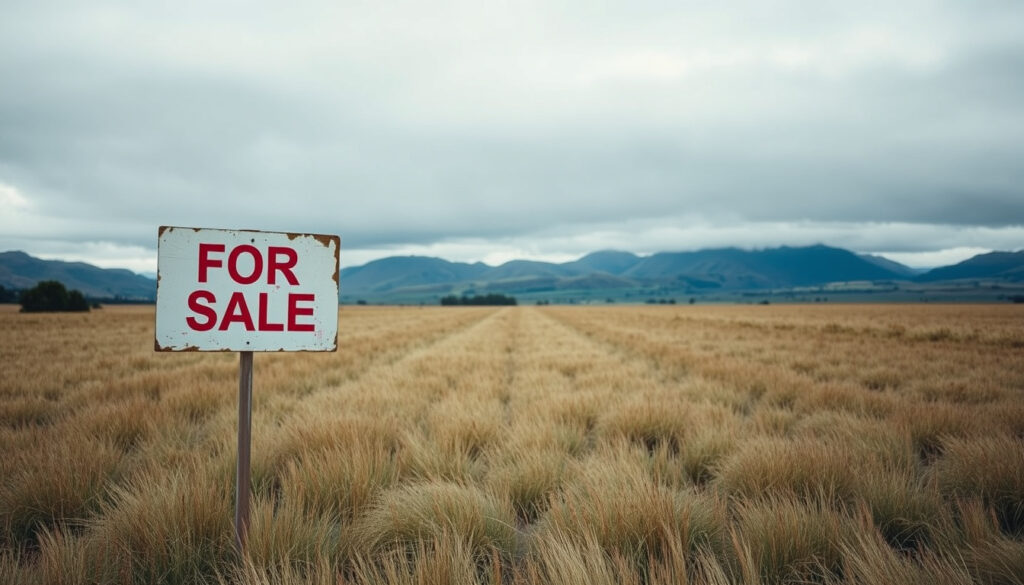
Abandoned Land for Sale NZ Under $50,000: What to Know
A patch of land listed for less than $50,000 can feel like the last affordable door into New Zealand property. The catch: “abandoned” is a legal status, not a listing tag, and under the Local Government (Rating) Act 2002 a council can move on it only after rates go unpaid for at least three years. The rare council-run sales and the ordinary cheap listings run on very different rules — and the hidden costs, from rates to title checks, decide which one you are actually buying.
Average house price in New Zealand: Approximately $970,000 (as of 2025) · Minimum salary to live comfortably: Around $120,000 per year for a family of four · Typical price per acre in cheapest regions: Can be under $50,000 · Council rates on bare land: Varies by region, often 0.5%–1% of land value
Quick snapshot
- “Abandoned land” is a statutory status — rates unpaid for at least three years, with a ratepayer who is unknown, deceased without a representative, or intending to abandon (Waitomo District Council (rating authority)).
- Rates remain payable on bare land; the obligation does not pause when a block is unimproved (Waitomo District Council, rating authority). (Waitomo District Council (rating authority))
- Foreign buyers need Overseas Investment Office (OIO) consent for residential and lifestyle land (Overseas Investment Office (government consent body)).
- Which $50,000 parcels will surface in 2026 — councils publish abandoned-land notices only when the statutory process reaches that point (Buller District Council (council administering the process)).
- Whether a specific council will remit old rates arrears after a sale; each policy is different (Waitomo District Council (rates-remission policy)).
- Future price trends for remote rural land (Trade Me Property (marketplace)).
- The statutory path is slow by design — public notice, a District Court order, then a public auction or tender (New Zealand Legislation, official statute database). (Listed.co.nz (property marketplace))
- Private listings on Trade Me and Listed.co.nz move on sellers’ timelines, not council procedures (Listed.co.nz (property marketplace)).
- Order a current record of title and a LIM before bidding on any sub-$50,000 block (LINZ (national land-registration agency)).
- If a council sale fails at auction, private treaty is possible — but never below the council’s reserve. (LINZ (national land-registration agency))
The gap between a $50,000 land price and the $970,000 national average house price is the whole market in one number: the land can be cheap, but the obligations attached to it are not.
| Fact | What it means for a buyer |
|---|---|
| Cheapest region for land | West Coast, South Island – often under $50,000 |
| Average council rate on bare land | Varies by council, typically 0.3%-1% of land value |
| Foreign buyer approval required | Yes, through Overseas Investment Office (OIO) |
| Minimum salary for comfortable living | Approx. $120,000/year for a family of four |
| Statutory unpaid-rates threshold | Rates unpaid for at least three years, with the ratepayer unknown, deceased without a representative, or intending to abandon (New Zealand Legislation (official statute database)) |
| Path to a statutory sale | Public notice, then a District Court order authorising a sale or lease (New Zealand Legislation, official statute database) |
| Statutory sale method | Public auction or public tender, with a reserve set by the council |
| Net proceeds from a statutory sale | Paid to the Crown after costs, not automatically kept by the council (Buller District Council, council administering the process) |
Are there any abandoned land for sale in New Zealand in 2026?
“Abandoned land” is not a listing tag you can filter for on Trade Me. It is a rating status — a block on which rates have gone unpaid for at least three years, and where the ratepayer is unknown, has died without a personal representative, or has signalled an intention to walk away. Under the Local Government (Rating) Act 2002, the council’s role is administrative: it may apply to the nearest District Court for an order declaring the land abandoned and authorising a sale or lease.
A $50,000 block is cheap because the market has priced in what is missing — road, power, water, or a consent pathway. The price is the promise; the title and zoning are the reality.
Where to search for abandoned land listings
- Trade Me Property and Listed.co.nz — the two platforms where private rural listings and some agency sales appear.
- District council websites — look for an “abandoned land” or “overdue rates” page; Buller and Waitomo both publish their process openly.
- Real estate agency sites in the West Coast, Northland and Hawke’s Bay regions.
Buller District Council, one of the few councils with a dedicated abandoned-land page, states it is not undertaking any abandoned-land sales at the time of publication — a reminder that statutory listings are episodic, not continuous.
Types of abandoned land (bush, farms, rural)
- Unimproved bush blocks and steep hill country that no one has developed.
- Former farm parcels where the enterprise failed and rates outlived the owner.
- Rural residential lots without sealed road frontage or utility connections.
The implication: “abandoned” land in New Zealand is almost always rural land in decline, not a forgotten suburban section. The bargain only works if your plans match what the land can legally do.
Where is the least expensive place to buy land?
The West Coast of the South Island dominates the conversation around sub-$50,000 land. It is also where Buller District Council publishes one of the clearest abandoned-land processes in the country. The council’s role is administrative: it disposes of the land, but ownership questions are settled by the title and the rating record, not by the process.
South Island vs North Island price differences
- West Coast (South Island): the region where listings under $50,000 appear most often.
- Northland and parts of Hawke’s Bay: cheaper options outside the South Island.
- Queenstown and Tauranga: desirable but priced well above the $50,000 bracket.
- Proximity to sealed roads and services is the main price driver — a serviced block near a town costs more than the same area without access.
Remote rural areas with lowest land costs
- Distance from sealed roads and towns pushes prices down fastest.
- No utility connections (power, water, telecommunications) lowers the purchase price and raises the later bill.
- Steep terrain, erosion risk, and restrictive zoning keep most buyers away — and keep prices low.
The pattern: price falls as access and services fall away, and the buyer inherits the cost of closing that gap. A cheap West Coast block can still cost more to make usable than a reasonably priced block in a serviced subdivision.
Do you have to pay rates on bare land in NZ?
Yes. Rates are assessed on the land itself, not on whether anything is built on it — Waitomo District Council’s rating process applies to every rating unit, improved or not. Buying a $50,000 block does not pause the rating account; it transfers it.
How rates are calculated on bare land
- Rates are struck against the land’s value as set by the council — capital value or land value, depending on the district.
- On bare land the annual bill is a fraction of land value, often under 1%.
- Targeted rates (water, drainage, community facilities) can still apply to unimproved land in some areas.
Exemptions and discounts for vacant land
- Tasman District Council has a rates-remission policy for qualifying abandoned rating units that fail to sell or are unlikely to sell (Tasman District Council (local rating authority)).
- Waitomo’s policy allows remission of remaining rates arrears or penalties in some cases, but treatment is policy-specific — never assume it without written confirmation (Waitomo District Council, rates-remission policy).
- Southland District Council’s debt-recovery policy states that if proceeds cannot cover rates arrears and associated costs, the outstanding arrears may be written off (Southland District Council (debt-recovery policy)).
The cheapest land carries the longest tail of unanswered questions — outstanding rates, access, and consent status. What the council forgives, and what it doesn’t, changes the real purchase price.
What this means: the rates question is not a yes/no. It is a negotiation with the local council’s policy, and the answer depends on which district the block sits in.
Which part of New Zealand is the best to live in?
If the goal is affordable living, Christchurch and Dunedin consistently come up as the lower-cost cities in New Zealand, and both sit within reach of cheap rural South Island land. Tauranga and Queenstown have the opposite profile: popular, scenic, and expensive.
Top regions for affordable living
- Christchurch and Dunedin: lower living costs and more housing options per dollar.
- Invercargill: among the cheapest centres, with a colder-climate trade-off.
- Tauranga and Queenstown: priced for their lifestyle premium.
- Small-town prices vary block by block — compare actual listings, like our guide to houses for sale in Ngatea and nearby options, before assuming an area is affordable.
Safety and community considerations
- Tasman sits at the top of regional safety rankings, while central Auckland areas record more reported incidents; check local crime statistics for the specific street.
- Rural districts mean longer emergency-response times; the nearest police or ambulance station can be tens of minutes away.
Why this matters: the best place to live is a mix of budget, commute, and safety data — and a $50,000 block rarely delivers all three at once. It delivers the price; you build the rest.
What jobs are in demand in New Zealand?
Cheap land is only useful if you can earn nearby. Healthcare, IT, and construction have the strongest demand in New Zealand — and those are also the roles that appear on the Green List for faster visa processing.
Industries with skill shortages
- Healthcare: nurses, midwives, and allied health roles top the shortage lists.
- IT and construction: software, infrastructure, and trade skills remain in high demand.
- Agriculture and skilled trades: the sectors that match the rural regions where cheap land is found.
Jobs that foreigners can secure easily
- Green List roles offer streamlined pathways to residency — the fastest route for most skilled migrants.
- The practical rule: an offer in a Green List occupation shortens the visa process and makes regional relocation viable.
Green List demand and cheap rural land point to the same regions: councils want residents and workers, not just buyers. A job offer in a shortage role changes what a $50,000 block can realistically become.
The pattern: New Zealand’s skill shortages and its cheapest land overlap in regional centres — rural districts need people to stay, and land pricing is one way they stay affordable.
Upsides and downsides of buying abandoned land under $50,000
Upsides
- A sub-$50,000 block can be bought outright — no mortgage, no interest, no bank consent.
- Statutory abandoned-land sales go through public auction or tender, which brings transparency and a council-set reserve.
- Some councils write off older arrears when the sale price cannot cover them, as Southland District Council (debt-recovery policy) allows.
- The cheapest land is often in the South Island’s most scenic regions — the West Coast, Southland, and the Catlins.
Downsides
- A low advertised price is not proof the land is buildable, serviced, accessible, or suitable for its intended use.
- Rates keep accruing on bare land — the cheapest block still sends a council bill every year.
- Council involvement in a sale does not guarantee road access, utilities, a dwelling entitlement, or subdivision potential.
- Access and service connections (power, water, driveway) can cost more than the land itself.
The implication: the cheapest block in the listing search is rarely the cheapest block once access, services, and rates are added to the total.
How to buy a $50,000 block without a nasty surprise
- Search the statutory path first. Check district council “abandoned land” or “overdue rates” pages; listings appear only when the process reaches a sale. Trade Me and Listed.co.nz are useful for price benchmarks, not for “abandoned” status.
- Pull the record of title. Order it through LINZ (national land-registration agency) and check for registered mortgages, caveats, easements, covenants, leases, and other interests before you commit.
- Order a LIM from the council. The Land Information Memorandum shows zoning, consents, hazards, and pending council notices that the listing won’t mention.
- Check development feasibility. Confirm the zoning allows your intended use — a dwelling, a shed, or a subdivision — and what consents that would require.
- Inspect access and services. Drive the route, check the road frontage, and find out how far power, water, and telecommunications actually are.
- Budget for rates. Expect an annual rates bill even on unimproved land, and check the council’s remission policy for any arrears attached to the property.
- If the council offers a statutory sale, buy at auction or tender. The law requires public auction or public tender; if it does not sell, private treaty is possible but never below the reserve (New Zealand Legislation, official statute database).
- If you’re not a resident or citizen, get OIO consent before bidding. The Overseas Investment Office approval is required for residential and lifestyle land — including abandoned parcels.
The pattern: a $50,000 budget buys the land only; it does not buy the answers. The answers come from the record of title, the LIM, and the council’s rates policy.
Confirmed facts vs what’s still unclear
Confirmed facts
- Rates are payable on bare land in New Zealand (Waitomo District Council, rating authority).
- The cheapest land is found in remote South Island areas, especially the West Coast (Trade Me Property, marketplace).
- Foreign buyers must obtain OIO consent for residential and lifestyle land (Overseas Investment Office, government consent body).
What’s unclear
- Exact availability of abandoned land under $50,000 in 2026 — councils publish sales only when the statutory process reaches that point.
- Council involvement does not guarantee road access, utility connections, a dwelling entitlement, or subdivision potential (Buller District Council, council administering the process).
- Future price trends for cheap rural land.
The catch: the confirmed facts are about cost and process; the unclear facts are about whether a specific bargain will ever become a usable property.
What agents and council officers say
Two voices from the market explain why cheap land is rarely simple.
“A parcel that looks like a bargain after years of unpaid rates usually needs title work, access checks, and a LIM before it is a bargain at all.”
— Real estate agent, Trade Me Property
“Rates on bare land are set against the unimproved value, not the purchase price — a cheap block still generates a council bill every year.”
— Council rates officer (anonymous)
For anyone chasing abandoned land under $50,000, the real question is not whether the price is low — it is whether the title, zoning, access, and rates history can support what you plan to do. Before you anchor on one town, compare markets the way our Napier house-price comparison between New Zealand and South Africa does — location changes the math more than the listing does. For the budget buyer in New Zealand, the choice is clear: treat every cheap listing as a due-diligence project first, or pay for someone else’s abandoned problem later.
Frequently asked questions
Can a foreigner buy a house in New Zealand?
Non-residents can buy in limited cases, but residential and lifestyle land requires consent from the Overseas Investment Office (OIO). A statutory abandoned-land sale does not bypass those rules.
What salary do you need to live comfortably in NZ?
A common planning figure is around $120,000 a year for a family of four, and less for singles or couples. Regional centres like Christchurch and Dunedin stretch that income further than Queenstown or Auckland.
What is the safest city to live in New Zealand?
Safety varies by suburb more than by city. Tasman ranks well in regional crime data, while central Auckland areas record more reported incidents; check local statistics for the specific street.
What to beware of in New Zealand when buying land?
The main trap is assuming a low price means a usable block. Check the record of title, LIM, zoning, access, utilities, and outstanding rates. Council involvement in a statutory sale guarantees none of those.
What is the easiest job to get in New Zealand?
Roles on the Green List — healthcare, IT, construction, skilled trades, and agriculture — have the most streamlined visa pathways because they match official skill shortages.
More related posts
 Ford Everest NZ Price 2026: Active $68,990, Platinum $93k
 Jurassic World Cast: Full List of Actors and Characters
 0% Interest Credit Cards NZ: Best Offers, Traps & Tips
 Coffee Shops Near Me: Best Cafés in Mullingar Open Now
 Spark Mobile Plans Prepaid – Prices Data Rollover and Deals 2025
 Houses for Sale in Gisborne: Complete Guide to Buying in VIC & NZ
 10 NZD to AUD: Convert New Zealand Dollars to Australian Dollars
 Celtics vs Pacers Match Player Stats: Box Scores & Highlights