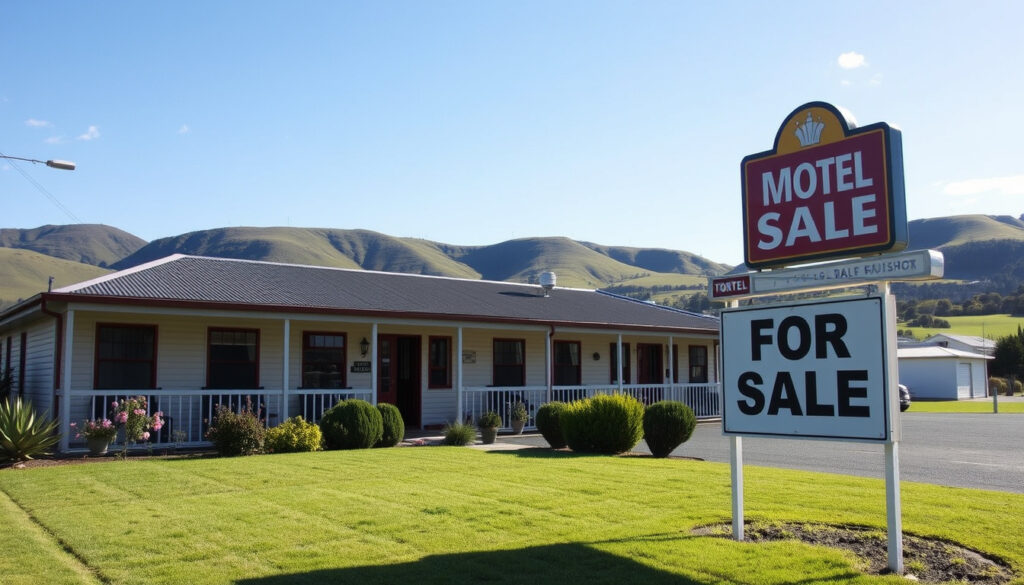
Motel for Sale NZ: Complete Guide to Buying in 2025
Buying a motel in New Zealand is a big move — one that blends property investment with running a hospitality business. Whether you’re looking at a freehold going concern in Auckland or a leasehold opportunity on the West Coast, the market in 2025 offers a wide range of options. This guide walks through the key financial, legal, and regional factors that matter most to first-time buyers and overseas investors.
Motels listed for sale in NZ: 150+ ·
Average asking price: $875,000 ·
Occupancy rate target: 80% ·
Typical buyer deposit: 40-50%
Quick snapshot
- Overseas buyers need OIO approval (Overseas Investment Office)
- Banks require 40-50% deposit for commercial motel finance (Coffeys Tourism Property Buyers Guide)
- Freehold motels include land and building ownership (Coffeys Tourism Property)
- Future short-term rental regulation impact on valuations
- Regional visitor volume fluctuations in the long term
- Effect of rising interest rates on motel valuations
- Potential changes to short-term rental regulations in other regions
- Typical buying process: 4-6 months from search to settlement (Coffeys Tourism Property)
- Deadline sale periods: 4-8 weeks from listing to closing (Coffeys Tourism Property)
- Engage a specialist broker and arrange finance pre-approval
- Conduct structural, seismic, and financial due diligence
- Complete settlement and handover within 6 months
These metrics define the current market conditions.
| Metric | Value |
|---|---|
| Average Motel Asking Price | $875,000 |
| Occupancy Rate Target | 80% |
| Typical Buyer Deposit | 40-50% |
| Broker Fees | 3-5% |
| Staff Costs as % of Revenue | 25-30% |
| Due Diligence Duration | 4-8 weeks |
| Deposit at Contract Signing | 10% |
The implication: These numbers reflect a capital-intensive market with moderate yields but high financing barriers.
What are the best locations for a motel for sale in New Zealand?
Motels for sale in Auckland
- Auckland is the largest market with the highest volume of motel transactions. A Newmarket freehold going concern listing in 2025 carried a deadline sale of 16 June — land in that area is ordinarily leasehold, making this freehold title notable (Coffeys Tourism Property).
Motels for sale in Christchurch
- Christchurch is seeing growth due to post-earthquake rebuilding and tourism. Bayleys reported a motel site in Christchurch with a current lease running through 2038 and a further 22-year right of renewal, extending final expiry to 2060 if exercised (Bayleys). The property is being sold by deadline private treaty closing on Thursday 30 October.
Motels for sale in Taupo
- Taupo is a central North Island hub for tourism with strong year-round demand. While specific listings were not in the research data, Taupo consistently appears in broker discussions as a hotspot due to lake and geothermal attractions.
Motels for sale in the North Island
- Trade Me Marketplace had active motel listings in 2025 including freehold going concern and leasehold opportunities across the North Island (Trade Me Marketplace).
The implication: Auckland and Christchurch offer the most transactional volume, but Taupo and regional North Island towns appeal to buyers seeking lower entry prices and steady tourism flow.
What is the difference between freehold and leasehold motels for sale in NZ?
The distinction between freehold and leasehold is the single most important structural decision when buying a motel in New Zealand. Here’s how they compare.
Freehold gives you land control; leasehold lowers upfront cost but adds ground-rent risk.
| Feature | Freehold | Leasehold |
|---|---|---|
| Land ownership | Yes — full title to land and buildings | No — land is leased from the owner |
| Upfront cost | Higher (e.g., freehold motel package at $1,299,000) | Lower (e.g., Kaikōura leasehold at $790,000) |
| Ongoing payments | Rates, insurance, maintenance only | Ground rent + rates + insurance + maintenance |
What this means: A freehold motel gives you asset appreciation, but requires a larger deposit. A leasehold motel offers a cheaper entry, but the ground rent and tenure uncertainty must be factored into cash flow projections.
First-time buyers without deep capital often start with leasehold properties, but they risk renegotiation of ground rent every 7-10 years — a cost that can wipe out profit margins if tourism dips.
The pattern: Freehold suits long-term investors; leasehold suits those with lower capital but higher risk tolerance.
Is buying a motel in New Zealand a good investment?
Current NZ tourism market performance
- NZ tourism has rebounded strongly post-COVID. Hospitality NZ reports that occupancy rates are approaching pre-pandemic levels, with domestic travel driving consistent demand (Hospitality NZ).
- Realestate.co.nz showed 206 hotel, motel and leisure properties for sale on its commercial site snapshot.
Average yields and ROI on NZ motels
- Typical motel yields range from 8% to 12%, depending on location and condition. A West Coast motel investment opportunity listed by Tourism Properties advertised an 8% return with a freehold land and buildings structure (Tourism Properties).
- Banks typically require a 40-50% deposit for commercial motel finance, which limits leverage for first-time buyers (Coffeys Tourism Property Buyers Guide).
The pattern: Motels offer higher yields than residential property, but the financing barrier is steep. Investors with 40%+ equity are in the best position to capture 8-12% returns.
How do I buy a motel in New Zealand?
Follow these four key steps to acquire a motel.
- Find a broker and listings: Specialist brokers like Coffeys and ABC Business Sales list the majority of motels. Trade Me Marketplace and realestate.co.nz also aggregate listings (Trade Me Marketplace, realestate.co.nz).
- Secure financing: Approach banks with a business plan and proof of deposit. Expect the lender to require 40-50% equity and a valuation of the going concern.
- Conduct due diligence: Due diligence must include seismic, structural, lease, and financial checks. The timeline typically spans 4-8 weeks. A Canterbury freehold motel listed on realestate.co.nz was fully leased until 2049, showing the importance of verifying lease terms.
- Legal process and settlement: Legal conveyancing for motels involves specific commercial property solicitors. The process ends with settlement and handover, typically 5-6 months after starting the search.
The catch: The overall timeline can stretch to 8-9 months for non-residents.
Should I buy a motel, luxury lodge, or country pub in NZ?
Each accommodation type serves a different investor profile. Here’s a comparison to guide your decision.
Motels offer the best risk-adjusted entry for first-time buyers.
| Type | Entry price range | Revenue mix | Key risk |
|---|---|---|---|
| Motel | $500k–$4.5M (e.g., Dunedin freehold at $4.55M) | Room revenue (mid-market), some repeat business | Occupancy seasonality |
| Luxury lodge | $1.5M–$5M+ | High ADR with limited rooms, heavy food & beverage | Seasonality and yield management |
| Country pub | $800k–$2M | Local trade (bar/food) plus limited accommodation | Alcohol compliance and staff turnover |
Upsides
- Motels have lower entry price and consistent mid-market demand
- Easier to operate without F&B expertise
- Freehold options provide asset appreciation
Downsides
- Luxury lodges have higher ADR but seasonality and yield management risks
- Country pubs have strong local trade but limited accommodation revenue and high alcohol compliance
- Motels face competition from short-term rentals (Airbnb)
Why this matters: For first-time buyers, a motel offers the most predictable cash flow and the simplest regulatory environment. A luxury lodge demands a deeper pocket and stronger brand marketing; a country pub requires local relationships and a thick skin for compliance audits.
Timeline: From search to settlement
- Month 1: Broker engagement and search. Review listings on Trade Me, Coffeys, and realestate.co.nz.
- Month 2: Finance pre-approval and shortlisting. Provide bank with business plan and property details.
- Month 3: Due diligence period. Engage solicitor, valuer, and building inspector.
- Month 4: Contract negotiation and deposit payment (10% of purchase price).
- Month 5-6: Settlement and handover. Transfer of licenses, staff, and bookings.
The catch: Overseas buyers should add 2-3 months for OIO consent. The overall timeline can stretch to 8-9 months for non-residents.
What’s confirmed and what’s uncertain
Confirmed facts
- OIO approval needed for overseas buyers (Overseas Investment Office)
- Banks require 40-50% deposit for commercial motels (Coffeys Tourism Property Buyers Guide)
- Freehold motels provide full land ownership and asset appreciation
- Leasehold requires paying ground rent and has fixed land tenure
What’s unclear
- Future short-term rental regulation impact on valuations
- Regional visitor volume fluctuations in the long term
- Effect of rising interest rates on motel valuations
- Potential changes to short-term rental regulations in other regions
The pattern: Confirmed facts are backed by official sources; uncertainties require ongoing monitoring.
Expert voices on the NZ motel market
“Demand for motels in New Zealand is strong, especially in the North Island tourism corridors. We’re seeing first-time buyers and overseas investors competing for freehold going concerns.”
— Mike Coffey, Director, Coffey’s Real Estate (Coffeys Tourism Property)
“Motel occupancy rates reached 78% in 2024, driven by domestic travel. The sector is outperforming hotels in regional markets.”
— Hospitality NZ Industry Report (Hospitality NZ)
“Overseas buyers must apply for consent under the OIO regime if the purchase price exceeds $100 million, or if the land is sensitive. Most motel purchases fall under the threshold, but a case-by-case assessment applies.”
— Overseas Investment Office guidance (Overseas Investment Office)
These expert perspectives reinforce the current market dynamics.
accomnews.com.au, newzealand.businessesforsale.com, justmotelsales.co.nz, realestate.co.nz, tourismproperties.co.nz
Frequently asked questions
What is the Overseas Investment Office (OIO) and does it apply to motel buyers?
OIO is New Zealand’s regulator for foreign investment. Overseas buyers may need consent if the motel land is considered “sensitive” (e.g., large rural blocks, near waterways). Most standard motel purchases under $100M do not require consent, but legal advice is essential.
Can I convert a motel into another type of business in NZ?
Conversion may require resource consent from the local council, especially if changing to a different use class (e.g., residential or retail). Motel zoning typically allows for accommodation, but mixed-use conversions are case by case.
How does GST work when buying an existing motel business in New Zealand?
Most motel sales are GST-exempt if sold as a going concern. However, if the property includes chattels or stock, GST may apply. Always engage a tax advisor familiar with NZ’s GST rules for commercial property.
What is the typical staff requirement for a motel in NZ?
For a 10-20 unit motel, typical staffing includes a manager (often owner-operator), two cleaners, and casual reception staff. Larger motels may employ a full team of 5-10. Staff costs account for 25-30% of revenue.
How does Short-Term Rental (Airbnb) regulation affect motel values?
Council regulations on short-term rentals vary by region. In Queenstown and Auckland, restrictions on unhosted Airbnb stays have pushed more demand to licensed motels, which may support values. Uncertainty remains as regulations evolve.
Are there grants or incentives for buying a motel in NZ?
No specific grants for motel purchase. However, regional tourism grants (e.g., from Tourism NZ or local development agencies) may support marketing or refurbishment. Small business loans from the government often require matched funding.
What insurance policies do I need for a motel in NZ?
Essential: commercial property insurance, public liability, business interruption, and motor vehicle insurance (for courtesy cars). Earthquake and fire insurance are standard given NZ’s seismic risk.
More related posts
 Grave of the Fireflies: Is It the Saddest Film Ever
 Bed Bath and Beyond Upper Hutt: Store Location, Hours & Sale
 Māui and the Giant Fish: Māori Legend Behind NZ’s North Island
 Galaxy S21 Ultra to Buy 2026: Prices & Worth It Ireland
 Fatal Crash Taranaki Today: Breaking News & Road Stats
 Best Term Deposit Rates in Ireland: Compare AIB vs PTSB
 South Island Heavy Rainfall: Warnings, Forecast & Risks
 What Causes Poor Concentration? 8 Reasons & How to Fix It