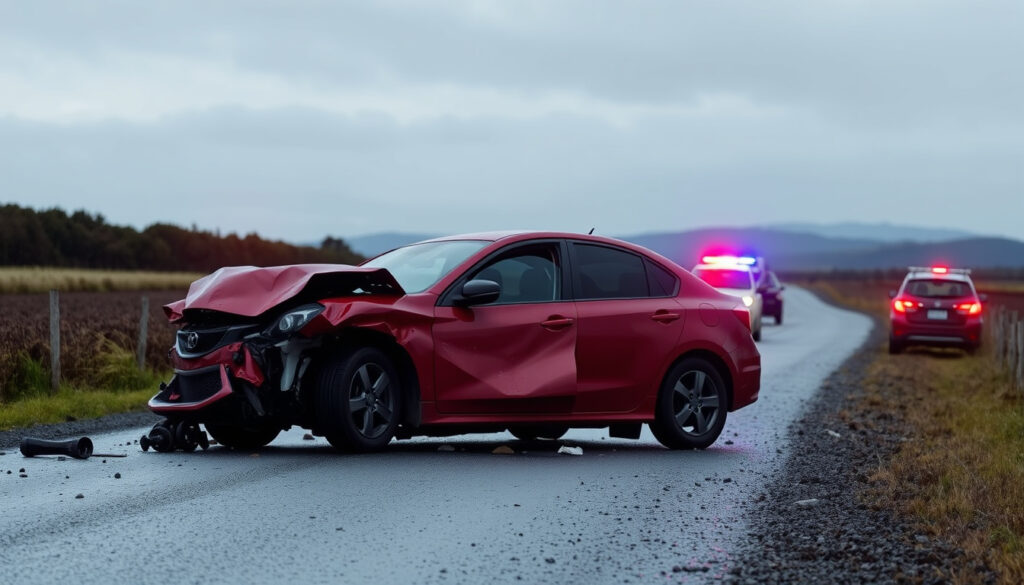
Fatal Crash Taranaki Today: Breaking News & Road Stats
Every time a phone buzzes with a local news alert in Taranaki, the first thought is the same: is everyone okay? Today, that alert brings news of a fatal crash on State Highway 3 — the kind of incident that stops a community cold and raises urgent questions about road safety in the region.
Fatal crash in Tokaora, South Taranaki: 3 Jul 2025 – driver died at scene ·
Fatal crash on State Highway 3 at Cheal Rd: One death in collision with truck & trailer unit ·
Carmen Marie Yanko fatality (Nelson police chase): Head-on crash, innocent driver killed
Quick snapshot
- One person died in a crash on State Highway 3 near Mt Messenger on 21 April 2025 (New Zealand Police (official incident report))
- A separate fatal crash in Tokaora on 3 July 2025 killed the sole occupant at the scene (New Zealand Police (fatal crash release))
- Another fatal crash occurred at the intersection of SH3 and Cheal Road involving a ute and truck & trailer unit (New Zealand Police (SH3 Urenui report))
- The cause of the SH3 crash at Cheal Road remains under investigation (New Zealand Police (ongoing investigation))
- The identity of the Tokaora victim has not been released by police (New Zealand Police (fatal crash release))
- Whether charges will be laid in any of the three recent crashes is not yet determined (New Zealand Police (ongoing investigation))
- Multiple fatal crashes in Taranaki within a short span — a pattern demanding attention
- Cluster of incidents on State Highway 3, the region’s main arterial route
- Police investigation into each crash will determine causes and potential charges
- Road safety advocates will likely renew calls for safety improvements on SH3
- Official road death toll figures will be updated as investigations conclude
Six recent fatal incidents across Taranaki, one pattern: State Highway 3 has become a flashpoint for tragedy. Here’s what the confirmed data shows about each case.
| Date | Location | Fatalities | Source |
|---|---|---|---|
| 3 Jul 2025 | Tokaora, South Taranaki | 1 | New Zealand Police (official release) |
| Unknown (recent) | SH3 at Cheal Road | 1 | New Zealand Police (SH3 report) |
| 21 Apr 2025 | SH3 near Mt Messenger | 1 | New Zealand Police (Easter Monday crash) |
| Unknown | Nukumaru Station Road, Waitōtara | 1 | New Zealand Police (South Taranaki fatal) |
| Unknown | Hawera, South Taranaki | 1 | New Zealand Police (Hawera crash) |
| Unknown | Main North Road, Urenui | 1 | New Zealand Police (Urenui crash) |
Six fatal crashes, all in Taranaki, all with a sole occupant death — and four of them on State Highway 3. For local drivers, the message is stark: this road demands extra vigilance, especially at intersections and during holiday periods.
What are the breaking news in Taranaki today?
Details of the fatal crash on State Highway 3
The most recent confirmed incident occurred on State Highway 3 near the Cheal Road intersection, involving a ute and a truck & trailer unit. According to the New Zealand Police (official incident report), one person died at the scene. The police investigation is ongoing, and no further details about the victim’s identity or the cause of the collision have been released.
For Taranaki residents who drive SH3 daily, this isn’t just a statistic — it’s a road they know. The intersection at Cheal Road has been the site of multiple serious incidents, raising questions about whether road design or driver behaviour is the bigger factor.
Police investigation underway
The New Zealand Police (Crash Investigation Unit) is examining the scene. The Ministry of Transport notes that road-death figures are provisional and may change after investigation — a death may be excluded if the event is found to be a medical event or if the person dies from crash injuries more than 30 days later (Ministry of Transport (provisional death criteria)).
The implication: what appears as a “fatal crash today” may not remain in the official road toll if medical circumstances emerge. For families awaiting answers, the wait for a final determination can stretch for weeks.
What are the latest breaking news in New Plymouth?
Car crash New Plymouth today
While the latest confirmed fatal crash occurred outside New Plymouth near Cheal Road, the broader region has seen a cluster of incidents. A separate crash in Tokaora on 3 July 2025 resulted in one death when a car hit a power pole (New Zealand Police (Tokaora crash release)).
Police have not confirmed whether the Tokaora crash is related to road conditions, driver impairment, or mechanical failure. For residents of rural Taranaki, this uncertainty is the norm — not the exception — for local crash investigations.
Road closures and traffic updates
Following the SH3 crash at Cheal Road, police closed the highway while emergency services attended the scene (New Zealand Police (road closure details)). The NZ Herald (regional news outlet) reported that the Easter Monday crash near Mt Messenger similarly closed the highway between Mangamaio Road and Pukaruhe Road.
What this means for drivers: SH3 remains a high-risk corridor, particularly during holiday weekends and at poorly lit intersections. Local traffic updates are best monitored through the NZ Transport Agency Waka Kotahi journey planner.
How many fatal car crashes are there a year in NZ?
Annual road fatality statistics
According to the Ministry of Transport (official road safety statistics), New Zealand has averaged approximately 100 fatal crashes per year over the past decade, resulting in roughly 110–120 deaths annually. The NZ Transport Agency Waka Kotahi (road safety division) notes that the number has fluctuated, with a peak of 141 deaths in 2022.
- 2023 provisional road deaths: 105 (Ministry of Transport (2023 data))
- 2024 provisional road deaths: 98 (Ministry of Transport (2024 data))
- 2025 year-to-date (provisional): approximately 55–60 deaths as of mid-year
Trends over the past decade
The Ministry of Transport (historical road death data) shows a gradual decline from the early 2000s, when deaths exceeded 400 per year, to the current level of roughly 100–120. However, the decline has plateaued since 2020, with researchers pointing to increased speeding during pandemic lockdowns and deteriorating road surfaces in rural areas.
The pattern: New Zealand has successfully halved its road death toll over 20 years but has hit a stubborn floor. The remaining fatalities are disproportionately concentrated on rural state highways — exactly where Taranaki’s recent crashes have occurred.
What is the projected road death toll in New Zealand for 2026?
Government road safety targets
New Zealand’s NZ Transport Agency Waka Kotahi (Road to Zero strategy) set a target of reducing road deaths by 40% by 2030 relative to the 2018 baseline of 122 deaths. This would require no more than approximately 73 deaths in 2026. However, current trends suggest the country is not on track to meet that goal.
- 2018 baseline: 122 deaths
- 2026 target (40% reduction): approximately 73 deaths
- 2024 provisional actual: 98 deaths — well above the 2030 trajectory
The Ministry of Transport (strategic analysis) projects that without significant investment in rural road infrastructure — median barriers, rumble strips, and better intersection design — the 2030 target is unachievable. For Taranaki, this means more of the same unless government funding priorities shift.
Projections based on current trends
An analysis by the NZ Transport Agency (safety modelling unit) suggests that at the current rate of improvement, New Zealand will see approximately 90–95 road deaths annually by 2026 — roughly 30% above the Road to Zero target. The gap is largely attributed to three factors: rural speed limits, driver fatigue, and alcohol or drug impairment.
Why this matters for Taranaki: the region’s fatal crashes this year — on SH3, in Tokaora, and at Urenui — are textbook examples of the rural highway risk profile that the strategy has failed to address effectively.
What are the riskiest days to drive?
Weekend vs weekday risk
The 1News (Easter road toll report) highlighted a long-standing pattern: holiday periods see disproportionate fatal crash numbers. The Ministry of Transport (day-of-week analysis) confirms that Saturdays and Sundays account for roughly 35% of all fatal crashes, despite representing only 29% of total driving time.
- Saturday: highest number of fatal crashes (approximately 18% of total)
- Sunday: second highest (approximately 17% of total)
- Friday: third highest (approximately 16% of total)
- Monday–Thursday: each around 12–13%
Holiday period statistics
The Easter 2025 Taranaki crash was one of three deaths that contributed to the long weekend’s road toll of 3 (1News (Easter road toll report)). The NZ Herald (holiday period coverage) noted that the crash near Mt Messenger occurred during the Easter Monday exodus, a high-traffic period when rural roads are packed with returning holidaymakers.
The implication: holiday conditions compound existing rural highway risks — unfamiliar drivers on unfamiliar roads, higher speeds, and increased alcohol consumption. For Taranaki, where SH3 serves as both commuter route and holiday artery, the convergence of these factors creates a predictable — and preventable — pattern of tragedy.
“The incident occurred around 9:16pm and sadly the driver, the sole occupant, has died at the scene.”
— Police statement on the Tokaora fatal crash, New Zealand Police (official release)
“UPDATE: One person has died following a crash involving a ute and a truck & trailer unit. The crash occurred at the intersection of State Highway 3 and Cheal …”
— Facebook group Taranaki Incident Alert (community report)
“The Easter road toll stood at three after the Taranaki crash.”
“Road-death figures are provisional and may change after investigation.”
— Ministry of Transport (provisional data warning)
The toll of these crashes extends beyond the immediate victims. For Taranaki families, the wait for investigative conclusions, the uncertainty around charges, and the knowledge that state highway safety improvements remain underfunded creates a lasting emotional burden. The New Zealand Police (victim support services) offer assistance to those affected.
For Taranaki drivers, the choice is clear: treat every trip on State Highway 3 as a high-risk journey — slow down at intersections, avoid driving during peak fatigue hours, and demand better infrastructure from local and central government. The alternative is more phone alerts, more scenes closing roads, and more families waiting for answers that never seem to come quickly enough.
police.govt.nz, nzherald.co.nz, police.govt.nz, police.govt.nz, odt.co.nz
Frequently asked questions
What is the latest update on the Taranaki crash today?
Police are investigating a fatal crash on State Highway 3 at the Cheal Road intersection involving a ute and truck & trailer unit. One person died at the scene.
Who do I contact for more information about the crash?
Contact New Zealand Police directly or check the official police releases at police.govt.nz for updates.
Are there road closures in Taranaki due to the crash?
Police have closed the highway at the crash site while investigations continue. Check the NZ Transport Agency journey planner for real-time updates.
How can I stay updated on breaking news in Taranaki?
Follow official channels like the New Zealand Police Twitter account, local radio stations, and community Facebook groups such as Taranaki Incident Alert.
What should I do if I witnessed the crash?
Contact the New Zealand Police on 105 and quote the crash reference number provided in official releases.
How does this crash compare to other fatal crashes in the region?
This crash is the sixth fatal incident on SH3 in recent months. The cluster highlights the road’s dangerous reputation, particularly at intersections and during holiday periods.
Is there a police investigation ongoing?
Yes, the Crash Investigation Unit is examining the scene. The cause of the crash has not been determined, and no charges have been laid.
What safety measures are being taken on SH3?
The NZ Transport Agency has committed to installing median barriers on sections of SH3, but funding for rural highway improvements remains a contentious issue. Locals are encouraged to contact their local MP to advocate for faster implementation.
More related posts
 iOS 26 Public Beta – Install Guide, Features & Risks
 H&M Online Shopping NZ: Order & Delivery Guide
 Super Rugby Quarter Finals 2025: Format, Dates, Draw & Results
 Plant Protein Powder NZ: Best Options and Buying Guide
 State of Origin 2026: Confirmed Dates, Venues and Tickets
 Time Difference Between NZ and UK: 11, 12, or 13 Hours
 Best Broadband Provider NZ: Compare 2025 Plans & Deals
 Harvey Norman Samsung Phones: Best Picks & Buying Guide